Shining Cuckoo

Shining Cuckoo

Chrysococcyx lucidus

Silhouette: Nicolas Huet le Jeune and Jean-Gabriel Prêtre (vectorized by T. Michael Keesey) · PhyloPic

Daily sighting probability ~20% · Possible
at Springbrook National Park

In 3 days ~40% in a week ~70%

61 Verified sightings at Springbrook National Park From 2019 to 2026
2,118 In all 19 parks
February Best month
☀️ Diurnal When it's spotted

About the Shining Cuckoo

The shining bronze cuckoo or pīpīwharauroa (Chalcites lucidus) is a species of cuckoo in the family Cuculidae, found in Australia, Indonesia, New Caledonia, New Zealand, Papua New Guinea, Solomon Islands, and Vanuatu. It was formerly placed in the genus Chrysococcyx.

It is a very small cuckoo, being only 13 to 18 cm (5.1 to 7.1 in) in length, and parasitises chiefly dome-shaped nests of various Gerygone species, having a range that largely corresponds with the distribution of that genus. It may also parasitise other Acanthizidae species, and is also the most southerly ranging brood parasitic bird species in the world, extending to at least 46°S in New Zealand.

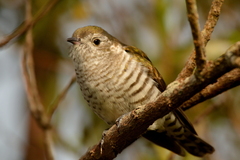
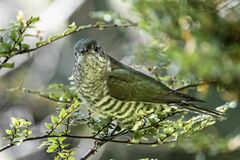
Hard to spot and easier to hear, the shining bronze cuckoo is 13–18 cm (5.1–7.1 in) in overall length, has a wingspan of 25–32 cm (9.8–12.6 in) and weighs around 25 g (0.88 oz). It is slightly larger than Horsfield's bronze cuckoo (Chalcites basalis). It has metallic golden or coppery green upperparts and white cheeks and underparts barred with dark green. The female is similar with a more purplish sheen to the crown and nape and bronzer-tinged barring on the belly. The bill is black and the feet are black with... Wikipedia →

Sounds

Call0:07

Australia · 2026

© Marc Anderson · XC1086186 · CC BY-NC-ND 4.0

Song0:09

Australia · 2023

© Peter Boesman · XC859748 · CC BY-NC-ND 4.0

Begging call0:26

Australia · 2018

© Martin Cake · XC409817 · CC BY-NC-SA 4.0

Global Distribution

Parks Where Found

# Park Country Daily sighting probability
1 Maria Island National Park 🇦🇺 Australia
~30%
2 Lamington National Park 🇦🇺 Australia
~20%
3 Springbrook National Park 🇦🇺 Australia
~20%
4 Egmont National Park 🇳🇿 New Zealand
~10%
5 Grampians National Park 🇦🇺 Australia
~10%
6 Great Otway National Park 🇦🇺 Australia
~10%
7 Royal National Park 🇦🇺 Australia
~10%
8 Fiordland National Park 🇳🇿 New Zealand
~10%
9 Blue Mountains National Park 🇦🇺 Australia
~10%
10 Cradle Mountain-Lake St Clair National Park 🇦🇺 Australia
~10%
11 Kosciuszko National Park 🇦🇺 Australia
<5%
12 Freycinet National Park 🇦🇺 Australia
<5%
13 Wilsons Promontory National Park 🇦🇺 Australia
<5%
14 Booderee National Park 🇦🇺 Australia
<5%
15 Rakiura National Park 🇳🇿 New Zealand
<5%
16 Abel Tasman National Park 🇳🇿 New Zealand
<5%
17 Noosa National Park 🇦🇺 Australia
<5%
18 Arthur's Pass National Park 🇳🇿 New Zealand
<5%
19 Daintree National Park 🇦🇺 Australia
<5%

Cities Where Found

# City Country Daily sighting probability
1 Auckland 🇳🇿 New Zealand
~10%
2 Brisbane 🇦🇺 Australia
<5%
3 Hobart 🇦🇺 Australia
<5%
4 Perth 🇦🇺 Australia
<5%
5 Melbourne 🇦🇺 Australia
<5%
6 Sydney 🇦🇺 Australia
<5%

Before you go

What are the chances of seeing a Shining Cuckoo in Springbrook National Park?

Possible

About 20% of wildlife watchers report a Shining Cuckoo sighting in Springbrook National Park on a given day, based on 61 verified sightings from GBIF citizen-science data from 2019 to 2026. It is the 46th most-seen of the 136 birds we can rate there. Over three days the chance rises to about 40%, and over a week to about 70%, if each day is a fresh chance.

When is the best time to see a Shining Cuckoo in Springbrook National Park?

February–March and November

In those months about 30% of wildlife watchers report a Shining Cuckoo in Springbrook National Park on a given day, against about 10% in May–August and December–January, the lowest months. Those are among Springbrook National Park's wettest months, with about 170 mm of rain a month against 45 mm in August.

What time of day is best to see a Shining Cuckoo?

Between 8 and 11 am

Across all the parks we cover, that three-hour window holds the most Shining Cuckoo sightings with a recorded time, and nearly all of them come between 6 am and 6 pm: it is a daytime animal.

Is Springbrook National Park the best place to see a Shining Cuckoo?

3rd of 19

Of the 19 parks where we can rate Shining Cuckoo sightings, Springbrook National Park ranks 3rd at about 20%. The best odds are in Maria Island National Park (Australia, about 30%) and Lamington National Park (Australia, about 20%).

Which relatives of the Shining Cuckoo live in Springbrook National Park?

Same family: Cuculidae

The closest relatives of the Shining Cuckoo that you can see in Springbrook National Park (family Cuculidae, Cuckoos) are Fan-tailed Cuckoo (about 20%) and Rusty-breasted Cuckoo (about 10%), with each one's daily chance of a sighting.

Where does the Shining Cuckoo sighting chance come from?

GBIF citizen-science records

It is estimated from how often the Shining Cuckoo is recorded against all the birds logged in Springbrook National Park (61 verified sightings from 2019 to 2026), calibrated against known sighting rates. Figures are rounded to the nearest 10% because citizen-science data supports honest approximations, not decimals, and months with records from fewer than five people show "—". How it works.

← Back to Springbrook National Park