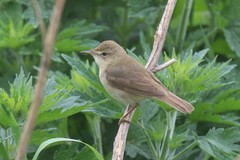
Blyth's Reed Warbler

Blyth's Reed Warbler

Acrocephalus dumetorum

Silhouette: Yves Hoebeke · PhyloPic

LCLeast ConcernNTVUENCR
Daily sighting probability <5% · Rare
at Sundarbans National Park

In 3 days ~10%

19 Verified sightings at Sundarbans National Park From 2019 to 2026
3,902 In all 23 parks
February Best month
🌅 Crepuscular When it's spotted

About the Blyth's Reed Warbler

Blyth's reed warbler (Acrocephalus dumetorum) is a species of reed warbler belonging to the family Acrocephalidae, which also includes the tree warblers. Blyth's reed warbler breeds across the Palearctic zoogeographical region and winters in South Asia. The species has been expanding its range westwards in Europe.

Blyth's reed warbler was first formally described in 1849 by the English zoologist Edward Blyth with its type locality given as India. It is classified in the reed warbler genus Acrocephalus which was formerly included in the polyphyletic family Sylviidae but is now included in the family Acrocephalidae.

Blyth's reed warbler is named in honour of Edward Blyth, its describer. The genus name Acrocephalus is from Ancient Greek akros, "highest", and kephale, "head". It is possible that Naumann and Naumann thought akros meant "sharp-pointed". The specific dumetorum is from Latin dumetum, "thicket".

Blyth's reed warbler is between 12 and 14 cm (4.7 and 5.5 in) in length and weighs between 8 and 16 g (0.28 and 0.56 oz). It is a slim warbler with relatively short wings and a long bill. The plumage is rather plain with few distinguishing... Wikipedia →

Sounds

Song0:46

Sweden · 2026

© Louis-Marie Gourmelon · XC1142507 · CC BY-NC-SA 4.0

Song1:03

Sweden · 2025

© Kalle Brinell · XC1058309 · CC BY-NC-SA 4.0

Song1:05

Sweden · 2025

© Lars Edenius · XC1006090 · CC BY-NC-SA 4.0

Global Distribution

Parks Where Found

# Park Country Daily sighting probability
1 Keoladeo National Park 🇮🇳 India
~30%
2 Eravikulam National Park 🇮🇳 India
~30%
3 Periyar National Park 🇮🇳 India
~20%
4 Mudumalai National Park 🇮🇳 India
~20%
5 Bandipur National Park 🇮🇳 India
~20%
6 Udawalawe National Park 🇱🇰 Sri Lanka
~10%
7 Nagarhole National Park 🇮🇳 India
~10%
8 Chitwan National Park 🇳🇵 Nepal
~10%
9 Kanha National Park 🇮🇳 India
~10%
10 Bandhavgarh National Park 🇮🇳 India
~10%
11 Satpura National Park 🇮🇳 India
~10%
12 Yala National Park 🇱🇰 Sri Lanka
<5%
13 Wilpattu National Park 🇱🇰 Sri Lanka
<5%
14 Minneriya National Park 🇱🇰 Sri Lanka
<5%
15 Ranthambore National Park 🇮🇳 India
<5%
16 Horton Plains National Park 🇱🇰 Sri Lanka
<5%
17 Royal Bardia National Park 🇳🇵 Nepal
<5%
18 Sinharaja Forest Reserve 🇱🇰 Sri Lanka
<5%
19 Sundarbans National Park 🇮🇳 India
<5%
20 Manas National Park 🇮🇳 India
<5%
21 Jim Corbett National Park 🇮🇳 India
<5%
22 Kaziranga National Park 🇮🇳 India
<5%
23 Royal Manas National Park 🇧🇹 Bhutan
<5%

Cities Where Found

# City Country Daily sighting probability
1 Vasai-Virar 🇮🇳 India
~40%
2 Thrissur 🇮🇳 India
~30%
3 Tamluk 🇮🇳 India
~30%
4 Bengaluru 🇮🇳 India
~30%
5 Thiruvananthapuram 🇮🇳 India
~30%
6 Tiruppur 🇮🇳 India
~30%
7 Coimbatore 🇮🇳 India
~20%
8 Hyderabad 🇮🇳 India
~20%
9 Jabalpur 🇮🇳 India
~20%
10 Mumbai 🇮🇳 India
~20%

Before you go

What are the chances of seeing a Blyth's Reed Warbler in Sundarbans National Park?

Rare

Under 5% of wildlife watchers report a Blyth's Reed Warbler sighting in Sundarbans National Park on a given day, based on 19 verified sightings from GBIF citizen-science data from 2019 to 2026. It is the 130th most-seen of the 177 birds we can rate there. Over three days the chance rises to about 10%, if each day is a fresh chance.

When is the best time to see a Blyth's Reed Warbler in Sundarbans National Park?

February

In that month about 10% of wildlife watchers report a Blyth's Reed Warbler in Sundarbans National Park on a given day, against under 5% in March–April and July–January, the lowest months. That is one of Sundarbans National Park's driest months, with about 20 mm of rain against 480 mm in July. May and June have too few records to rate.

What time of day is best to see a Blyth's Reed Warbler?

Between 5 and 8 am

Across all the parks we cover, that three-hour window holds the most Blyth's Reed Warbler sightings with a recorded time, and about 7 in 10 of them come between 6 am and 6 pm: it is most active around dawn and dusk.

Is Sundarbans National Park the best place to see a Blyth's Reed Warbler?

19th of 23

Of the 23 parks where we can rate Blyth's Reed Warbler sightings, Sundarbans National Park ranks 19th at under 5%. The best odds are in Keoladeo National Park (India, about 30%), Eravikulam National Park (India, about 30%) and Periyar National Park (India, about 20%).

Where does the Blyth's Reed Warbler sighting chance come from?

GBIF citizen-science records

It is estimated from how often the Blyth's Reed Warbler is recorded against all the birds logged in Sundarbans National Park (19 verified sightings from 2019 to 2026), calibrated against known sighting rates. Figures are rounded to the nearest 10% because citizen-science data supports honest approximations, not decimals, and months with records from fewer than five people show "—". How it works.

← Back to Sundarbans National Park