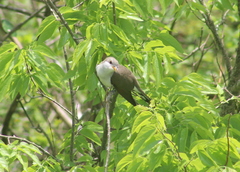
Yellow-billed Cuckoo

Yellow-billed Cuckoo

Coccyzus americanus

Silhouette: Andy Wilson · PhyloPic

LCLeast ConcernNTVUENCR
Daily sighting probability <5% · Rare
at Tapantí-Macizo de la Muerte National Park

In 3 days <5%

7 Verified sightings at Tapantí-Macizo de la Muerte National Park From 2019 to 2026
2,796 In all 31 parks
May Best month
☀️ Diurnal When it's spotted

About the Yellow-billed Cuckoo

The yellow-billed cuckoo (Coccyzus americanus) is a member of the cuckoo family. Common folk names for this bird in the southern United States are rain crow and storm crow. These likely refer to the bird's habit of calling on hot days, often presaging rain showers or thunderstorms. The genus name is from the Ancient Greek kokkuzo, which means to call like a common cuckoo, and americanus means "of America".

The yellow-billed cuckoo was formally described by the Swedish naturalist Carl Linnaeus in 1758 in the tenth edition of his Systema Naturae. He placed it with all the other cuckoos in the genus Cuculus and coined the binomial name Cuculus americanus. Linnaeus based his description on the "Cuckow of Carolina" that had been described and illustrated in 1729–1732 by the English naturalist Mark Catesby in his The Natural History of Carolina, Florida and the Bahama Islands. The yellow-billed cuckoo is now placed with 12 other species in the genus Coccyzus that was introduced in 1816 by the French ornithologist Louis Pierre Vieillot. The genus name is from the Ancient Greek kokkuzō meaning "to cry cuckoo". The species is monotypic: no subspecies are recognised. Wikipedia →

Sounds

Nocturnal flight call0:10

United States · 2024

© David Tattersley · XC901133 · CC BY-NC-SA 4.0

Call0:06

Brazil · 2023

© JAYRSON ARAUJO DE OLIVEIRA · XC843437 · CC BY-NC-SA 4.0

Song0:37

United States · 2023

© Sue Riffe · XC819386 · CC BY-NC-SA 4.0

Global Distribution

Parks Where Found

# Park Country Daily sighting probability
1 Congaree National Park 🇺🇸 United States
~30%
2 Shenandoah National Park 🇺🇸 United States
~10%
3 Cumbres de Monterrey National Park 🇲🇽 Mexico
~10%
4 Point Pelee National Park 🇨🇦 Canada
~10%
5 El Impenetrable National Park 🇦🇷 Argentina
<5%
6 Montes Azules Biosphere Reserve 🇲🇽 Mexico
<5%
7 Great Smoky Mountains National Park 🇺🇸 United States
<5%
8 Everglades National Park 🇺🇸 United States
<5%
9 Big Cypress National Preserve 🇺🇸 United States
<5%
10 Arrecifes de Cozumel National Park 🇲🇽 Mexico
<5%
11 Big Bend National Park 🇺🇸 United States
<5%
12 Calakmul Biosphere Reserve 🇲🇽 Mexico
<5%
13 Biotopo Cerro Cahuí 🇬🇹 Guatemala
<5%
14 Soberanía National Park 🇵🇦 Panama
<5%
15 Henri Pittier National Park 🇻🇪 Venezuela
<5%
16 Tayrona National Natural Park 🇨🇴 Colombia
<5%
17 Pico Bonito National Park 🇭🇳 Honduras
<5%
18 Los Haitises National Park 🇩🇴 Dominican Republic
<5%
19 Parque Natural Metropolitano 🇵🇦 Panama
<5%
20 Sian Ka'an Biosphere Reserve 🇲🇽 Mexico
<5%
21 Tortuguero National Park 🇨🇷 Costa Rica
<5%
22 Bastimentos Island National Marine Park 🇵🇦 Panama
<5%
23 Merritt Island National Wildlife Refuge 🇺🇸 United States
<5%
24 Celestún Biosphere Reserve 🇲🇽 Mexico
<5%
25 Cahuita National Park 🇨🇷 Costa Rica
<5%
26 La Amistad International Park (Panama) 🇵🇦 Panama
<5%
27 Volcán Barú National Park 🇵🇦 Panama
<5%
28 Braulio Carrillo National Park 🇨🇷 Costa Rica
<5%
29 Acadia National Park 🇺🇸 United States
<5%
30 Manu National Park 🇵🇪 Peru
<5%
31 Tapantí-Macizo de la Muerte National Park 🇨🇷 Costa Rica
<5%

Cities Where Found

# City Country Daily sighting probability
1 Austin 🇺🇸 United States
~10%
2 San Antonio 🇺🇸 United States
~10%
3 Bogota 🇨🇴 Colombia
~10%
4 Havana 🇨🇺 Cuba
~10%
5 Dallas 🇺🇸 United States
<5%
6 Houston 🇺🇸 United States
<5%
7 Orlando 🇺🇸 United States
<5%
8 Washington 🇺🇸 United States
<5%
9 Monterrey 🇲🇽 México
<5%
10 Miami 🇺🇸 United States
<5%

Before you go

What are the chances of seeing a Yellow-billed Cuckoo in Tapantí-Macizo de la Muerte National Park?

Rare

Under 5% of wildlife watchers report a Yellow-billed Cuckoo sighting in Tapantí-Macizo de la Muerte National Park on a given day, based on 7 verified sightings from GBIF citizen-science data from 2019 to 2026. It is the 445th most-seen of the 467 birds we can rate there. Over three days the chance rises to under 5%, if each day is a fresh chance.

When is the best time to see a Yellow-billed Cuckoo in Tapantí-Macizo de la Muerte National Park?

Any time of year

In every month with enough records, under 5% of wildlife watchers report a Yellow-billed Cuckoo in Tapantí-Macizo de la Muerte National Park on a given day, so our monthly data shows no clear season.

What time of day is best to see a Yellow-billed Cuckoo?

Between 9 am and noon

Across all the parks we cover, that three-hour window holds the most Yellow-billed Cuckoo sightings with a recorded time, and about 9 in 10 of them come between 6 am and 6 pm: it is a daytime animal.

Is Tapantí-Macizo de la Muerte National Park the best place to see a Yellow-billed Cuckoo?

31st of 31

Of the 31 parks where we can rate Yellow-billed Cuckoo sightings, Tapantí-Macizo de la Muerte National Park ranks 31st at under 5%. The best odds are in Congaree National Park (United States, about 30%), Shenandoah National Park (United States, about 10%) and Cumbres de Monterrey National Park (Mexico, about 10%).

Where does the Yellow-billed Cuckoo sighting chance come from?

GBIF citizen-science records

It is estimated from how often the Yellow-billed Cuckoo is recorded against all the birds logged in Tapantí-Macizo de la Muerte National Park (7 verified sightings from 2019 to 2026), calibrated against known sighting rates. Figures are rounded to the nearest 10% because citizen-science data supports honest approximations, not decimals, and months with records from fewer than five people show "—". How it works.

← Back to Tapantí-Macizo de la Muerte National Park