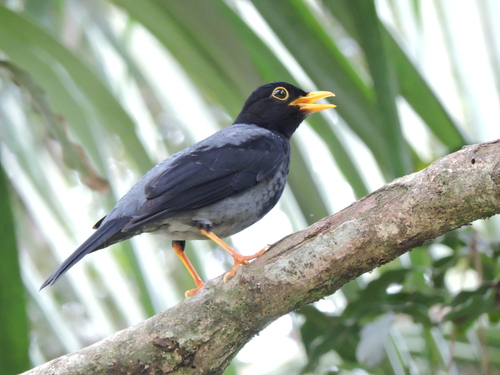
White-necked Thrush

White-necked Thrush

Turdus albicollis

Silhouette: Sharon Wegner-Larsen · PhyloPic

LCLeast ConcernNTVUENCR
Daily sighting probability <5% · Rare
at Tijuca National Park

In 3 days ~10%

42 Verified sightings at Tijuca National Park From 2019 to 2026
2,729 In all 16 parks
July Best month
☀️ Diurnal When it's spotted

About the White-necked Thrush

The white-necked thrush (Turdus albicollis) is a species of bird in the family Turdidae. It is found on Trinidad and Tobago and in every mainland South American country except Chile. It previously was called the white-necked robin.

The white-necked thrush was originally described in 1818 with its current binomial Turdus albicollis. The species' further taxonomy is complicated and as of early 2026 remains unsettled. For much of the twentieth century what are now the white-throated thrush (T. assimilis) and Dagua thrush (T. daguae) were included as subspecies of the white-necked thrush. The North American Classification Committee of the American Ornithological Society (NACC) recognized the white-necked and white-throated thrushes as separate species in the first edition of its "Checklist of North American Birds". BirdLife International's Handbook of the Birds of the World (HBW) split them its Version 0, issued in 2007. What is now the independent South American Classification Committee (SACC) had done so by 2007. By 2018 the IOC had adopted the split and the Clements taxonomy followed in 2025. AviList adopted it in its first version (2025). When they made... Wikipedia →

Sounds

Call0:18

Brazil · 2026

© JAYRSON ARAUJO DE OLIVEIRA · XC1150293 · CC BY-NC-SA 4.0

Song0:16

Brazil · 2025

© Fabrício Grigolin · XC1051959 · CC BY-NC-SA 4.0

Recording1:20

Colombia · 2001

© Mauricio Álvarez-Rebolledo (Colección de Sonidos Ambientales - Instituto Humboldt) · XC525689 · CC BY-NC-SA 4.0

Global Distribution

Parks Where Found

# Park Country Daily sighting probability
1 Brownsberg Nature Park 🇸🇷 Suriname
~40%
2 Amboró National Park 🇧🇴 Bolivia
~40%
3 Serra dos Órgãos National Park 🇧🇷 Brazil
~30%
4 Main Ridge Forest Reserve 🇹🇹 Trinidad and Tobago
~30%
5 Henri Pittier National Park 🇻🇪 Venezuela
~30%
6 Itatiaia National Park 🇧🇷 Brazil
~20%
7 Podocarpus National Park 🇪🇨 Ecuador
~20%
8 Tambopata National Reserve 🇵🇪 Peru
~10%
9 Iguazú National Park 🇦🇷 Argentina
~10%
10 Iguaçu National Park 🇧🇷 Brazil
~10%
11 Manu National Park 🇵🇪 Peru
<5%
12 Sierra de la Macarena National Park 🇨🇴 Colombia
<5%
13 Tijuca National Park 🇧🇷 Brazil
<5%
14 Yasuní National Park 🇪🇨 Ecuador
<5%
15 Amacayacu National Natural Park 🇨🇴 Colombia
<5%
16 Tayrona National Natural Park 🇨🇴 Colombia
<5%

Cities Where Found

# City Country Daily sighting probability
1 Santos 🇧🇷 Brazil
~10%
2 Curitiba 🇧🇷 Brazil
<5%
3 São Paulo 🇧🇷 Brazil
<5%
4 Porto Alegre 🇧🇷 Brazil
<5%
5 Rio de Janeiro 🇧🇷 Brazil
<5%

Before you go

What are the chances of seeing a White-necked Thrush in Tijuca National Park?

Rare

Under 5% of wildlife watchers report a White-necked Thrush sighting in Tijuca National Park on a given day, based on 42 verified sightings from GBIF citizen-science data from 2019 to 2026. It is the 134th most-seen of the 214 birds we can rate there. Over three days the chance rises to about 10%, if each day is a fresh chance.

When is the best time to see a White-necked Thrush in Tijuca National Park?

Any time of year

In every month with enough records, under 5% of wildlife watchers report a White-necked Thrush in Tijuca National Park on a given day, so our monthly data shows no clear season.

What time of day is best to see a White-necked Thrush?

Between 9 am and noon

Across all the parks we cover, that three-hour window holds the most White-necked Thrush sightings with a recorded time, and about 9 in 10 of them come between 6 am and 6 pm: it is a daytime animal.

Which relatives of the White-necked Thrush live in Tijuca National Park?

Same genus: Turdus

The closest relatives of the White-necked Thrush that you can see in Tijuca National Park (genus Turdus, Typical Thrushes) are Rufous-bellied Thrush (about 70%), Pale-breasted Thrush (about 70%) and Creamy-bellied Thrush (about 10%), with each one's daily chance of a sighting.

Where does the White-necked Thrush sighting chance come from?

GBIF citizen-science records

It is estimated from how often the White-necked Thrush is recorded against all the birds logged in Tijuca National Park (42 verified sightings from 2019 to 2026), calibrated against known sighting rates. Figures are rounded to the nearest 10% because citizen-science data supports honest approximations, not decimals, and months with records from fewer than five people show "—". How it works.

← Back to Tijuca National Park