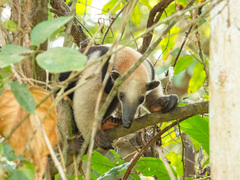
Northern Tamandua

Northern Tamandua

Tamandua mexicana

Silhouette: Xavier A. Jenkins · PhyloPic

LCLeast ConcernNTVUENCR
Daily sighting probability ~30% · Possible
at Tikal National Park

In 3 days ~60% in a week ~90%

14 Verified sightings at Tikal National Park From 2019 to 2026
870 In all 22 parks
March Best month
☀️ Diurnal When it's spotted

About the Northern Tamandua

The northern tamandua (Tamandua mexicana) is a species of tamandua, an anteater in the family Myrmecophagidae. They live in tropical and subtropical forests from southern Mexico, through Central America, and to the edge of the northern Andes.

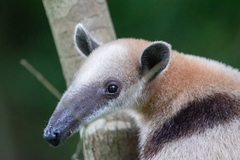
The northern tamandua is a medium-sized anteater with a prehensile tail, small eyes and ears, and a long snout. The fur is pale yellow over most of the body, with a distinctive patch of black fur over the flanks, back, and shoulders, that somewhat resembles a vest in shape. The tail has fur on its upper surface for about a third of its length, but is otherwise hairless. The hind feet have five toes, while the fore feet have only four.

Males and females are similar in size and colour, and range from 102 to 130 centimetres (40 to 51 in) in total length, including the 40 to 68 centimetres (16 to 27 in) tail. Adults weigh between 3.2 to 5.4 kilograms (7.1 to 11.9 lb).

The northern tamandua closely resembles its southern relative. In contrast to the northern tamandua, which always has a black-vested pattern, southern tamanduas are highly variable in appearance across their range. Some southern tamandua populations are entirely pale... Wikipedia →

Sounds

Recording0:14

Mexico · 2025

© Luis Guillermo · iNaturalist · CC BY-NC 4.0

Recording0:10

Costa Rica · 2025

© Jazz (aka turtlehelper) · iNaturalist · CC BY-NC 4.0

Global Distribution

Parks Where Found

# Park Country Daily sighting probability
1 Corcovado National Park 🇨🇷 Costa Rica
~60%
2 Piedras Blancas National Park 🇨🇷 Costa Rica
~40%
3 Rincón de la Vieja National Park 🇨🇷 Costa Rica
~30%
4 Soberanía National Park 🇵🇦 Panama
~30%
5 Santa Rosa National Park 🇨🇷 Costa Rica
~30%
6 Tikal National Park 🇬🇹 Guatemala
~30%
7 Tayrona National Natural Park 🇨🇴 Colombia
~30%
8 Manuel Antonio National Park 🇨🇷 Costa Rica
~30%
9 Palo Verde National Park 🇨🇷 Costa Rica
~30%
10 Tortuguero National Park 🇨🇷 Costa Rica
~30%
11 Braulio Carrillo National Park 🇨🇷 Costa Rica
~30%
12 Arenal Volcano National Park 🇨🇷 Costa Rica
~20%
13 Cabo Blanco Absolute Nature Reserve 🇨🇷 Costa Rica
~20%
14 Carara National Park 🇨🇷 Costa Rica
~20%
15 Tenorio Volcano National Park 🇨🇷 Costa Rica
~20%
16 Cahuita National Park 🇨🇷 Costa Rica
~20%
17 Ostional Wildlife Refuge 🇨🇷 Costa Rica
~10%
18 Marino Ballena National Park 🇨🇷 Costa Rica
~10%
19 Gandoca-Manzanillo Wildlife Refuge 🇨🇷 Costa Rica
~10%
20 Bastimentos Island National Marine Park 🇵🇦 Panama
~10%
21 Parque Natural Metropolitano 🇵🇦 Panama
~10%
22 La Amistad International Park (Panama) 🇵🇦 Panama
~10%

Zoos & Centres Where Found

# Zoo / Centre Country
1 San Diego Zoo 🇺🇸 United States In captivity
2 Antwerp Zoo 🇧🇪 Belgium In captivity
3 Parque Municipal Summit 🇵🇦 Panama In captivity
4 Audubon Zoo 🇺🇸 United States In captivity
5 Zoológico de San Juan de Aragón 🇲🇽 Mexico In captivity
6 Zoológico Benito Juárez 🇲🇽 Mexico In captivity
7 Jackson Zoo 🇺🇸 United States In captivity
8 Krefelder Zoo 🇩🇪 Germany In captivity
9 Papiliorama 🇨🇭 Switzerland In captivity
10 El Nispero Zoo 🇵🇦 Panama In captivity
11 Kobe Animal Kingdom 🇯🇵 Japan In captivity
12 Texas State Aquarium 🇺🇸 United States In captivity
13 Aquatopia 🇧🇪 Belgium In captivity
14 International Animal Rescue – Costa Rica 🇨🇷 Costa Rica In captivity
15 Zoológico Miguél Álvarez del Toro 🇲🇽 Mexico In captivity

Before you go

What are the chances of seeing a Northern Tamandua in Tikal National Park?

Possible

About 30% of wildlife watchers report a Northern Tamandua sighting in Tikal National Park on a given day, based on 14 verified sightings from GBIF citizen-science data from 2019 to 2026. It is the 7th most-seen of the 11 mammals we can rate there. Over three days the chance rises to about 60%, and over a week to about 90%, if each day is a fresh chance.

When is the best time to see a Northern Tamandua in Tikal National Park?

February and March

In those months about 40% of wildlife watchers report a Northern Tamandua in Tikal National Park on a given day, against under 5% in June–July and October–November, the lowest months. Those are among Tikal National Park's driest months, with about 30 mm of rain a month against 190 mm in June.

What time of day is best to see a Northern Tamandua?

Between 9 am and noon

Across all the parks we cover, that three-hour window holds the most Northern Tamandua sightings with a recorded time, and about 9 in 10 of them come between 6 am and 6 pm: it is a daytime animal.

Where does the Northern Tamandua sighting chance come from?

GBIF citizen-science records

It is estimated from how often the Northern Tamandua is recorded against all the mammals logged in Tikal National Park (14 verified sightings from 2019 to 2026), calibrated against known sighting rates. Figures are rounded to the nearest 10% because citizen-science data supports honest approximations, not decimals, and months with records from fewer than five people show "—". How it works.

← Back to Tikal National Park