Nashville Warbler

Nashville Warbler

Leiothlypis ruficapilla

Silhouette: Andy Wilson · PhyloPic

LCLeast ConcernNTVUENCR
Daily sighting probability ~50% · Likely
at Voyageurs National Park

In 3 days ~80% in a week >90%

201 Verified sightings at Voyageurs National Park From 2019 to 2026
10,780 In all 29 parks
May Best month
☀️ Diurnal When it's spotted

About the Nashville Warbler

The Nashville warbler (Leiothlypis ruficapilla) is a small songbird in the New World warbler family, found in North and Central America. It breeds in parts of the northern and western United States and southern Canada, and migrates to winter in southern California and Texas, Mexico, and the north of Central America. It has a gray head and a green back, and its underparts are yellow and white.

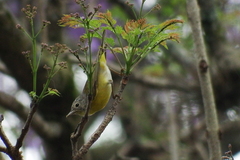
The Nashville warbler is a small warbler. Both male and female Nashville warblers have a gray head fading into a greenish back and wings, a white belly and a yellow throat and breast. They have a complete white eye ring, no wing bars, and a thin pointed black bill. Adult males have a rusty brown patch on their crown, which is usually hard to see and often covered by gray feathers. Males will raise it slightly when agitated. Females and immature birds have a duller olive-grey head, and less bold yellow on their throat. The Nashville warbler is closely related to Virginia's warbler, Lucy's warbler, and the Colima warbler, the four sharing generally similar plumage.

Measurements: Length: 4.3–5.1 in (11–13 cm) Weight: 0.2–0.5 oz (5.7–14.2 g) Wingspan: 6.7–7.9 in (17–20 cm) ��2... Wikipedia →

Sounds

Song1:26

Canada · 2026

© Michael Collins · XC1145433 · CC BY-NC-SA 4.0

Call1:13

United States · 2020

© Ed Pandolfino · XC555127 · CC BY-NC-SA 4.0

Flight call0:04

United States · 2020

© Paul Marvin · XC546515 · CC BY-NC-SA 4.0

Global Distribution

Parks Where Found

# Park Country Daily sighting probability
1 Isle Royale National Park 🇺🇸 United States
~60%
2 Voyageurs National Park 🇺🇸 United States
~50%
3 Point Pelee National Park 🇨🇦 Canada
~40%
4 Riding Mountain National Park 🇨🇦 Canada
~40%
5 Cañón del Sumidero National Park 🇲🇽 Mexico
~30%
6 Yosemite National Park 🇺🇸 United States
~20%
7 Sequoia and Kings Canyon National Parks 🇺🇸 United States
~10%
8 Cumbres de Monterrey National Park 🇲🇽 Mexico
~10%
9 Reserva de la Biosfera Mariposa Monarca 🇲🇽 Mexico
~10%
10 Big Bend National Park 🇺🇸 United States
~10%
11 Cape Breton Highlands National Park 🇨🇦 Canada
~10%
12 Acadia National Park 🇺🇸 United States
<5%
13 El Triunfo 🇲🇽 Mexico
<5%
14 Celaque National Park 🇭🇳 Honduras
<5%
15 Death Valley National Park 🇺🇸 United States
<5%
16 Joshua Tree National Park 🇺🇸 United States
<5%
17 Glacier National Park 🇺🇸 United States
<5%
18 El Vizcaíno Biosphere Reserve 🇲🇽 Mexico
<5%
19 Saguaro National Park 🇺🇸 United States
<5%
20 Grand Canyon National Park 🇺🇸 United States
<5%
21 Guadalupe Mountains National Park 🇺🇸 United States
<5%
22 Great Smoky Mountains National Park 🇺🇸 United States
<5%
23 Channel Islands National Park 🇺🇸 United States
<5%
24 Shenandoah National Park 🇺🇸 United States
<5%
25 Redwood National Park 🇺🇸 United States
<5%
26 Banff National Park 🇨🇦 Canada
<5%
27 Grand Teton National Park 🇺🇸 United States
<5%
28 Rocky Mountain National Park 🇺🇸 United States
<5%
29 Merritt Island National Wildlife Refuge 🇺🇸 United States
<5%

Cities Where Found

# City Country Daily sighting probability
1 Puebla 🇲🇽 México
~40%
2 Mexico City 🇲🇽 México
~30%
3 Guadalajara 🇲🇽 México
~30%
4 Toluca 🇲🇽 México
~20%
5 San Antonio 🇺🇸 United States
~10%
6 Monterrey 🇲🇽 México
~10%
7 Chicago 🇺🇸 United States
~10%
8 Minneapolis [Saint Paul] 🇺🇸 United States
~10%
9 Austin 🇺🇸 United States
~10%
10 Detroit 🇺🇸 United States
~10%

Before you go

What are the chances of seeing a Nashville Warbler in Voyageurs National Park?

Likely

About 50% of wildlife watchers report a Nashville Warbler sighting in Voyageurs National Park on a given day, based on 201 verified sightings from GBIF citizen-science data from 2019 to 2026. It is the 12th most-seen of the 116 birds we can rate there. Over three days the chance rises to about 80%, and over a week to over 90%, if each day is a fresh chance.

When is the best time to see a Nashville Warbler in Voyageurs National Park?

May

In that month about 70% of wildlife watchers report a Nashville Warbler in Voyageurs National Park on a given day, against about 20% in February and September–October, the lowest months. December and January have too few records to rate.

What time of day is best to see a Nashville Warbler?

Between 8 and 11 am

Across all the parks we cover, that three-hour window holds the most Nashville Warbler sightings with a recorded time, and nearly all of them come between 6 am and 6 pm: it is a daytime animal.

Is Voyageurs National Park the best place to see a Nashville Warbler?

2nd of 29

Of the 29 parks where we can rate Nashville Warbler sightings, Voyageurs National Park ranks 2nd at about 50%. The best odds are in Isle Royale National Park (United States, about 60%). All parks ranked.

Where does the Nashville Warbler sighting chance come from?

GBIF citizen-science records

It is estimated from how often the Nashville Warbler is recorded against all the birds logged in Voyageurs National Park (201 verified sightings from 2019 to 2026), calibrated against known sighting rates. Figures are rounded to the nearest 10% because citizen-science data supports honest approximations, not decimals, and months with records from fewer than five people show "—". How it works.

← Back to Voyageurs National Park