
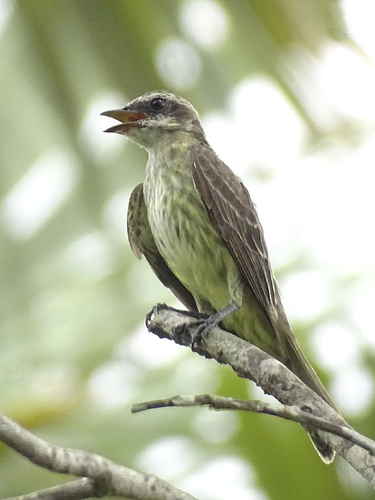
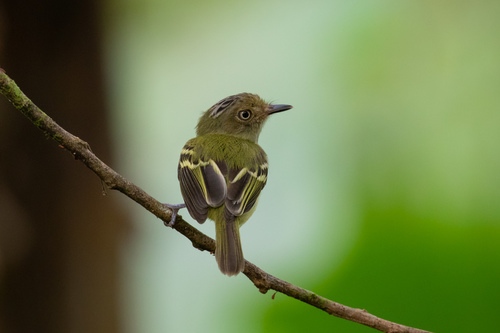
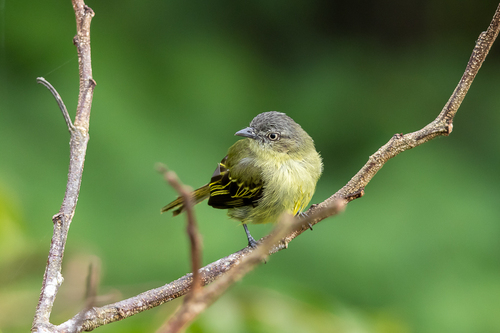
Fuscous Flycatcher

Fuscous Flycatcher

Cnemotriccus fuscatus

Silhouette: Emily Willoughby · PhyloPic

LCLeast ConcernNTVUENCR
Daily sighting probability ~10% · With luck
at Amacayacu National Natural Park

In 3 days ~20% in a week ~40%

44 Verified sightings at Amacayacu National Natural Park From 2019 to 2026
1,606 In all 14 parks
August Best month
☀️ Diurnal When it's spotted

About the Fuscous Flycatcher

The fuscous flycatcher (Cnemotriccus fuscatus) is a small passerine bird in the family Tyrannidae, the tyrant flycatchers. It is found in Trinidad and Tobago and in every mainland South American country except Chile. The fuscous flycatcher was originally described as Muscipeta fuscata. It was later transferred to genus Empidochanes and still later to its current genus Cnemotriccus, where it was originally called the dusky flycatcher.

The fuscous flycatcher has these seven subspecies: The fuscous flycatcher is the only member of genus Cnemotriccus. Wikipedia →

Sounds

Song0:07

Brazil · 2026

© JAYRSON ARAUJO DE OLIVEIRA · XC1162261 · CC BY-NC-SA 4.0

Call0:30

Brazil · 2025

© Joost van Bruggen · XC1050479 · CC BY-NC-ND 4.0

Subsong0:27

Bolivia · 2021

© Jacob Wijpkema · XC655517 · CC BY-NC-SA 4.0

Global Distribution

Parks Where Found

# Park Country Daily sighting probability
1 Main Ridge Forest Reserve 🇹🇹 Trinidad and Tobago
~30%
2 Iguazú National Park 🇦🇷 Argentina
~10%
3 Iguaçu National Park 🇧🇷 Brazil
~10%
4 Parque Estadual Encontro das Águas 🇧🇷 Brazil
~10%
5 Amacayacu National Natural Park 🇨🇴 Colombia
~10%
6 Serra da Canastra National Park 🇧🇷 Brazil
~10%
7 El Impenetrable National Park 🇦🇷 Argentina
~10%
8 Chapada dos Guimarães National Park 🇧🇷 Brazil
<5%
9 Iberá National Park 🇦🇷 Argentina
<5%
10 Yasuní National Park 🇪🇨 Ecuador
<5%
11 Anavilhanas National Park 🇧🇷 Brazil
<5%
12 Cuyabeno Wildlife Reserve 🇪🇨 Ecuador
<5%
13 Tambopata National Reserve 🇵🇪 Peru
<5%
14 Tijuca National Park 🇧🇷 Brazil
<5%

Cities Where Found

# City Country Daily sighting probability
1 Belo Horizonte 🇧🇷 Brazil
<5%
2 Campo Grande 🇧🇷 Brazil
<5%
3 Asuncion 🇵🇾 Paraguay
<5%
4 Valencia 🇻🇪 Venezuela
<5%
5 Rio de Janeiro 🇧🇷 Brazil
<5%

Before you go

What are the chances of seeing a Fuscous Flycatcher in Amacayacu National Natural Park?

With luck

About 10% of wildlife watchers report a Fuscous Flycatcher sighting in Amacayacu National Natural Park on a given day, based on 44 verified sightings from GBIF citizen-science data from 2019 to 2026. It is the 213th most-seen of the 436 birds we can rate there. Over three days the chance rises to about 20%, and over a week to about 40%, if each day is a fresh chance.

When is the best time to see a Fuscous Flycatcher in Amacayacu National Natural Park?

August

In that month about 20% of wildlife watchers report a Fuscous Flycatcher in Amacayacu National Natural Park on a given day, against under 5% in April, July, October and December–February, the lowest months. That is one of Amacayacu National Natural Park's driest months, with about 160 mm of rain against 390 mm in March.

What time of day is best to see a Fuscous Flycatcher?

Between 8 and 11 am

Across all the parks we cover, that three-hour window holds the most Fuscous Flycatcher sightings with a recorded time, and nearly all of them come between 6 am and 6 pm: it is a daytime animal.

Is Amacayacu National Natural Park the best place to see a Fuscous Flycatcher?

5th of 14

Of the 14 parks where we can rate Fuscous Flycatcher sightings, Amacayacu National Natural Park ranks 5th at about 10%. The best odds are in Main Ridge Forest Reserve (Trinidad and Tobago, about 30%), Iguazú National Park (Argentina, about 10%) and Iguaçu National Park (Brazil, about 10%).

Which relatives of the Fuscous Flycatcher live in Amacayacu National Natural Park?

Same family: Tyrannidae

The closest relatives of the Fuscous Flycatcher that you can see in Amacayacu National Natural Park (family Tyrannidae, Tyrant Flycatchers) are Tropical Kingbird (about 40%), Great Kiskadee (about 40%) and Yellow-crowned Tyrannulet (about 30%), with each one's daily chance of a sighting.

Where does the Fuscous Flycatcher sighting chance come from?

GBIF citizen-science records

It is estimated from how often the Fuscous Flycatcher is recorded against all the birds logged in Amacayacu National Natural Park (44 verified sightings from 2019 to 2026), calibrated against known sighting rates. Figures are rounded to the nearest 10% because citizen-science data supports honest approximations, not decimals, and months with records from fewer than five people show "—". How it works.

← Back to Amacayacu National Natural Park