Black Swift

Black Swift

Cypseloides niger

Silhouette: vectorized by Rob Sparks · PhyloPic

LCNTVUVulnerableENCR
Daily sighting probability <5% · Rare
at Arenal Volcano National Park

In 3 days <5% in a week ~10%

137 Verified sightings at Arenal Volcano National Park From 2019 to 2026
1,331 In all 26 parks
July Best month
☀️ Diurnal When it's spotted

About the Black Swift

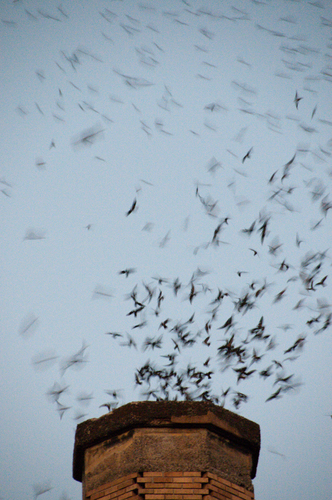
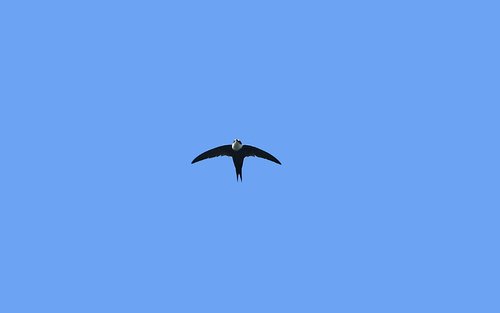
The American black swift, or more simply black swift (Cypseloides niger), is a species of bird that is found from northern British Columbia in Canada through the United States and Mexico to Costa Rica and Brazil. They are also found in the Caribbean.

The American black swift was formally described in 1789 by the German naturalist Johann Friedrich Gmelin in his revised and expanded edition of Carl Linnaeus's Systema Naturae. He placed it with all the other swallows and swifts in the genus Hirundo and coined the binomial name Hirundo nigra. Gmelin based his description on that of French zoologist Mathurin Jacques Brisson who, in 1760, had described and illustrated "Le Martinet de Saint Dominigue" from a preserved specimen. The type locality is Hispaniola: Saint-Domingue was a French colony on the Caribbean island. The American black swift is now placed with seven other swifts in the genus Cypseloides and was introduced in 1848 by the German naturist August Vollrath Streubel. The genus name combines the genus Cypselus introduced by Johann Illiger in 1811 and the Ancient Greek -oidēs meaning "resembling". The specific epithet niger is the Latin word for "black".

Three subspecies... Wikipedia →

Sounds

Call1:15

Mexico · 2021

© Richard E. Webster · XC677208 · CC BY-NC-SA 4.0

Call0:38

Mexico · 2015

© Nathan Pieplow · XC255567 · CC BY-NC-SA 4.0

Call0:04

United States · 2020

© Timothy Leque · XC614152 · CC BY-NC-SA 4.0

Global Distribution

Parks Where Found

# Park Country Daily sighting probability
1 Blue and John Crow Mountains National Park 🇯🇲 Jamaica
~10%
2 Jasper National Park 🇨🇦 Canada
~10%
3 Glacier National Park 🇺🇸 United States
~10%
4 Bastimentos Island National Marine Park 🇵🇦 Panama
<5%
5 Olympic National Park 🇺🇸 United States
<5%
6 Pacific Rim National Park Reserve 🇨🇦 Canada
<5%
7 Yosemite National Park 🇺🇸 United States
<5%
8 Manuel Antonio National Park 🇨🇷 Costa Rica
<5%
9 Tortuguero National Park 🇨🇷 Costa Rica
<5%
10 Great Bear Rainforest 🇨🇦 Canada
<5%
11 La Amistad International Park (Panama) 🇵🇦 Panama
<5%
12 Arenal Volcano National Park 🇨🇷 Costa Rica
<5%
13 Banff National Park 🇨🇦 Canada
<5%
14 Gandoca-Manzanillo Wildlife Refuge 🇨🇷 Costa Rica
<5%
15 Braulio Carrillo National Park 🇨🇷 Costa Rica
<5%
16 Sequoia and Kings Canyon National Parks 🇺🇸 United States
<5%
17 Marino Ballena National Park 🇨🇷 Costa Rica
<5%
18 Corcovado National Park 🇨🇷 Costa Rica
<5%
19 Soberanía National Park 🇵🇦 Panama
<5%
20 Rocky Mountain National Park 🇺🇸 United States
<5%
21 Tapantí-Macizo de la Muerte National Park 🇨🇷 Costa Rica
<5%
22 Chagres National Park 🇵🇦 Panama
<5%
23 Monteverde Cloud Forest Reserve 🇨🇷 Costa Rica
<5%
24 Poás Volcano National Park 🇨🇷 Costa Rica
<5%
25 Los Quetzales National Park 🇨🇷 Costa Rica
<5%
26 Carara National Park 🇨🇷 Costa Rica
<5%

Cities Where Found

# City Country Daily sighting probability
1 Vancouver 🇨🇦 Canada
<5%
2 San José 🇨🇷 Costa Rica
<5%
3 Mexico City 🇲🇽 México
<5%
4 Seattle 🇺🇸 United States
<5%
5 San Francisco 🇺🇸 United States
<5%
6 San Diego 🇺🇸 United States
<5%

Zoos & Centres Where Found

# Zoo / Centre Country
1 Vancouver Aquarium 🇨🇦 Canada In captivity

Before you go

What are the chances of seeing a Black Swift in Arenal Volcano National Park?

Rare

Under 5% of wildlife watchers report a Black Swift sighting in Arenal Volcano National Park on a given day, based on 137 verified sightings from GBIF citizen-science data from 2019 to 2026. It is the 338th most-seen of the 503 birds we can rate there. Over three days the chance rises to under 5%, and over a week to about 10%, if each day is a fresh chance.

When is the best time to see a Black Swift in Arenal Volcano National Park?

Any time of year

In every month with enough records, under 5% of wildlife watchers report a Black Swift in Arenal Volcano National Park on a given day, so our monthly data shows no clear season.

What time of day is best to see a Black Swift?

Between 9 am and noon

Across all the parks we cover, that three-hour window holds the most Black Swift sightings with a recorded time, and about 8 in 10 of them come between 6 am and 6 pm: it is a daytime animal.

Where does the Black Swift sighting chance come from?

GBIF citizen-science records

It is estimated from how often the Black Swift is recorded against all the birds logged in Arenal Volcano National Park (137 verified sightings from 2019 to 2026), calibrated against known sighting rates. Figures are rounded to the nearest 10% because citizen-science data supports honest approximations, not decimals, and months with records from fewer than five people show "—". How it works.

← Back to Arenal Volcano National Park