Variable Sunbird

Variable Sunbird

Cinnyris venustus

Silhouette: Sheatherius · PhyloPic

LCLeast ConcernNTVUENCR
Daily sighting probability <5% · Rare
at Awash National Park

In 3 days ~10% in a week ~30%

5 Verified sightings at Awash National Park From 2019 to 2026
5,459 In all 35 parks
January Best month
☀️ Diurnal When it's spotted

About the Variable Sunbird

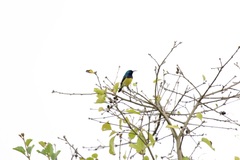
The variable sunbird or yellow-bellied sunbird (Cinnyris venustus), formerly Nectarinia venusta, is a sunbird. The sunbirds are a group of small Old World passerine birds which feed largely on nectar, although they will also take insects, especially when feeding young. Flight is fast and direct on their short wings. Most species can take nectar by hovering like a hummingbird, but usually perch to feed most of the time.

The variable sunbird is a fairly common resident breeder in equatorial Africa. Two eggs are laid in a suspended nest in a tree. This species is found in open woodland and cultivation. Variable sunbirds are small, only 10 cm long. They have medium-length thin down-curved bills and brush-tipped tubular tongues, both adaptations to their nectar feeding.

The adult male has a glossy green head, throat and nape, and a maroon breast band. In most subspecies, the belly of the male is yellow, but in a few it is orange or white. The female has grey-brown upperparts and yellowish underparts, and an obvious pale supercilium. The eclipse male is like the female, but shows some green, especially on the throat. The call is a clear tew-tew-tew-tew-tew. Wikipedia →

Sounds

Song0:21

Kenya · 2026

© Ding Li Yong · XC1178810 · CC BY-NC-ND 4.0

Call0:22

Uganda · 2022

© Peter Boesman · XC739541 · CC BY-NC-ND 4.0

Flight call0:26

Kenya · 2014

© James Bradley · XC205448 · CC BY-NC-SA 4.0

Global Distribution

Parks Where Found

# Park Country Daily sighting probability
1 Volcanoes National Park 🇷🇼 Rwanda
~60%
2 Nairobi National Park 🇰🇪 Kenya
~60%
3 Arusha National Park 🇹🇿 Tanzania
~60%
4 Nyungwe National Park 🇷🇼 Rwanda
~50%
5 Ngorongoro Conservation Area 🇹🇿 Tanzania
~30%
6 Ruaha National Park 🇹🇿 Tanzania
~30%
7 Lake Manyara National Park 🇹🇿 Tanzania
~20%
8 Virunga National Park 🇨🇩 Democratic Republic of the Congo
~20%
9 Mkomazi National Park 🇹🇿 Tanzania
~20%
10 Bwindi Impenetrable National Park 🇺🇬 Uganda
~20%
11 Aberdare National Park 🇰🇪 Kenya
~10%
12 Tsavo West National Park 🇰🇪 Kenya
~10%
13 Gorongosa National Park 🇲🇿 Mozambique
~10%
14 Lake Nakuru National Park 🇰🇪 Kenya
~10%
15 Akagera National Park 🇷🇼 Rwanda
~10%
16 Meru National Park 🇰🇪 Kenya
~10%
17 Bale Mountains National Park 🇪🇹 Ethiopia
~10%
18 Mikumi National Park 🇹🇿 Tanzania
~10%
19 Serengeti National Park 🇹🇿 Tanzania
~10%
20 Masai Mara National Reserve 🇰🇪 Kenya
~10%
21 Tarangire National Park 🇹🇿 Tanzania
~10%
22 Liwonde National Park 🇲🇼 Malawi
~10%
23 Kibale National Park 🇺🇬 Uganda
~10%
24 Awash National Park 🇪🇹 Ethiopia
<5%
25 Amboseli National Park 🇰🇪 Kenya
<5%
26 Lake Mburo National Park 🇺🇬 Uganda
<5%
27 Niokolo-Koba National Park 🇸🇳 Senegal
<5%
28 Mana Pools National Park 🇿🇼 Zimbabwe
<5%
29 Queen Elizabeth National Park 🇺🇬 Uganda
<5%
30 Lower Zambezi National Park 🇿🇲 Zambia
<5%
31 Kafue National Park 🇿🇲 Zambia
<5%
32 South Luangwa National Park 🇿🇲 Zambia
<5%
33 Semuliki National Park 🇺🇬 Uganda
<5%
34 Tsavo East National Park 🇰🇪 Kenya
<5%
35 Samburu National Reserve 🇰🇪 Kenya
<5%

Cities Where Found

# City Country Daily sighting probability
1 Lusaka 🇿🇲 Zambia
~80%
2 Nairobi 🇰🇪 Kenya
~70%
3 Abuja 🇳🇬 Nigeria
~70%
4 Harare 🇿🇼 Zimbabwe
~60%
5 Kigali 🇷🇼 Rwanda
~60%
6 Lomé 🇹🇬 Togo
~30%
7 Freetown 🇸🇱 Sierra Leone
~30%
8 Dakar 🇸🇳 Senegal
~20%
9 Kumasi 🇬🇭 Ghana
~20%
10 Lilongwe 🇲🇼 Malawi
~20%

Zoos & Centres Where Found

# Zoo / Centre Country
1 Wilhelma 🇩🇪 Germany In captivity
2 Papiliorama 🇨🇭 Switzerland In captivity

Before you go

What are the chances of seeing a Variable Sunbird in Awash National Park?

Rare

Under 5% of wildlife watchers report a Variable Sunbird sighting in Awash National Park on a given day, based on 5 verified sightings from GBIF citizen-science data from 2019 to 2026. It is the 199th most-seen of the 217 birds we can rate there. Over three days the chance rises to about 10%, and over a week to about 30%, if each day is a fresh chance.

When is the best time to see a Variable Sunbird in Awash National Park?

January

In that month about 30% of wildlife watchers report a Variable Sunbird in Awash National Park on a given day, against under 5% in April, June–August and October–December, the lowest months. That is one of Awash National Park's driest months, with about 10 mm of rain against 85 mm in August. February–March, May and September have too few records to rate.

What time of day is best to see a Variable Sunbird?

Between 7 and 10 am

Across all the parks we cover, that three-hour window holds the most Variable Sunbird sightings with a recorded time, and about 9 in 10 of them come between 6 am and 6 pm: it is a daytime animal.

Which relatives of the Variable Sunbird live in Awash National Park?

Same genus: Cinnyris

The closest relatives of the Variable Sunbird that you can see in Awash National Park (genus Cinnyris, Cinnyris Sunbirds) are Beautiful Sunbird (about 40%), Shining Sunbird (about 40%) and Mariqua Sunbird (about 10%), with each one's daily chance of a sighting.

Where does the Variable Sunbird sighting chance come from?

GBIF citizen-science records

It is estimated from how often the Variable Sunbird is recorded against all the birds logged in Awash National Park (5 verified sightings from 2019 to 2026), calibrated against known sighting rates. Figures are rounded to the nearest 10% because citizen-science data supports honest approximations, not decimals, and months with records from fewer than five people show "—". How it works.

← Back to Awash National Park