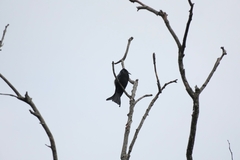
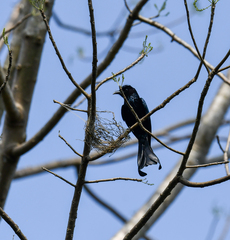
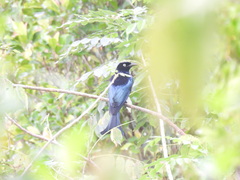
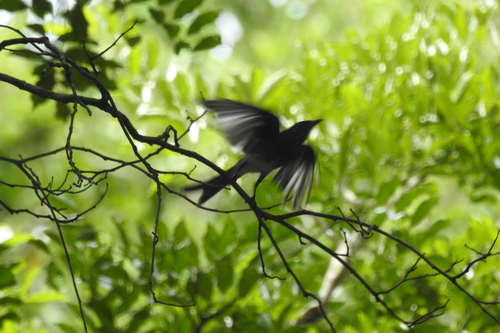
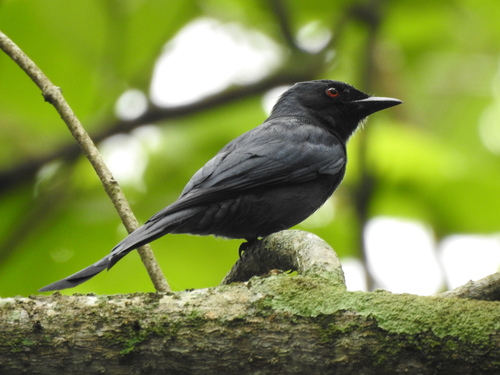
Hair-crested Drongo

Hair-crested Drongo

Dicrurus hottentottus

Silhouette: Ferran Sayol · PhyloPic

LCLeast ConcernNTVUENCR
Daily sighting probability <5% · Rare
at Bandhavgarh National Park

In 3 days ~10%

31 Verified sightings at Bandhavgarh National Park From 2019 to 2026
9,800 In all 23 parks
August Best month
🌅 Crepuscular When it's spotted

About the Hair-crested Drongo

The hair-crested drongo (Dicrurus hottentottus) is an Asian bird of the family Dicruridae. This species was formerly considered conspecific with Dicrurus bracteatus, for which the name "spangled drongo" – formerly used for both – is now usually reserved. Some authorities include the Sumatran drongo (D. sumatranus) in D. hottentottus as subspecies.

It is native from Pakistan, Bangladesh, India, and Bhutan through Indochina to China, Indonesia, and Brunei. Hair-crested drongos move in small flocks and are very noisy. The "spangled drongo", Dicrurus bracteatus, is native on the east coast of Australia and its name is a pejorative slang for a silly person. This may be due to its strange chattering and cackling.

In 1760, French zoologist Mathurin Jacques Brisson included a description of the hair-crested drongo in his Ornithologie based on a specimen that he mistakenly believed had been collected from the Cape of Good Hope in South Africa. He used the French name Le choucas du Cap de Bonne Espérance and the Latin Monedula Capitis Bonae Spei. Although Brisson coined Latin names, these do not conform to the binomial system and are not recognised by the International Commission... Wikipedia →

Sounds

Subsong0:25

Malaysia · 2026

© Ding Li Yong · XC1103993 · CC BY-NC-ND 4.0

Song0:17

Indonesia · 2019

© yasinchumaedi · XC1099352 · CC BY-NC-SA 4.0

Call1:07

Indonesia · 2025

© Richard E. Webster · XC1075206 · CC BY-NC-SA 4.0

Global Distribution

Parks Where Found

# Park Country Daily sighting probability
1 Tangkoko Nature Reserve 🇮🇩 Indonesia
~70%
2 Kaeng Krachan National Park 🇹🇭 Thailand
~50%
3 Khao Yai National Park 🇹🇭 Thailand
~50%
4 Kinabalu Park 🇲🇾 Malaysia
~50%
5 Manas National Park 🇮🇳 India
~40%
6 Kaziranga National Park 🇮🇳 India
~30%
7 Royal Manas National Park 🇧🇹 Bhutan
~20%
8 Royal Bardia National Park 🇳🇵 Nepal
~20%
9 Jim Corbett National Park 🇮🇳 India
~20%
10 Chitwan National Park 🇳🇵 Nepal
~20%
11 Doi Inthanon National Park 🇹🇭 Thailand
~20%
12 Namdapha National Park 🇮🇳 India
~20%
13 Bali Barat National Park 🇮🇩 Indonesia
~20%
14 Cat Tien National Park 🇻🇳 Vietnam
~20%
15 Kanha National Park 🇮🇳 India
~10%
16 Nagarhole National Park 🇮🇳 India
<5%
17 Cuc Phuong National Park 🇻🇳 Vietnam
<5%
18 Bandhavgarh National Park 🇮🇳 India
<5%
19 Satpura National Park 🇮🇳 India
<5%
20 Sepilok 🇲🇾 Malaysia
<5%
21 Sundarbans National Park 🇮🇳 India
<5%
22 Danum Valley Conservation Area 🇲🇾 Malaysia
<5%
23 Kinabatangan Wildlife Sanctuary 🇲🇾 Malaysia
<5%

Cities Where Found

# City Country Daily sighting probability
1 Dehradun 🇮🇳 India
~30%
2 Guwahati 🇮🇳 India
~30%
3 Tuen Mun 🇨🇳 China
~20%
4 Hefei 🇨🇳 China
~10%
5 Yangon 🇲🇲 Myanmar
~10%
6 Chandigarh 🇮🇳 India
~10%
7 Chattogram 🇧🇩 Bangladesh
~10%
8 Guangzhou 🇨🇳 China
~10%
9 Jammu 🇮🇳 India
~10%
10 Wuhan 🇨🇳 China
~10%

Zoos & Centres Where Found

# Zoo / Centre Country
1 Macau Zoo 🇲🇴 Macao SAR China In captivity

Before you go

What are the chances of seeing a Hair-crested Drongo in Bandhavgarh National Park?

Rare

Under 5% of wildlife watchers report a Hair-crested Drongo sighting in Bandhavgarh National Park on a given day, based on 31 verified sightings from GBIF citizen-science data from 2019 to 2026. It is the 174th most-seen of the 241 birds we can rate there. Over three days the chance rises to about 10%, if each day is a fresh chance.

When is the best time to see a Hair-crested Drongo in Bandhavgarh National Park?

January and August

In those months about 10% of wildlife watchers report a Hair-crested Drongo in Bandhavgarh National Park on a given day, against under 5% in February–July and September–December, the lowest months. Those are among Bandhavgarh National Park's wettest months, with about 210 mm of rain a month against almost none in November.

What time of day is best to see a Hair-crested Drongo?

Between 8 and 11 am

Across all the parks we cover, that three-hour window holds the most Hair-crested Drongo sightings with a recorded time, and about 6 in 10 of them come between 6 am and 6 pm: it is most active around dawn and dusk.

Which relatives of the Hair-crested Drongo live in Bandhavgarh National Park?

Same genus: Dicrurus

The closest relatives of the Hair-crested Drongo that you can see in Bandhavgarh National Park (genus Dicrurus, Drongos) are Black Drongo (about 60%), Greater Racket-tailed Drongo (about 60%) and White-bellied Drongo (about 40%), with each one's daily chance of a sighting.

Where does the Hair-crested Drongo sighting chance come from?

GBIF citizen-science records

It is estimated from how often the Hair-crested Drongo is recorded against all the birds logged in Bandhavgarh National Park (31 verified sightings from 2019 to 2026), calibrated against known sighting rates. Figures are rounded to the nearest 10% because citizen-science data supports honest approximations, not decimals, and months with records from fewer than five people show "—". How it works.

← Back to Bandhavgarh National Park