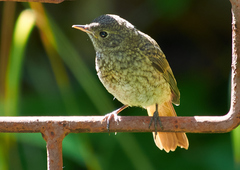
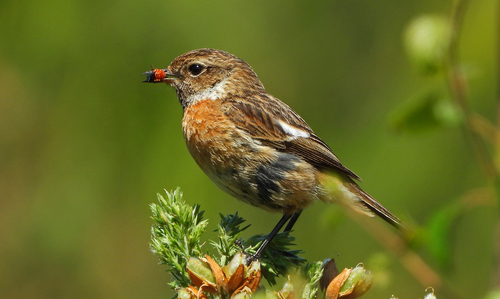
Common Redstart

Common Redstart

Phoenicurus phoenicurus

Silhouette: Martin Bulla, based on François Desbordes' illustration · PhyloPic

LCLeast ConcernNTVUENCR
Daily sighting probability ~10% · With luck
at Bavarian Forest National Park

In 3 days ~20% in a week ~30%

48 Verified sightings at Bavarian Forest National Park From 2019 to 2026
2,349 In all 28 parks
May Best month
☀️ Diurnal When it's spotted

About the Common Redstart

The common redstart (Phoenicurus phoenicurus), or often simply redstart, is a small passerine bird in the genus Phoenicurus. Like its relatives, it was formerly classed as a member of the thrush family, (Turdidae), but is now known to be an Old World flycatcher (family Muscicapidae).

The first formal description of the common redstart was by the Swedish naturalist Carl Linnaeus in 1758 in the tenth edition of his Systema Naturae under the binomial name Motacilla phoenicurus. The genus Phoenicurus was introduced by the English naturalist Thomas Forster in 1817. The genus and species name phoenicurus is from Ancient Greek phoinix, "red", and -ouros -"tailed".

Two subspecies are accepted. The nominate P. p. phoenicurus is found all over Europe and reaches into Siberia. To the southeast, subspecies P. p. samamisicus, sometimes called 'Ehrenberg's redstart', is found from the Crimean Peninsula and Greece through Turkey, the Caucasus, the Middle East, and into Central Asia. Adult males have white outer webs in the remiges, forming a pale to whitish wing-patch similar to the one seen in black redstart and Daurian redstart. This patch is also present but less... Wikipedia →

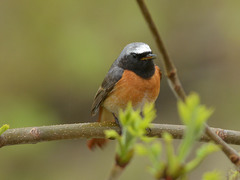
Sounds

Call0:44

Italy · 2026

© Luca Baghino · XC1101917 · CC BY-NC-SA 4.0

Song0:14

Sweden · 2022

© Marc Anderson · XC1080027 · CC BY-NC-ND 4.0

Imitation0:55

Netherlands · 2025

© Abe Bakker · XC994935 · CC BY-NC-SA 4.0

Global Distribution

Parks Where Found

# Park Country Daily sighting probability
1 Gauja National Park 🇱🇻 Latvia
~20%
2 Białowieża National Park 🇵🇱 Poland
~20%
3 Ecrins National Park 🇫🇷 France
~10%
4 Cévennes National Park 🇫🇷 France
~10%
5 Biebrza National Park 🇵🇱 Poland
~10%
6 Vanoise National Park 🇫🇷 France
~10%
7 Hohe Tauern National Park 🇦🇹 Austria
~10%
8 Snowdonia National Park 🇬🇧 United Kingdom
~10%
9 Triglav National Park 🇸🇮 Slovenia
~10%
10 Niokolo-Koba National Park 🇸🇳 Senegal
~10%
11 Cairngorms National Park 🇬🇧 United Kingdom
~10%
12 Picos de Europa National Park 🇪🇸 Spain
~10%
13 Tatra National Park 🇸🇰 Slovakia
~10%
14 Mercantour National Park 🇫🇷 France
~10%
15 Bavarian Forest National Park 🇩🇪 Germany
~10%
16 Ordesa y Monte Perdido National Park 🇪🇸 Spain
~10%
17 Pyrénées National Park 🇫🇷 France
~10%
18 Camargue 🇫🇷 France
<5%
19 Gobi Gurvansaikhan National Park 🇲🇳 Mongolia
<5%
20 Wadden Sea National Park 🇩🇪 Germany
<5%
21 Sierra de Guadarrama National Park 🇪🇸 Spain
<5%
22 Aigüestortes National Park 🇪🇸 Spain
<5%
23 Doñana National Park 🇪🇸 Spain
<5%
24 Hortobágy National Park 🇭🇺 Hungary
<5%
25 Sierra Nevada National Park 🇪🇸 Spain
<5%
26 Fertő-Hanság National Park 🇭🇺 Hungary
<5%
27 Kiskunság National Park 🇭🇺 Hungary
<5%
28 Monfragüe National Park 🇪🇸 Spain
<5%

Cities Where Found

# City Country Daily sighting probability
1 Jerusalem 🇮🇱 Israel
~30%
2 Yekaterinburg 🇷🇺 Russia
~20%
3 Ramallah 🇵🇸 Palestine
~20%
4 Bucharest 🇷🇴 Romania
~10%
5 Berlin 🇩🇪 Germany
~10%
6 Rostov-on-Don 🇷🇺 Russia
~10%
7 Prague 🇨🇿 Czechia
~10%
8 Nizhny Novgorod 🇷🇺 Russia
~10%
9 Turin 🇮🇹 Italy
~10%
10 Abu Dhabi 🇦🇪 United Arab Emirates
~10%

Zoos & Centres Where Found

# Zoo / Centre Country
1 Parc des oiseaux 🇫🇷 France In captivity

Before you go

What are the chances of seeing a Common Redstart in Bavarian Forest National Park?

With luck

About 10% of wildlife watchers report a Common Redstart sighting in Bavarian Forest National Park on a given day, based on 48 verified sightings from GBIF citizen-science data from 2019 to 2026. It is the 94th most-seen of the 170 birds we can rate there. Over three days the chance rises to about 20%, and over a week to about 30%, if each day is a fresh chance.

When is the best time to see a Common Redstart in Bavarian Forest National Park?

April–June and September

In those months about 10% of wildlife watchers report a Common Redstart in Bavarian Forest National Park on a given day, against under 5% in July–August and October–March, the lowest months.

What time of day is best to see a Common Redstart?

Between 8 and 11 am

Across all the parks we cover, that three-hour window holds the most Common Redstart sightings with a recorded time, and about 8 in 10 of them come between 6 am and 6 pm: it is a daytime animal.

Is Bavarian Forest National Park the best place to see a Common Redstart?

15th of 28

Of the 28 parks where we can rate Common Redstart sightings, Bavarian Forest National Park ranks 15th at about 10%. The best odds are in Gauja National Park (Latvia, about 20%), Białowieża National Park (Poland, about 20%) and Ecrins National Park (France, about 10%).

Where does the Common Redstart sighting chance come from?

GBIF citizen-science records

It is estimated from how often the Common Redstart is recorded against all the birds logged in Bavarian Forest National Park (48 verified sightings from 2019 to 2026), calibrated against known sighting rates. Figures are rounded to the nearest 10% because citizen-science data supports honest approximations, not decimals, and months with records from fewer than five people show "—". How it works.

← Back to Bavarian Forest National Park