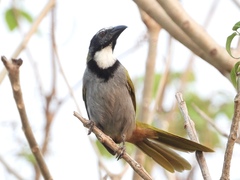

Black-headed Saltator

Black-headed Saltator

Saltator atriceps

Silhouette: Sheatherius · PhyloPic

LCLeast ConcernNTVUENCR
Daily sighting probability ~30% · Possible
at Cañón del Sumidero National Park

In 3 days ~60% in a week ~90%

176 Verified sightings at Cañón del Sumidero National Park From 2019 to 2026
6,522 In all 27 parks
April Best month
☀️ Diurnal When it's spotted

About the Black-headed Saltator

The black-headed saltator (Saltator atriceps) is a species of songbird in the family Thraupidae, the tanagers and allies. It is found from Mexico to Panama. The black-headed saltator was formally described in 1832 with the binomial Tanagra (Saltator) atriceps.

The black-headed saltator has these six subspecies: The sexes have the same plumage. Adults of the nominate subspecies S. a. atriceps have a mostly black head with a thin supercilium to just past the eye; it begins gray and becomes white to the rear. Their face is gray below the eye and onto the cheek. Their back, scapulars, rump, uppertail coverts, wings, and tail are bright yellowish olive-green; it is brightest on the tail. The flight- and tail feathers have black shafts. The center of their throat and their upper breast are white surrounded by black. Their lower breast and belly are ash-gray... Wikipedia →

Sounds

Call0:08

Costa Rica · 2026

© Nick Talbot · XC1180272 · CC BY-NC-SA 4.0

Song0:18

Guatemala · 2024

© Peter Boesman · XC880276 · CC BY-NC-ND 4.0

Several birds singing at same time0:15

Honduras · 2015

© Alfonso Auerbach · XC284585 · CC BY-NC-SA 4.0

Global Distribution

Parks Where Found

# Park Country Daily sighting probability
1 El Triunfo 🇲🇽 Mexico
~40%
2 Celaque National Park 🇭🇳 Honduras
~40%
3 Cockscomb Basin Wildlife Sanctuary 🇧🇿 Belize
~40%
4 Cusuco National Park 🇭🇳 Honduras
~40%
5 Sian Ka'an Biosphere Reserve 🇲🇽 Mexico
~40%
6 Cerro Azul Meámbar National Park 🇭🇳 Honduras
~30%
7 Montes Azules Biosphere Reserve 🇲🇽 Mexico
~30%
8 Lago de Yojoa 🇭🇳 Honduras
~30%
9 Cañón del Sumidero National Park 🇲🇽 Mexico
~30%
10 Tikal National Park 🇬🇹 Guatemala
~20%
11 Calakmul Biosphere Reserve 🇲🇽 Mexico
~20%
12 La Tigra National Park 🇭🇳 Honduras
~20%
13 Biotopo Cerro Cahuí 🇬🇹 Guatemala
~20%
14 Pico Bonito National Park 🇭🇳 Honduras
~20%
15 Arenal Volcano National Park 🇨🇷 Costa Rica
~10%
16 Masaya Volcano National Park 🇳🇮 Nicaragua
~10%
17 Tapantí-Macizo de la Muerte National Park 🇨🇷 Costa Rica
~10%
18 Poás Volcano National Park 🇨🇷 Costa Rica
<5%
19 Braulio Carrillo National Park 🇨🇷 Costa Rica
<5%
20 Cahuita National Park 🇨🇷 Costa Rica
<5%
21 La Amistad International Park (Panama) 🇵🇦 Panama
<5%
22 Tortuguero National Park 🇨🇷 Costa Rica
<5%
23 Tenorio Volcano National Park 🇨🇷 Costa Rica
<5%
24 Celestún Biosphere Reserve 🇲🇽 Mexico
<5%
25 Gandoca-Manzanillo Wildlife Refuge 🇨🇷 Costa Rica
<5%
26 Soberanía National Park 🇵🇦 Panama
<5%
27 Monteverde Cloud Forest Reserve 🇨🇷 Costa Rica
<5%

Cities Where Found

# City Country Daily sighting probability
1 Guatemala City 🇬🇹 Guatemala
~30%
2 San Salvador 🇸🇻 El Salvador
~30%
3 Tegucigalpa 🇭🇳 Honduras
~20%
4 San Pedro Sula 🇭🇳 Honduras
~10%
5 Managua 🇳🇮 Nicaragua
~10%
6 San José 🇨🇷 Costa Rica
<5%

Before you go

What are the chances of seeing a Black-headed Saltator in Cañón del Sumidero National Park?

Possible

About 30% of wildlife watchers report a Black-headed Saltator sighting in Cañón del Sumidero National Park on a given day, based on 176 verified sightings from GBIF citizen-science data from 2019 to 2026. It is the 44th most-seen of the 243 birds we can rate there. Over three days the chance rises to about 60%, and over a week to about 90%, if each day is a fresh chance.

When is the best time to see a Black-headed Saltator in Cañón del Sumidero National Park?

April, June and September

In those months about 40% of wildlife watchers report a Black-headed Saltator in Cañón del Sumidero National Park on a given day, against about 10% in January, the lowest month. Those are among Cañón del Sumidero National Park's wettest months, with about 180 mm of rain a month against 5 mm in February.

What time of day is best to see a Black-headed Saltator?

Between 7 and 10 am

Across all the parks we cover, that three-hour window holds the most Black-headed Saltator sightings with a recorded time, and about 9 in 10 of them come between 6 am and 6 pm: it is a daytime animal.

Where does the Black-headed Saltator sighting chance come from?

GBIF citizen-science records

It is estimated from how often the Black-headed Saltator is recorded against all the birds logged in Cañón del Sumidero National Park (176 verified sightings from 2019 to 2026), calibrated against known sighting rates. Figures are rounded to the nearest 10% because citizen-science data supports honest approximations, not decimals, and months with records from fewer than five people show "—". How it works.

← Back to Cañón del Sumidero National Park