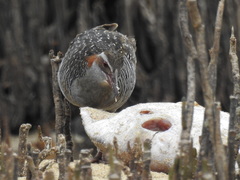
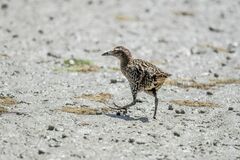
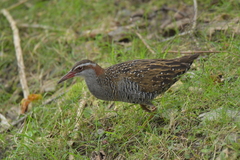
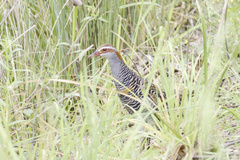
Buff-banded Rail

Buff-banded Rail

Gallirallus philippensis

Silhouette: T. Michael Keesey (vectorization) and HuttyMcphoo (photography) · PhyloPic

Daily sighting probability ~10% · With luck
at Cape Range

In 3 days ~10% in a week ~30%

9 Verified sightings at Cape Range From 2019 to 2026
714 In all 12 parks
July Best month
☀️ Diurnal When it's spotted

About the Buff-banded Rail

The buff-banded rail (Gallirallus philippensis) is a distinctively coloured, highly dispersive, medium-sized rail of the rail family, Rallidae. This species comprises several subspecies found throughout much of Australasia and the south-west Pacific region, including the Philippines (where it is known as tikling), New Guinea, Australia, New Zealand (where it is known as the banded rail, or moho-pererū in Māori), and numerous smaller islands, covering a range of latitudes from the tropics to the subantarctic. The species was formerly placed in the genus Hypotaenidia.

In 1760 the French zoologist Mathurin Jacques Brisson described and illustrated the buff-banded rail in his multi-volume Ornithologie based on a specimen collected in the Philippines. He used the French name Le rasle rayé des Philippines and the Latin name Rallus Philippensis Striatus. Although Brisson coined Latin names, these do not conform to the binomial system and are not recognised by the International Commission on Zoological Nomenclature. When in 1766 the Swedish naturalist Carl Linnaeus updated his Systema Naturae for the twelfth edition he added 240 species that had been previously described by Brisson... Wikipedia →

Sounds

Recording0:26

Australia · 2025

© jennyzvo · iNaturalist · CC BY-NC 4.0

Recording0:24

Australia · 2026

© verimaz · iNaturalist · CC BY-NC 4.0

Recording0:45

Australia · 2023

© Colin Trainor · iNaturalist · CC BY-NC 4.0

Global Distribution

Parks Where Found

# Park Country Daily sighting probability
1 Rottnest Island 🇦🇺 Australia
~20%
2 Tangkoko Nature Reserve 🇮🇩 Indonesia
~20%
3 Abel Tasman National Park 🇳🇿 New Zealand
~10%
4 Cape Range 🇦🇺 Australia
~10%
5 Ningaloo Marine Park 🇦🇺 Australia
<5%
6 Great Otway National Park 🇦🇺 Australia
<5%
7 Wilsons Promontory National Park 🇦🇺 Australia
<5%
8 Daintree National Park 🇦🇺 Australia
<5%
9 Royal National Park 🇦🇺 Australia
<5%
10 Blue Mountains National Park 🇦🇺 Australia
<5%
11 Lamington National Park 🇦🇺 Australia
<5%
12 Kinabalu Park 🇲🇾 Malaysia
<5%

Cities Where Found

# City Country Daily sighting probability
1 Makassar 🇮🇩 Indonesia
~10%
2 Brisbane 🇦🇺 Australia
~10%
3 Perth 🇦🇺 Australia
~10%
4 Melbourne 🇦🇺 Australia
~10%
5 Sydney 🇦🇺 Australia
~10%
6 Manila 🇵🇭 Philippines
<5%
7 Auckland 🇳🇿 New Zealand
<5%

Zoos & Centres Where Found

# Zoo / Centre Country
1 Territory Wildlife Park 🇦🇺 Australia In captivity
2 Zoo Miami 🇺🇸 United States In captivity
3 Parc zoologique et forestier Michel-Corbasson 🇫🇷 France In captivity
4 Cleland Wildlife Park 🇦🇺 Australia In captivity
5 Currumbin Wildlife Sanctuary 🇦🇺 Australia In captivity
6 Melbourne Zoo 🇦🇺 Australia In captivity
7 Auckland Zoo 🇳🇿 New Zealand In captivity
8 Adelaide Zoo 🇦🇺 Australia In captivity
9 Australian Reptile Park 🇦🇺 Australia In captivity
10 Featherdale Sydney Wildlife Park 🇦🇺 Australia In captivity
11 Cairns Aquarium 🇦🇺 Australia In captivity
12 Birdworld Kuranda 🇦🇺 Australia In captivity
13 Kuranda Koala Gardens 🇦🇺 Australia In captivity
14 Caversham Wildlife Park 🇦🇺 Australia In captivity
15 Wildlife Habitat Port Douglas 🇦🇺 Australia In captivity

Before you go

What are the chances of seeing a Buff-banded Rail in Cape Range?

With luck

About 10% of wildlife watchers report a Buff-banded Rail sighting in Cape Range on a given day, based on 9 verified sightings from GBIF citizen-science data from 2019 to 2026. It is the 70th most-seen of the 84 birds we can rate there. Over three days the chance rises to about 10%, and over a week to about 30%, if each day is a fresh chance.

When is the best time to see a Buff-banded Rail in Cape Range?

January, July, September and November

In those months about 10% of wildlife watchers report a Buff-banded Rail in Cape Range on a given day, against under 5% in March–June, August, October and December, the lowest months. Those are among Cape Range's driest months, with about 10 mm of rain a month against 55 mm in June. February has too few records to rate.

What time of day is best to see a Buff-banded Rail?

Between 11 am and 2 pm

Across all the parks we cover, that three-hour window holds the most Buff-banded Rail sightings with a recorded time, and nearly all of them come between 6 am and 6 pm: it is a daytime animal.

Is Cape Range the best place to see a Buff-banded Rail?

4th of 12

Of the 12 parks where we can rate Buff-banded Rail sightings, Cape Range ranks 4th at about 10%. The best odds are in Rottnest Island (Australia, about 20%), Tangkoko Nature Reserve (Indonesia, about 20%) and Abel Tasman National Park (New Zealand, about 10%).

Where does the Buff-banded Rail sighting chance come from?

GBIF citizen-science records

It is estimated from how often the Buff-banded Rail is recorded against all the birds logged in Cape Range (9 verified sightings from 2019 to 2026), calibrated against known sighting rates. Figures are rounded to the nearest 10% because citizen-science data supports honest approximations, not decimals, and months with records from fewer than five people show "—". How it works.

← Back to Cape Range