Black-cowled Oriole

Black-cowled Oriole

Icterus prosthemelas

Silhouette: Matt Wilkins · PhyloPic

LCLeast ConcernNTVUENCR
Daily sighting probability <5% · Rare
at Carara National Park

In 3 days <5%

11 Verified sightings at Carara National Park From 2019 to 2026
5,519 In all 25 parks
May Best month
☀️ Diurnal When it's spotted

About the Black-cowled Oriole

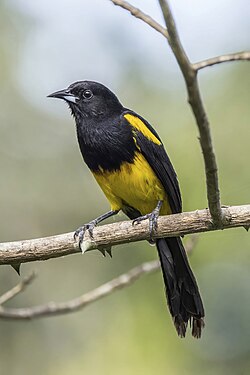
The black-cowled oriole (Icterus prosthemelas) is a species of bird in the family Icteridae. It is common and widespread in the Caribbean lowlands and foothills from southern Mexico to western Panama. It lives primarily in humid or semihumid forest, as well as in clearings, along forest edges, in plantations, in semi-open areas with scattered trees and bushes, and in gardens. The adult male is black, with yellow on the belly, shoulder, rump, wing lining, and crissum. The female's plumage varies depending on location. In the south of its range, it is similar to that of the male. In the north, its crown and upperparts are olive-yellow, while its face, throat, upper breast, wings, and tail are black.

It forages mostly at mid-levels, and its diet includes a mix of arthropods, nectar and fruit. The female lays three eggs in a shallow pendent nest, which is stitched to the underside of a large leaf. Both parents defend the nest, and brood and feed the young. Due to its very large range and apparently stable population, it is considered by the International Union for Conservation of Nature to be a species of least concern.

First described by Hugh Strickland in 1850, the black-cowled oriole has at times been considered conspecific with several oriole species from the Greater Antilles. Wikipedia →

Sounds

Begging call1:07

Mexico · 2016

© Ross Gallardy · XC332677 · CC BY-NC-SA 4.0

Call0:08

Costa Rica · 2011

© Andrew Spencer · XC72419 · CC BY-NC-ND 2.5

Subsong1:01

Costa Rica · 2021

© Sue Riffe · XC690664 · CC BY-NC-SA 4.0

Global Distribution

Parks Where Found

# Park Country Daily sighting probability
1 Cockscomb Basin Wildlife Sanctuary 🇧🇿 Belize
~30%
2 Sian Ka'an Biosphere Reserve 🇲🇽 Mexico
~20%
3 Tikal National Park 🇬🇹 Guatemala
~20%
4 Arenal Volcano National Park 🇨🇷 Costa Rica
~10%
5 Cusuco National Park 🇭🇳 Honduras
~10%
6 Gandoca-Manzanillo Wildlife Refuge 🇨🇷 Costa Rica
~10%
7 Braulio Carrillo National Park 🇨🇷 Costa Rica
~10%
8 Tortuguero National Park 🇨🇷 Costa Rica
~10%
9 Calakmul Biosphere Reserve 🇲🇽 Mexico
~10%
10 Pico Bonito National Park 🇭🇳 Honduras
~10%
11 Tenorio Volcano National Park 🇨🇷 Costa Rica
~10%
12 Cahuita National Park 🇨🇷 Costa Rica
~10%
13 Bastimentos Island National Marine Park 🇵🇦 Panama
~10%
14 Montes Azules Biosphere Reserve 🇲🇽 Mexico
<5%
15 Biotopo Cerro Cahuí 🇬🇹 Guatemala
<5%
16 La Amistad International Park (Panama) 🇵🇦 Panama
<5%
17 Rincón de la Vieja National Park 🇨🇷 Costa Rica
<5%
18 Celestún Biosphere Reserve 🇲🇽 Mexico
<5%
19 Cañón del Sumidero National Park 🇲🇽 Mexico
<5%
20 Tapantí-Macizo de la Muerte National Park 🇨🇷 Costa Rica
<5%
21 Marino Ballena National Park 🇨🇷 Costa Rica
<5%
22 Poás Volcano National Park 🇨🇷 Costa Rica
<5%
23 Manuel Antonio National Park 🇨🇷 Costa Rica
<5%
24 Carara National Park 🇨🇷 Costa Rica
<5%
25 Monteverde Cloud Forest Reserve 🇨🇷 Costa Rica
<5%

Cities Where Found

# City Country Daily sighting probability
1 San Pedro Sula 🇭🇳 Honduras
<5%

Before you go

What are the chances of seeing a Black-cowled Oriole in Carara National Park?

Rare

Under 5% of wildlife watchers report a Black-cowled Oriole sighting in Carara National Park on a given day, based on 11 verified sightings from GBIF citizen-science data from 2019 to 2026. It is the 386th most-seen of the 414 birds we can rate there. Over three days the chance rises to under 5%, if each day is a fresh chance.

When is the best time to see a Black-cowled Oriole in Carara National Park?

Any time of year

In every month with enough records, under 5% of wildlife watchers report a Black-cowled Oriole in Carara National Park on a given day, so our monthly data shows no clear season.

What time of day is best to see a Black-cowled Oriole?

Between 7 and 10 am

Across all the parks we cover, that three-hour window holds the most Black-cowled Oriole sightings with a recorded time, and about 9 in 10 of them come between 6 am and 6 pm: it is a daytime animal.

Which relatives of the Black-cowled Oriole live in Carara National Park?

Same genus: Icterus

The closest relatives of the Black-cowled Oriole that you can see in Carara National Park (genus Icterus, New World Orioles) are Baltimore Oriole (about 30%) and Streak-backed Oriole (about 20%), with each one's daily chance of a sighting.

Where does the Black-cowled Oriole sighting chance come from?

GBIF citizen-science records

It is estimated from how often the Black-cowled Oriole is recorded against all the birds logged in Carara National Park (11 verified sightings from 2019 to 2026), calibrated against known sighting rates. Figures are rounded to the nearest 10% because citizen-science data supports honest approximations, not decimals, and months with records from fewer than five people show "—". How it works.

← Back to Carara National Park