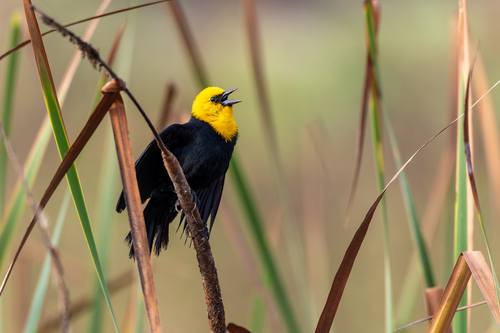
Red-breasted Blackbird

Red-breasted Blackbird

Sturnella militaris

Silhouette: Sheatherius · PhyloPic

LCLeast ConcernNTVUENCR
Daily sighting probability ~10% · With luck
at Caroni Swamp

In 3 days ~20% in a week ~30%

34 Verified sightings at Caroni Swamp From 2019 to 2026
2,265 In all 20 parks
June Best month
☀️ Diurnal When it's spotted

About the Red-breasted Blackbird

The red-breasted meadowlark (Leistes militaris) is a passerine bird in the New World family Icteridae. It was formerly named red-breasted blackbird but is not closely related to the red-winged blackbird group. The red-breasted meadowlark was formally described in 1758 by the Swedish naturalist Carl Linnaeus in the tenth edition of his Systema Naturae. He placed it with the buntings in the genus Emberiza and coined the binomial name Emberiza militaris. Linnaeus cited his own catalogue of the cabinet of curiosities belonging to the king of Sweden, Adolf Frederick, as well as the description and illustration of the "Greater Bull-Finch" by the English naturalist George Edwards's that had been published in 1747. Neither Edwards nor Linnaeus knew the origin of their specimens but in 1902 the German ornithologists Hans von Berlepsch and Ernst Hartert designated type locality as Suriname. The species is monotypic: no subspecies are recognised.

The red-breasted meadowlark is a small icterid, 19 cm (7.5 in) long and weighing 40–48 g (1.4–1.7 oz). Males are larger than females. The male has mainly black plumage, apart from a bright red throat, belly and wing... Wikipedia →

Sounds

Song0:05

Brazil · 2024

© JAYRSON ARAUJO DE OLIVEIRA · XC944057 · CC BY-NC-SA 4.0

Call0:33

Colombia · 2019

© David Monroy Rengifo · XC506958 · CC BY-NC-SA 4.0

Flight call0:19

Peru · 2005

© Daniel F. Lane · XC257158 · CC BY-NC-SA 4.0

Global Distribution

Parks Where Found

# Park Country Daily sighting probability
1 San Lorenzo Protected Forest 🇵🇦 Panama
~30%
2 Piedras Blancas National Park 🇨🇷 Costa Rica
~30%
3 Sierra de la Macarena National Park 🇨🇴 Colombia
~20%
4 La Amistad International Park (Panama) 🇵🇦 Panama
~10%
5 Bastimentos Island National Marine Park 🇵🇦 Panama
~10%
6 Gandoca-Manzanillo Wildlife Refuge 🇨🇷 Costa Rica
~10%
7 Caroni Swamp 🇹🇹 Trinidad and Tobago
~10%
8 Rincón de la Vieja National Park 🇨🇷 Costa Rica
<5%
9 Manuel Antonio National Park 🇨🇷 Costa Rica
<5%
10 Tortuguero National Park 🇨🇷 Costa Rica
<5%
11 Corcovado National Park 🇨🇷 Costa Rica
<5%
12 Braulio Carrillo National Park 🇨🇷 Costa Rica
<5%
13 Chagres National Park 🇵🇦 Panama
<5%
14 Carara National Park 🇨🇷 Costa Rica
<5%
15 Manu National Park 🇵🇪 Peru
<5%
16 Tambopata National Reserve 🇵🇪 Peru
<5%
17 Poás Volcano National Park 🇨🇷 Costa Rica
<5%
18 Arenal Volcano National Park 🇨🇷 Costa Rica
<5%
19 Tapantí-Macizo de la Muerte National Park 🇨🇷 Costa Rica
<5%
20 Soberanía National Park 🇵🇦 Panama
<5%

Cities Where Found

# City Country Daily sighting probability
1 Panama City 🇵🇦 Panama
<5%
2 Manaus 🇧🇷 Brazil
<5%
3 Valencia 🇻🇪 Venezuela
<5%
4 San José 🇨🇷 Costa Rica
<5%

Zoos & Centres Where Found

# Zoo / Centre Country
1 Aviario Nacional de Colombia 🇨🇴 Colombia In captivity

Before you go

What are the chances of seeing a Red-breasted Blackbird in Caroni Swamp?

With luck

About 10% of wildlife watchers report a Red-breasted Blackbird sighting in Caroni Swamp on a given day, based on 34 verified sightings from GBIF citizen-science data from 2019 to 2026. It is the 105th most-seen of the 169 birds we can rate there. Over three days the chance rises to about 20%, and over a week to about 30%, if each day is a fresh chance.

When is the best time to see a Red-breasted Blackbird in Caroni Swamp?

June

In that month about 20% of wildlife watchers report a Red-breasted Blackbird in Caroni Swamp on a given day, against under 5% in February–March, May, September and November–December, the lowest months. That is one of Caroni Swamp's wettest months, with about 120 mm of rain against 25 mm in February.

What time of day is best to see a Red-breasted Blackbird?

Between 7 and 10 am

Across all the parks we cover, that three-hour window holds the most Red-breasted Blackbird sightings with a recorded time, and about 9 in 10 of them come between 6 am and 6 pm: it is a daytime animal.

Which relatives of the Red-breasted Blackbird live in Caroni Swamp?

Same family: Icteridae

The closest relatives of the Red-breasted Blackbird that you can see in Caroni Swamp (family Icteridae, New World Blackbirds and Orioles) are Yellow-hooded Blackbird (about 40%), Carib Grackle (about 30%) and Yellow Oriole (about 30%), with each one's daily chance of a sighting.

Where does the Red-breasted Blackbird sighting chance come from?

GBIF citizen-science records

It is estimated from how often the Red-breasted Blackbird is recorded against all the birds logged in Caroni Swamp (34 verified sightings from 2019 to 2026), calibrated against known sighting rates. Figures are rounded to the nearest 10% because citizen-science data supports honest approximations, not decimals, and months with records from fewer than five people show "—". How it works.

← Back to Caroni Swamp