Lesser Whitethroat

Lesser Whitethroat

Sylvia curruca

Silhouette: Martin Bulla, based on John Cox's illustration · PhyloPic

LCLeast ConcernNTVUENCR
Daily sighting probability ~10% · With luck
at Bareilly

In 3 days ~30% in a week ~60%

10 Verified sightings at Bareilly
3,650 In all 31 parks From 2019 to 2026
January Best month
☀️ Diurnal When it's spotted

About the Lesser Whitethroat

The lesser whitethroat (Curruca curruca) is a common and widespread Old World warbler which breeds in temperate Europe, except the southwest, and in the western and central Palearctic. This small passerine bird is strongly migratory, wintering in Africa just south of the Sahara, Arabia and India.

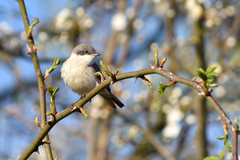
Unlike many sylviid warblers, the sexes are almost identical. This is a small species with a grey back, whitish underparts, a grey head with a darker "bandit mask" through the eyes and a white throat. It is slightly smaller than the common whitethroat, and lacks the chestnut wings and uniform head-face colour of that species. The lesser whitethroat's song is a fast and rattling sequence of tet or che calls, quite different from the common whitethroat's scolding song.

Like most "warblers", it is insectivorous, but will also take berries and other soft fruit. This is a bird of fairly open country and cultivation, with large bushes for nesting and some trees. The nest is built in low shrub or brambles, and 3 to 7 eggs are laid.

The lesser whitethroat was formally described by the Swedish naturalist Carl Linnaeus in 1758 in the tenth edition of his Systema Naturae under the binomial... Wikipedia →

Sounds

Recording0:22

Austria · 2025

© E. A. · iNaturalist · CC BY 4.0

Recording0:16

Russia · 2024

© Dina Nesterkova · iNaturalist · CC BY-NC 4.0

Recording0:14

Germany · 2026

© Frederic Griesbaum · iNaturalist · CC BY-NC 4.0

Global Distribution

Parks Where Found

# Park Country Daily sighting probability
1 Keoladeo National Park 🇮🇳 India
~50%
2 Biebrza National Park 🇵🇱 Poland
~30%
3 Białowieża National Park 🇵🇱 Poland
~20%
4 Ecrins National Park 🇫🇷 France
~20%
5 Hortobágy National Park 🇭🇺 Hungary
~20%
6 Hemis National Park 🇮🇳 India
~20%
7 Ranthambore National Park 🇮🇳 India
~20%
8 Gauja National Park 🇱🇻 Latvia
~10%
9 Vanoise National Park 🇫🇷 France
~10%
10 Mercantour National Park 🇫🇷 France
~10%
11 Hohe Tauern National Park 🇦🇹 Austria
~10%
12 Kiskunság National Park 🇭🇺 Hungary
~10%
13 Gobi Gurvansaikhan National Park 🇲🇳 Mongolia
~10%
14 Awash National Park 🇪🇹 Ethiopia
~10%
15 Fertő-Hanság National Park 🇭🇺 Hungary
~10%
16 Tatra National Park 🇸🇰 Slovakia
~10%
17 Wadden Sea National Park 🇩🇪 Germany
~10%
18 Mudumalai National Park 🇮🇳 India
~10%
19 Triglav National Park 🇸🇮 Slovenia
~10%
20 Jim Corbett National Park 🇮🇳 India
<5%
21 Bavarian Forest National Park 🇩🇪 Germany
<5%
22 Kruger National Park 🇿🇦 South Africa
<5%
23 Satpura National Park 🇮🇳 India
<5%
24 Bandipur National Park 🇮🇳 India
<5%
25 Plitvice Lakes National Park 🇭🇷 Croatia
<5%
26 Bandhavgarh National Park 🇮🇳 India
<5%
27 Yala National Park 🇱🇰 Sri Lanka
<5%
28 Udawalawe National Park 🇱🇰 Sri Lanka
<5%
29 Kanha National Park 🇮🇳 India
<5%
30 Royal Bardia National Park 🇳🇵 Nepal
<5%
31 Snowdonia National Park 🇬🇧 United Kingdom
<5%

Cities Where Found

# City Country Daily sighting probability
1 Jerusalem 🇮🇱 Israel
~60%
2 Ramallah 🇵🇸 Palestine
~40%
3 Jodhpur 🇮🇳 India
~30%
4 Dushanbe 🇹🇯 Tajikistan
~30%
5 Jaipur 🇮🇳 India
~30%
6 Bhopal 🇮🇳 India
~30%
7 Tashkent 🇺🇿 Uzbekistan
~20%
8 Jabalpur 🇮🇳 India
~20%
9 Abu Dhabi 🇦🇪 United Arab Emirates
~20%
10 Kuwait City 🇰🇼 Kuwait
~20%

Zoos & Centres Where Found

# Zoo / Centre Country
1 Hanover Zoo 🇩🇪 Germany In captivity

Before you go

What are the chances of seeing a Lesser Whitethroat in Bareilly?

With luck

About 10% of wildlife watchers report a Lesser Whitethroat sighting in Bareilly on a given day, based on 10 verified sightings from GBIF citizen-science data. It is the 47th most-seen of the 72 birds we can rate there. Over three days the chance rises to about 30%, and over a week to about 60%, if each day is a fresh chance.

When is the best time to see a Lesser Whitethroat in Bareilly?

January

In that month about 30% of wildlife watchers report a Lesser Whitethroat in Bareilly on a given day, against about 10% in April–June and August–November, the lowest months. That is one of Bareilly's driest months, with about 20 mm of rain against 350 mm in July. July has too few records to rate.

What time of day is best to see a Lesser Whitethroat?

Between 8 and 11 am

Across all the parks we cover, that three-hour window holds the most Lesser Whitethroat sightings with a recorded time, and about 9 in 10 of them come between 6 am and 6 pm: it is a daytime animal.

Is Bareilly the best place to see a Lesser Whitethroat?

24th of 97

Of the 97 cities where we can rate Lesser Whitethroat sightings, Bareilly ranks 24th at about 10%. The best odds are in Jerusalem (Israel, about 60%), Ramallah (Palestine, about 40%) and Jodhpur (India, about 30%).

Which relatives of the Lesser Whitethroat live in Bareilly?

Same order: Passeriformes

The closest relatives of the Lesser Whitethroat that you can see in Bareilly (order Passeriformes, Perching Birds) are Jungle Babbler (about 80%), Rufous Treepie (about 70%) and House Crow (about 60%), with each one's daily chance of a sighting.

Where does the Lesser Whitethroat sighting chance come from?

GBIF citizen-science records

It is estimated from how often the Lesser Whitethroat is recorded against all the birds logged in Bareilly (10 verified sightings), calibrated against known sighting rates. Figures are rounded to the nearest 10% because citizen-science data supports honest approximations, not decimals, and months with records from fewer than five people show "—". How it works.

← Back to Bareilly