Eurasian Jay

Eurasian Jay

Garrulus glandarius

Silhouette: Martin Bulla, based on Brian Small's illustration · PhyloPic

LCLeast ConcernNTVUENCR
Daily sighting probability ~40% · Likely
at Berlin

In 3 days ~80% in a week >90%

1,842 Verified sightings at Berlin
9,144 In all 31 parks From 2019 to 2026
December Best month
☀️ Diurnal When it's spotted

About the Eurasian Jay

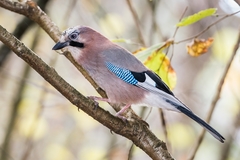
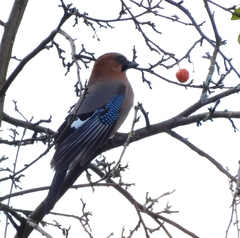
The Eurasian jay (Garrulus glandarius) is a species of passerine bird in the family Corvidae. It has pinkish brown plumage with a black stripe on each side of a whitish throat, a bright blue panel on the upper wing and a black tail. The Eurasian jay is a woodland bird that occurs over a vast region from western Europe and north-west Africa to the Indian subcontinent and farther to the eastern seaboard of Asia and down into south-east Asia. Across this vast range, several distinct racial forms have evolved which look different from each other, especially when comparing forms at the extremes of its range.

The Eurasian jay was formally described by the Swedish naturalist Carl Linnaeus in 1758 in the tenth edition of his Systema Naturae under the binomial name Corvus glandarius. Linnaeus specified the locality as "Europa" but this was restricted to Sweden by Ernst Hartert in 1903. The Eurasian jay is now one of three species placed in the genus Garrulus that was established in 1760 by the French zoologist Mathurin Jacques Brisson. The genus name Garrulus is a Latin word meaning "chattering", "babbling" or "noisy". The specific epithet glandarius is Latin meaning... Wikipedia →

Sounds

Call0:32

France · 2026

© Olivier SWIFT · XC1089334 · CC BY-NC-SA 4.0

Song0:20

China · 2025

© Lim Ying Hien 林勇贤 · XC1041506 · CC BY-NC-ND 4.0

Alarm call0:36

Italy · 2025

© Francesco Sottile · XC959123 · CC BY-NC-SA 4.0

Global Distribution

Parks Where Found

# Park Country Daily sighting probability
1 Białowieża National Park 🇵🇱 Poland
~60%
2 Nikko National Park 🇯🇵 Japan
~50%
3 Aigüestortes National Park 🇪🇸 Spain
~50%
4 Plitvice Lakes National Park 🇭🇷 Croatia
~50%
5 Biebrza National Park 🇵🇱 Poland
~40%
6 Triglav National Park 🇸🇮 Slovenia
~40%
7 Cévennes National Park 🇫🇷 France
~40%
8 Picos de Europa National Park 🇪🇸 Spain
~40%
9 Pyrénées National Park 🇫🇷 France
~40%
10 Gauja National Park 🇱🇻 Latvia
~40%
11 Bavarian Forest National Park 🇩🇪 Germany
~30%
12 Ordesa y Monte Perdido National Park 🇪🇸 Spain
~30%
13 Sierra Nevada National Park 🇪🇸 Spain
~30%
14 Mercantour National Park 🇫🇷 France
~30%
15 Tatra National Park 🇸🇰 Slovakia
~30%
16 Ecrins National Park 🇫🇷 France
~30%
17 Sierra de Guadarrama National Park 🇪🇸 Spain
~20%
18 Vanoise National Park 🇫🇷 France
~20%
19 Monfragüe National Park 🇪🇸 Spain
~20%
20 Taroko National Park 🇹🇼 Taiwan
~10%
21 Kiskunság National Park 🇭🇺 Hungary
~10%
22 Hohe Tauern National Park 🇦🇹 Austria
~10%
23 Snowdonia National Park 🇬🇧 United Kingdom
~10%
24 Doi Inthanon National Park 🇹🇭 Thailand
~10%
25 Fertő-Hanság National Park 🇭🇺 Hungary
~10%
26 Hortobágy National Park 🇭🇺 Hungary
~10%
27 Cairngorms National Park 🇬🇧 United Kingdom
~10%
28 Jiuzhaigou National Park 🇨🇳 China
~10%
29 Wadden Sea National Park 🇩🇪 Germany
<5%
30 Langtang National Park 🇳🇵 Nepal
<5%
31 Royal Manas National Park 🇧🇹 Bhutan
<5%

Cities Where Found

# City Country Daily sighting probability
1 Jerusalem 🇮🇱 Israel
~80%
2 Kharkiv 🇺🇦 Ukraine
~80%
3 Sofia 🇧🇬 Bulgaria
~80%
4 Ramallah 🇵🇸 Palestine
~70%
5 Tel Aviv 🇮🇱 Israel
~50%
6 Amman 🇯🇴 Jordan
~50%
7 Ankara 🇹🇷 Turkey
~50%
8 Antalya 🇹🇷 Turkey
~40%
9 Prague 🇨🇿 Czechia
~40%
10 Rostov-on-Don 🇷🇺 Russia
~40%

Zoos & Centres Where Found

# Zoo / Centre Country
1 Walsrode World Bird Park 🇩🇪 Germany In captivity
2 domain of the caves of Han 🇧🇪 Belgium In captivity
3 Beijing Wildlife Park 🇨🇳 China In captivity
4 Дельфинарий в Сочи-парке 🇷🇺 Russia In captivity
5 Seville Zoo 🇪🇸 Spain In captivity
6 Paphos Zoo 🇨🇾 Cyprus In captivity
7 Tabor Zoo 🇨🇿 Czechia In captivity
8 Kuala Lumpur Bird Park 🇲🇾 Malaysia In captivity
9 Budakeszi Game Preserve 🇭🇺 Hungary In captivity
10 Zoopark Limpopo 🇷🇺 Russia In captivity
11 Santillana Zoo 🇪🇸 Spain In captivity
12 Tiggywinkles Wildlife Teaching Hospital 🇬🇧 United Kingdom In captivity
13 Castellar Zoo 🇪🇸 Spain In captivity
14 Minizoo Malá Chuchle 🇨🇿 Czechia In captivity
15 Bird Kingdom 🇨🇦 Canada In captivity
16 Дельфинарий "Сочи Парк" 🇷🇺 Russia In captivity
17 River&#8217;s Wish Animal Sanctuary 🇺🇸 United States In captivity
18 Дельфинарий 🇷🇺 Russia In captivity

Before you go

What are the chances of seeing a Eurasian Jay in Berlin?

Likely

About 40% of wildlife watchers report a Eurasian Jay sighting in Berlin on a given day, based on 1,842 verified sightings from GBIF citizen-science data. It is the 18th most-seen of the 160 birds we can rate there. Over three days the chance rises to about 80%, and over a week to over 90%, if each day is a fresh chance.

When is the best time to see a Eurasian Jay in Berlin?

October and December–March

In those months about 50% of wildlife watchers report a Eurasian Jay in Berlin on a given day, against about 20% in June and July, the lowest months.

What time of day is best to see a Eurasian Jay?

Between 9 am and noon

Across all the parks we cover, that three-hour window holds the most Eurasian Jay sightings with a recorded time, and about 8 in 10 of them come between 6 am and 6 pm: it is a daytime animal.

Is Berlin the best place to see a Eurasian Jay?

13th of 70

Of the 70 cities where we can rate Eurasian Jay sightings, Berlin ranks 13th at about 40%. The best odds are in Jerusalem (Israel, about 80%), Kharkiv (Ukraine, about 80%) and Sofia (Bulgaria, about 80%).

Which relatives of the Eurasian Jay live in Berlin?

Same family: Corvidae

The closest relatives of the Eurasian Jay that you can see in Berlin (family Corvidae, Crows, Jays, and Magpies) are Hooded Crow (about 90%), Eurasian Magpie (about 40%) and Rook (about 20%), with each one's daily chance of a sighting.

Where does the Eurasian Jay sighting chance come from?

GBIF citizen-science records

It is estimated from how often the Eurasian Jay is recorded against all the birds logged in Berlin (1,842 verified sightings), calibrated against known sighting rates. Figures are rounded to the nearest 10% because citizen-science data supports honest approximations, not decimals, and months with records from fewer than five people show "—". How it works.

← Back to Berlin