Ruby-crowned Kinglet

Ruby-crowned Kinglet

Regulus calendula

Silhouette: Ferran Sayol · PhyloPic

LCLeast ConcernNTVUENCR
Daily sighting probability ~10% · With luck
at Calgary

In 3 days ~20% in a week ~30%

1,448 Verified sightings at Calgary
38,852 In all 45 parks From 2019 to 2026
September Best month
☀️ Diurnal When it's spotted

About the Ruby-crowned Kinglet

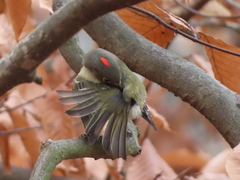
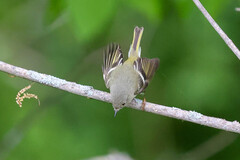
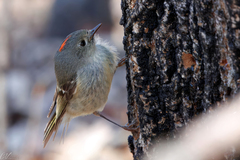
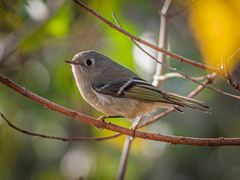
The ruby-crowned kinglet (Corthylio calendula) is a very small passerine bird found throughout North America. It is a member of the kinglet family. The bird has olive-green plumage with two white wing bars and a white eye-ring. Males have a red crown patch, which is often concealed. The sexes are identical apart from the crown, and juveniles are similar in plumage to adult females. It is one of the smallest songbirds in North America. The ruby-crowned kinglet is not closely related to other kinglets and was moved from Regulus to its own genus, Corthylio, in 2021. Three subspecies are currently recognized.

The kinglet is mostly migratory, and its range extends from northwest Canada and Alaska south to Mexico. Its breeding habitat is spruce-fir forests in the northern and mountainous regions of the United States and Canada. The ruby-crowned kinglet builds a cup-shaped nest, which may be pensile or placed on a tree branch and is often hidden. It lays up to 12 eggs, and has the largest clutch of any North American passerine for its size. It is mainly insectivorous, but also eats fruits and seeds.

The ruby-crowned kinglet was formally described in 1766 by the Swedish naturalist... Wikipedia →

Sounds

Recording0:04

United States · 2025

© zhen (he/him) · iNaturalist · CC BY-NC 4.0

Recording0:13

United States · 2024

© Sue Brady · iNaturalist · CC BY-NC 4.0

Recording0:07

Canada · 2023

© danielalain · iNaturalist · CC BY-NC 4.0

Global Distribution

Parks Where Found

# Park Country Daily sighting probability
1 Reserva de la Biosfera Mariposa Monarca 🇲🇽 Mexico
~70%
2 Grand Teton National Park 🇺🇸 United States
~60%
3 Gros Morne National Park 🇨🇦 Canada
~60%
4 Point Pelee National Park 🇨🇦 Canada
~50%
5 Glacier National Park 🇺🇸 United States
~50%
6 Congaree National Park 🇺🇸 United States
~50%
7 Banff National Park 🇨🇦 Canada
~50%
8 Cumbres de Monterrey National Park 🇲🇽 Mexico
~40%
9 Jasper National Park 🇨🇦 Canada
~40%
10 Yellowstone National Park 🇺🇸 United States
~40%
11 Rocky Mountain National Park 🇺🇸 United States
~40%
12 Guadalupe Mountains National Park 🇺🇸 United States
~30%
13 Big Bend National Park 🇺🇸 United States
~30%
14 Wrangell-St. Elias National Park 🇺🇸 United States
~30%
15 Death Valley National Park 🇺🇸 United States
~30%
16 Zion National Park 🇺🇸 United States
~30%
17 Joshua Tree National Park 🇺🇸 United States
~30%
18 Cape Breton Highlands National Park 🇨🇦 Canada
~20%
19 Redwood National Park 🇺🇸 United States
~20%
20 Sequoia and Kings Canyon National Parks 🇺🇸 United States
~20%
21 Denali National Park 🇺🇸 United States
~20%
22 Saguaro National Park 🇺🇸 United States
~20%
23 Riding Mountain National Park 🇨🇦 Canada
~20%
24 Channel Islands National Park 🇺🇸 United States
~20%
25 Kluane National Park 🇨🇦 Canada
~20%
26 Grand Canyon National Park 🇺🇸 United States
~20%
27 Yosemite National Park 🇺🇸 United States
~20%
28 Olympic National Park 🇺🇸 United States
~10%
29 Pacific Rim National Park Reserve 🇨🇦 Canada
~10%
30 Kenai Fjords National Park 🇺🇸 United States
~10%
31 Great Bear Rainforest 🇨🇦 Canada
~10%
32 Shenandoah National Park 🇺🇸 United States
~10%
33 Isle Royale National Park 🇺🇸 United States
~10%
34 Voyageurs National Park 🇺🇸 United States
~10%
35 Wood Buffalo National Park 🇨🇦 Canada
~10%
36 Merritt Island National Wildlife Refuge 🇺🇸 United States
~10%
37 Great Smoky Mountains National Park 🇺🇸 United States
~10%
38 Acadia National Park 🇺🇸 United States
~10%
39 Elk Island National Park 🇨🇦 Canada
~10%
40 Katmai National Park 🇺🇸 United States
<5%
41 El Vizcaíno Biosphere Reserve 🇲🇽 Mexico
<5%
42 Everglades National Park 🇺🇸 United States
<5%
43 Big Cypress National Preserve 🇺🇸 United States
<5%
44 Badlands National Park 🇺🇸 United States
<5%
45 Padre Island National Seashore 🇺🇸 United States
<5%

Cities Where Found

# City Country Daily sighting probability
1 Toluca 🇲🇽 México
~40%
2 San Antonio 🇺🇸 United States
~40%
3 Austin 🇺🇸 United States
~30%
4 Mexico City 🇲🇽 México
~30%
5 Sacramento 🇺🇸 United States
~30%
6 Houston 🇺🇸 United States
~30%
7 Puebla 🇲🇽 México
~30%
8 Mesa 🇺🇸 United States
~30%
9 Monterrey 🇲🇽 México
~30%
10 Seattle 🇺🇸 United States
~30%

Before you go

What are the chances of seeing a Ruby-crowned Kinglet in Calgary?

With luck

About 10% of wildlife watchers report a Ruby-crowned Kinglet sighting in Calgary on a given day, based on 1,448 verified sightings from GBIF citizen-science data. It is the 88th most-seen of the 259 birds we can rate there. Over three days the chance rises to about 20%, and over a week to about 30%, if each day is a fresh chance.

When is the best time to see a Ruby-crowned Kinglet in Calgary?

September

In that month about 20% of wildlife watchers report a Ruby-crowned Kinglet in Calgary on a given day, against under 5% in July–August and November–March, the lowest months.

What time of day is best to see a Ruby-crowned Kinglet?

Between 10 am and 1 pm

Across all the parks we cover, that three-hour window holds the most Ruby-crowned Kinglet sightings with a recorded time, and about 8 in 10 of them come between 6 am and 6 pm: it is a daytime animal.

Is Calgary the best place to see a Ruby-crowned Kinglet?

37th of 40

Of the 40 cities where we can rate Ruby-crowned Kinglet sightings, Calgary ranks 37th at about 10%. The best odds are in Toluca (México, about 40%), San Antonio (United States, about 40%) and Austin (United States, about 30%).

Where does the Ruby-crowned Kinglet sighting chance come from?

GBIF citizen-science records

It is estimated from how often the Ruby-crowned Kinglet is recorded against all the birds logged in Calgary (1,448 verified sightings), calibrated against known sighting rates. Figures are rounded to the nearest 10% because citizen-science data supports honest approximations, not decimals, and months with records from fewer than five people show "—". How it works.

← Back to Calgary