Eastern Cane Toad

Eastern Cane Toad

Rhinella marina

Silhouette: Dennis C. Murphy, after http://bit.ly/4q6IESe · PhyloPic

LCLeast ConcernNTVUENCR
Daily sighting probability ~10% · With luck
at Caracas

In 3 days ~20% in a week ~40%

13 Verified sightings at Caracas
1,241 In all 18 parks From 2019 to 2026
April Best month
☀️🌙 Day & Night When it's spotted

About the Eastern Cane Toad

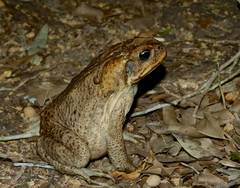
The cane toad (Rhinella marina), also known as the giant neotropical toad or marine toad, is a large, terrestrial true toad native to South and mainland Central America, but which has been introduced to various islands throughout Oceania and the Caribbean, as well as Northern Australia. It is a member of the genus Rhinella, which includes many true toad species found throughout Central and South America, but it was formerly assigned to the genus Bufo.

A fossil toad (specimen UCMP 41159) from the La Venta fauna of the late Miocene in Colombia is morphologically indistinguishable from modern cane toads from northern South America. It was discovered in a floodplain deposit, which suggests the R. marina habitat preferences have long been for open areas. The cane toad is a prolific breeder; females lay single-clump spawns with thousands of eggs. Its reproductive success is partly because of opportunistic feeding: it has a diet, unusual among anurans, of both dead and living matter. Adults average 10–15 cm (4–6 in) in length; the largest recorded specimen had a snout–vent length of 24 cm (9.4 in).

The cane toad has poison glands, and the tadpoles are highly toxic to most animals if ingested. Its toxic skin can kill many animals, both wild and domesticated, and cane toads are particularly dangerous to dogs. Because of its voracious appetite, the cane toad has been introduced to many regions of the Pacific and the Caribbean islands as a method of agricultural pest control. The common name of the species is derived from its use against the cane beetle (Dermolepida albohirtum), which damages sugar cane. The cane toad is now considered a pest and an invasive species in many of its introduced regions. The 1988 film Cane Toads: An Unnatural History documented the trials and tribulations of the introduction of cane toads in Australia. Wikipedia →

Sounds

Uncertain0:15

French Guiana · 2024

© Tristan Guillebot de Nerville · XC1093227 · CC BY-NC-SA 4.0

Territorial call0:21

Australia · 2015

© Chris Harrison · XC1051103 · CC BY-NC-SA 4.0

Advertisement call0:20

Australia · 2020

© Marc Anderson · XC883189 · CC BY-NC-ND 4.0

Global Distribution

Parks Where Found

# Park Country Daily sighting probability
1 Brownsberg Nature Park 🇸🇷 Suriname
~70%
2 Manu National Park 🇵🇪 Peru
~60%
3 Main Ridge Forest Reserve 🇹🇹 Trinidad and Tobago
~60%
4 Daintree National Park 🇦🇺 Australia
~60%
5 Los Haitises National Park 🇩🇴 Dominican Republic
~50%
6 Tambopata National Reserve 🇵🇪 Peru
~50%
7 Nitmiluk National Park 🇦🇺 Australia
~40%
8 Kakadu National Park 🇦🇺 Australia
~40%
9 Amacayacu National Natural Park 🇨🇴 Colombia
~40%
10 Anavilhanas National Park 🇧🇷 Brazil
~40%
11 Litchfield National Park 🇦🇺 Australia
~30%
12 Yasuní National Park 🇪🇨 Ecuador
~30%
13 Noosa National Park 🇦🇺 Australia
~30%
14 Lamington National Park 🇦🇺 Australia
~30%
15 Cuyabeno Wildlife Reserve 🇪🇨 Ecuador
~30%
16 Caroni Swamp 🇹🇹 Trinidad and Tobago
~20%
17 Springbrook National Park 🇦🇺 Australia
~20%
18 Everglades National Park 🇺🇸 United States
~10%

Cities Where Found

# City Country Daily sighting probability
1 Davao City 🇵🇭 Philippines
~80%
2 Angeles 🇵🇭 Philippines
~70%
3 Cebu City 🇵🇭 Philippines
~60%
4 Manila 🇵🇭 Philippines
~60%
5 Manaus 🇧🇷 Brazil
~50%
6 Valencia 🇻🇪 Venezuela
~40%
7 Brisbane 🇦🇺 Australia
~30%
8 Miami 🇺🇸 United States
~30%
9 Belém 🇧🇷 Brazil
~20%
10 Santo Domingo 🇩🇴 Dominican Republic
~20%

Zoos & Centres Where Found

# Zoo / Centre Country
1 Shedd Aquarium 🇺🇸 United States In captivity
2 Basel Zoo 🇨🇭 Switzerland In captivity
3 Tierpark Berlin 🇩🇪 Germany In captivity
4 Antwerp Zoo 🇧🇪 Belgium In captivity
5 Ostrava Zoo 🇨🇿 Czechia In captivity
6 Kolmården Wildlife Park 🇸🇪 Sweden In captivity
7 Zoo Miami 🇺🇸 United States In captivity
8 Zoológico de Brasília 🇧🇷 Brazil In captivity
9 São Paulo Zoo 🇧🇷 Brazil In captivity
10 Yaroslavl Zoo 🇷🇺 Russia In captivity
11 Granby Zoo 🇨🇦 Canada In captivity
12 Kyiv Zoo 🇺🇦 Ukraine In captivity
13 Berlin Zoological Garden 🇩🇪 Germany In captivity
14 Taronga Zoo 🇦🇺 Australia In captivity
15 Cleland Wildlife Park 🇦🇺 Australia In captivity
16 Arizona-Sonora Desert Museum 🇺🇸 United States In captivity
17 Zoo Opole 🇵🇱 Poland In captivity
18 Currumbin Wildlife Sanctuary 🇦🇺 Australia In captivity
19 Faunia 🇪🇸 Spain In captivity
20 Naples Zoo 🇺🇸 United States In captivity
21 Amaru 🇪🇨 Ecuador In captivity
22 Kazan Zoo & Botanical Garden 🇷🇺 Russia In captivity
23 Australian Reptile Park 🇦🇺 Australia In captivity
24 Parc Merveilleux 🇱🇺 Luxembourg In captivity
25 Zoo de Martinique 🇫🇷 France In captivity
26 Vancouver Aquarium 🇨🇦 Canada In captivity
27 Newport Aquarium 🇺🇸 United States In captivity
28 Zoo Samara 🇷🇺 Russia In captivity
29 Mote Marine Laboratory 🇺🇸 United States In captivity
30 Aquarium Berlin 🇩🇪 Germany In captivity
31 Tennessee Aquarium 🇺🇸 United States In captivity
32 Aquário de Paranaguá 🇧🇷 Brazil In captivity
33 Aquatopia 🇧🇪 Belgium In captivity
34 Austin Aquarium 🇺🇸 United States In captivity
35 Heal the Bay Aquarium 🇺🇸 United States In captivity
36 Port Moresby Nature Park 🇵🇬 Papua New Guinea In captivity

Before you go

What are the chances of seeing an Eastern Cane Toad in Caracas?

With luck

About 10% of wildlife watchers report an Eastern Cane Toad sighting in Caracas on a given day, based on 13 verified sightings from GBIF citizen-science data. It is the 4th most-seen of the 6 amphibians we can rate there. Over three days the chance rises to about 20%, and over a week to about 40%, if each day is a fresh chance.

When is the best time to see an Eastern Cane Toad in Caracas?

April–June and October–November

In those months about 10% of wildlife watchers report an Eastern Cane Toad in Caracas on a given day, against under 5% in July–September and December–March, the lowest months.

What time of day is best to see an Eastern Cane Toad?

Between 7 and 10 pm

Across all the parks we cover, that three-hour window holds the most Eastern Cane Toad sightings with a recorded time, and about 7 in 10 of them come between 6 pm and 6 am: it is seen both by day and at night.

Is Caracas the best place to see an Eastern Cane Toad?

11th of 12

Of the 12 cities where we can rate Eastern Cane Toad sightings, Caracas ranks 11th at about 10%. The best odds are in Davao City (Philippines, about 80%), Angeles (Philippines, about 70%) and Cebu City (Philippines, about 60%).

Where does the Eastern Cane Toad sighting chance come from?

GBIF citizen-science records

It is estimated from how often the Eastern Cane Toad is recorded against all the amphibians logged in Caracas (13 verified sightings), calibrated against known sighting rates. Figures are rounded to the nearest 10% because citizen-science data supports honest approximations, not decimals, and months with records from fewer than five people show "—". How it works.

← Back to Caracas