American Goldfinch

American Goldfinch

Spinus tristis

Silhouette: Andy Wilson · PhyloPic

LCLeast ConcernNTVUENCR
Daily sighting probability ~10% · With luck
at Dallas

In 3 days ~30% in a week ~60%

1,101 Verified sightings at Dallas
27,839 In all 36 parks From 2019 to 2026
January Best month
☀️ Diurnal When it's spotted

About the American Goldfinch

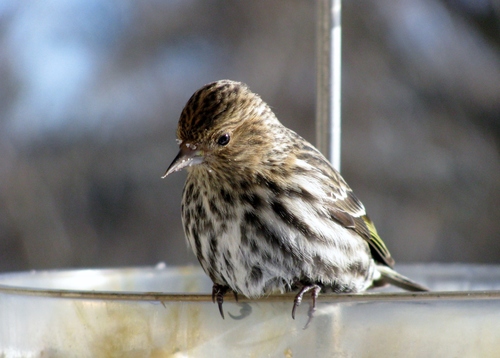
The American goldfinch (Spinus tristis) is a small North American bird in the finch family. It is migratory, ranging from mid-Alberta to North Carolina during the breeding season, and from just south of the Canada–United States border to Mexico during the winter.

The only finch in its subfamily to undergo a complete molt, the American goldfinch displays sexual dichromatism: the male is a vibrant yellow in the summer and an olive color during the winter, while the female is a dull yellow-brown shade which brightens only slightly during the summer. The male displays brightly colored plumage during the breeding season to attract a mate.

The American goldfinch is a granivore and adapted for the consumption of seedheads, with a conical beak to remove the seeds and agile feet to grip the stems of seedheads while feeding. It is a social bird and will gather in large flocks while feeding and migrating. It may behave territorially during nest construction, but this aggression is short-lived. Its breeding season is tied to the peak of food supply, beginning in late July, which is relatively late in the year for a finch. This species is generally monogamous and produces one brood each year.

Human activity has generally benefited the American goldfinch. It is often found in residential areas because it is attracted to bird feeders, which increase its survival rate in these areas. Deforestation also creates open meadow areas, which are its preferred habitat. Wikipedia →

Sounds

Call0:05

United States · 2024

© Denis Dujardin · XC1056062 · CC BY-NC-SA 4.0

Song0:06

Canada · 2025

© Romeo St-Cyr · XC1040648 · CC BY-NC-SA 4.0

Alarm call1:24

Canada · 2018

© Thomas Ryder Payne · XC636512 · CC BY-NC-SA 4.0

Global Distribution

Parks Where Found

# Park Country Daily sighting probability
1 Shenandoah National Park 🇺🇸 United States
~60%
2 Acadia National Park 🇺🇸 United States
~50%
3 Cape Breton Highlands National Park 🇨🇦 Canada
~50%
4 Great Smoky Mountains National Park 🇺🇸 United States
~50%
5 Point Pelee National Park 🇨🇦 Canada
~50%
6 Riding Mountain National Park 🇨🇦 Canada
~40%
7 Gros Morne National Park 🇨🇦 Canada
~20%
8 Congaree National Park 🇺🇸 United States
~20%
9 Elk Island National Park 🇨🇦 Canada
~20%
10 Olympic National Park 🇺🇸 United States
~20%
11 Voyageurs National Park 🇺🇸 United States
~20%
12 Redwood National Park 🇺🇸 United States
~10%
13 Badlands National Park 🇺🇸 United States
~10%
14 Pacific Rim National Park Reserve 🇨🇦 Canada
~10%
15 Grand Teton National Park 🇺🇸 United States
~10%
16 Glacier National Park 🇺🇸 United States
~10%
17 Zion National Park 🇺🇸 United States
~10%
18 Isle Royale National Park 🇺🇸 United States
~10%
19 Rocky Mountain National Park 🇺🇸 United States
~10%
20 Channel Islands National Park 🇺🇸 United States
<5%
21 Yellowstone National Park 🇺🇸 United States
<5%
22 Guadalupe Mountains National Park 🇺🇸 United States
<5%
23 Death Valley National Park 🇺🇸 United States
<5%
24 Banff National Park 🇨🇦 Canada
<5%
25 Great Bear Rainforest 🇨🇦 Canada
<5%
26 Sequoia and Kings Canyon National Parks 🇺🇸 United States
<5%
27 Jasper National Park 🇨🇦 Canada
<5%
28 Big Bend National Park 🇺🇸 United States
<5%
29 Grand Canyon National Park 🇺🇸 United States
<5%
30 Merritt Island National Wildlife Refuge 🇺🇸 United States
<5%
31 Cumbres de Monterrey National Park 🇲🇽 Mexico
<5%
32 Big Cypress National Preserve 🇺🇸 United States
<5%
33 Yosemite National Park 🇺🇸 United States
<5%
34 Everglades National Park 🇺🇸 United States
<5%
35 Joshua Tree National Park 🇺🇸 United States
<5%
36 Saguaro National Park 🇺🇸 United States
<5%

Cities Where Found

# City Country Daily sighting probability
1 Minneapolis [Saint Paul] 🇺🇸 United States
~70%
2 Montreal 🇨🇦 Canada
~70%
3 Toronto 🇨🇦 Canada
~60%
4 Chicago 🇺🇸 United States
~60%
5 Boston 🇺🇸 United States
~50%
6 Baltimore 🇺🇸 United States
~50%
7 Detroit 🇺🇸 United States
~50%
8 Philadelphia 🇺🇸 United States
~50%
9 Washington 🇺🇸 United States
~50%
10 Vancouver 🇨🇦 Canada
~40%

Zoos & Centres Where Found

# Zoo / Centre Country
1 National Zoological Park 🇺🇸 United States In captivity
2 Columbus Zoo and Aquarium 🇺🇸 United States In captivity
3 Burgers' Ocean 🇳🇱 Netherlands In captivity
4 Royal Burgers' Zoo 🇳🇱 Netherlands In captivity

Before you go

What are the chances of seeing an American Goldfinch in Dallas?

With luck

About 10% of wildlife watchers report an American Goldfinch sighting in Dallas on a given day, based on 1,101 verified sightings from GBIF citizen-science data. It is the 44th most-seen of the 253 birds we can rate there. Over three days the chance rises to about 30%, and over a week to about 60%, if each day is a fresh chance.

When is the best time to see an American Goldfinch in Dallas?

December and January

In those months about 30% of wildlife watchers report an American Goldfinch in Dallas on a given day, against under 5% in May to October, the lowest months.

What time of day is best to see an American Goldfinch?

Between 3 and 6 pm

Across all the parks we cover, that three-hour window holds the most American Goldfinch sightings with a recorded time, and about 8 in 10 of them come between 6 am and 6 pm: it is a daytime animal.

Is Dallas the best place to see an American Goldfinch?

20th of 30

Of the 30 cities where we can rate American Goldfinch sightings, Dallas ranks 20th at about 10%. The best odds are in Minneapolis [Saint Paul] (United States, about 70%), Montreal (Canada, about 70%) and Toronto (Canada, about 60%).

Where does the American Goldfinch sighting chance come from?

GBIF citizen-science records

It is estimated from how often the American Goldfinch is recorded against all the birds logged in Dallas (1,101 verified sightings), calibrated against known sighting rates. Figures are rounded to the nearest 10% because citizen-science data supports honest approximations, not decimals, and months with records from fewer than five people show "—". How it works.

← Back to Dallas