
Black-backed Puffback

Black-backed Puffback

Dryoscopus cubla

Silhouette: Sheatherius · PhyloPic

LCLeast ConcernNTVUENCR
Daily sighting probability ~10% · With luck
at Durban

In 3 days ~20% in a week ~40%

76 Verified sightings at Durban
11,448 In all 36 parks From 2019 to 2026
November Best month
☀️ Diurnal When it's spotted

About the Black-backed Puffback

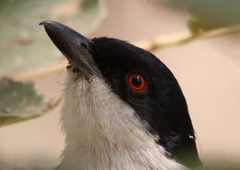
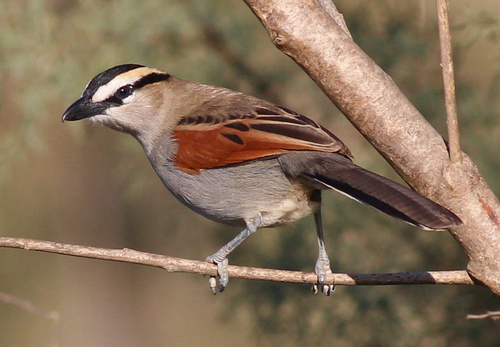
The black-backed puffback (Dryoscopus cubla) is a species of passerine bird in the family Malaconotidae. They are common to fairly common sedentary bushshrikes in various wooded habitats in Africa south of the equator. They restlessly move about singly, in pairs or family groups, and generally frequent tree canopies. Like others of its genus, the males puff out the loose rump and lower back feathers in display, to assume a remarkable ball-like appearance. They draw attention to themselves by their varied repertoire of whistling, clicking and rasping sounds. Their specific name cubla, originated with Francois Levaillant, who derived it from a native southern African name, where the "c" is an onomatopoeic click sound. None of the other five puffback species occur in southern Africa.

They measure about 17 cm in length, and the sexes are similar though easily distinguishable. Adult males have the upperparts deep blue-black with a slight luster. The black cap subtends the red eye, the upperpart plumage is black-and-white, and the underparts pure white. Females have a black loral stripe and white supraloral feathering, with the ear coverts pale and the crown not solidly... Wikipedia →

Sounds

Begging call0:21

Kenya · 2026

© Ding Li Yong · XC1179044 · CC BY-NC-ND 4.0

Call0:11

South Africa · 2026

© JJSUN · XC1080049 · CC BY-NC-SA 4.0

Song1:16

Kenya · 2025

© Louis A. Hansen · XC1068755 · CC BY-NC-SA 4.0

Global Distribution

Parks Where Found

# Park Country Daily sighting probability
1 uMkhuze Game Reserve 🇿🇦 South Africa
~60%
2 Gonarezhou National Park 🇿🇼 Zimbabwe
~60%
3 Gorongosa National Park 🇲🇿 Mozambique
~60%
4 iSimangaliso Wetland Park 🇿🇦 South Africa
~60%
5 Arusha National Park 🇹🇿 Tanzania
~50%
6 Kafue National Park 🇿🇲 Zambia
~50%
7 Kruger National Park 🇿🇦 South Africa
~50%
8 Mana Pools National Park 🇿🇼 Zimbabwe
~50%
9 Lower Zambezi National Park 🇿🇲 Zambia
~40%
10 Waterberg Plateau Park 🇳🇦 Namibia
~40%
11 Liwonde National Park 🇲🇼 Malawi
~30%
12 South Luangwa National Park 🇿🇲 Zambia
~30%
13 Meru National Park 🇰🇪 Kenya
~30%
14 Ruaha National Park 🇹🇿 Tanzania
~30%
15 Garden Route National Park 🇿🇦 South Africa
~30%
16 Mkomazi National Park 🇹🇿 Tanzania
~30%
17 Nairobi National Park 🇰🇪 Kenya
~30%
18 Mikumi National Park 🇹🇿 Tanzania
~30%
19 Lake Manyara National Park 🇹🇿 Tanzania
~20%
20 Hluhluwe-Imfolozi Park 🇿🇦 South Africa
~20%
21 Hwange National Park 🇿🇼 Zimbabwe
~20%
22 Masai Mara National Reserve 🇰🇪 Kenya
~20%
23 Pilanesberg National Park 🇿🇦 South Africa
~20%
24 Tsavo West National Park 🇰🇪 Kenya
~10%
25 Aberdare National Park 🇰🇪 Kenya
~10%
26 Ngorongoro Conservation Area 🇹🇿 Tanzania
~10%
27 Moremi Game Reserve 🇧🇼 Botswana
~10%
28 Tarangire National Park 🇹🇿 Tanzania
~10%
29 Chobe National Park 🇧🇼 Botswana
~10%
30 Etosha National Park 🇳🇦 Namibia
~10%
31 Serengeti National Park 🇹🇿 Tanzania
~10%
32 Lake Nakuru National Park 🇰🇪 Kenya
<5%
33 Addo Elephant National Park 🇿🇦 South Africa
<5%
34 Tsavo East National Park 🇰🇪 Kenya
<5%
35 Amboseli National Park 🇰🇪 Kenya
<5%
36 Akagera National Park 🇷🇼 Rwanda
<5%

Cities Where Found

# City Country Daily sighting probability
1 Mombasa 🇰🇪 Kenya
~50%
2 Zanzibar City 🇹🇿 Tanzania
~40%
3 Nairobi 🇰🇪 Kenya
~30%
4 Lusaka 🇿🇲 Zambia
~30%
5 Harare 🇿🇼 Zimbabwe
~30%
6 Dar es-Salaam 🇹🇿 Tanzania
~20%
7 Lilongwe 🇲🇼 Malawi
~20%
8 Pretoria 🇿🇦 South Africa
~10%
9 Lubango 🇦🇴 Angola
~10%
10 Johannesburg 🇿🇦 South Africa
~10%

Before you go

What are the chances of seeing a Black-backed Puffback in Durban?

With luck

About 10% of wildlife watchers report a Black-backed Puffback sighting in Durban on a given day, based on 76 verified sightings from GBIF citizen-science data. It is the 79th most-seen of the 219 birds we can rate there. Over three days the chance rises to about 20%, and over a week to about 40%, if each day is a fresh chance.

When is the best time to see a Black-backed Puffback in Durban?

April to January

In those months about 10% of wildlife watchers report a Black-backed Puffback in Durban on a given day, against under 5% in February and March, the lowest months.

What time of day is best to see a Black-backed Puffback?

Between 8 and 11 am

Across all the parks we cover, that three-hour window holds the most Black-backed Puffback sightings with a recorded time, and about 9 in 10 of them come between 6 am and 6 pm: it is a daytime animal.

Is Durban the best place to see a Black-backed Puffback?

11th of 12

Of the 12 cities where we can rate Black-backed Puffback sightings, Durban ranks 11th at about 10%. The best odds are in Mombasa (Kenya, about 50%), Zanzibar City (Tanzania, about 40%) and Nairobi (Kenya, about 30%).

Where does the Black-backed Puffback sighting chance come from?

GBIF citizen-science records

It is estimated from how often the Black-backed Puffback is recorded against all the birds logged in Durban (76 verified sightings), calibrated against known sighting rates. Figures are rounded to the nearest 10% because citizen-science data supports honest approximations, not decimals, and months with records from fewer than five people show "—". How it works.

← Back to Durban