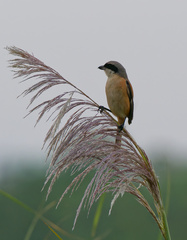
Long-tailed Shrike

Long-tailed Shrike

Lanius schach

Silhouette: Andy Wilson · PhyloPic

LCLeast ConcernNTVUENCR
Daily sighting probability <5% · Rare
at Jabalpur

In 3 days ~10% in a week ~20%

30 Verified sightings at Jabalpur
8,702 In all 29 parks From 2019 to 2026
February Best month
☀️ Diurnal When it's spotted

About the Long-tailed Shrike

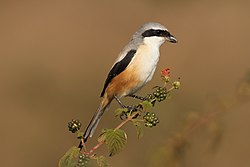
The long-tailed shrike or rufous-backed shrike (Lanius schach) is a member of the bird family Laniidae, the shrikes. They are found widely distributed across Asia and there are variations in plumage across the range. The species ranges across much of Asia, both on the mainland and the eastern archipelagos. The eastern or Himalayan subspecies, L. s. tricolor, is sometimes called the black-headed shrike. Although there are considerable differences in plumage among the subspecies, they all have a long and narrow black tail, have a black mask and forehead, rufous rump and flanks and a small white patch on the shoulder. It is considered to form a superspecies with the grey-backed shrike (Lanius tephronotus) which breeds on the Tibetan Plateau.

The long-tailed shrike was formally described by the Swedish naturalist Carl Linnaeus in 1758 in the tenth edition of his Systema Naturae under the binomial name Lanius schach. Linnaeus cited the description that the Swedish explorer Pehr Osbeck had included in the account of his stay in China. The type locality is the Canton area of China. The genus name, Lanius, is derived from the Latin word for "butcher", and some shrikes are also... Wikipedia →

Sounds

Recording0:14

Philippines · 2026

© bureaubenjamin · iNaturalist · CC BY-NC 4.0

Recording0:28

Philippines · 2025

© astronorm · iNaturalist · CC BY-NC 4.0

Recording0:04

China · 2026

© Dawn_Land · iNaturalist · CC BY-NC 4.0

Global Distribution

Parks Where Found

# Park Country Daily sighting probability
1 Mudumalai National Park 🇮🇳 India
~60%
2 Chitwan National Park 🇳🇵 Nepal
~50%
3 Jim Corbett National Park 🇮🇳 India
~50%
4 Keoladeo National Park 🇮🇳 India
~50%
5 Royal Bardia National Park 🇳🇵 Nepal
~40%
6 Manas National Park 🇮🇳 India
~40%
7 Bandipur National Park 🇮🇳 India
~40%
8 Bali Barat National Park 🇮🇩 Indonesia
~40%
9 Kaziranga National Park 🇮🇳 India
~30%
10 Ranthambore National Park 🇮🇳 India
~30%
11 Kerinci Seblat National Park 🇮🇩 Indonesia
~30%
12 Satpura National Park 🇮🇳 India
~30%
13 Eravikulam National Park 🇮🇳 India
~30%
14 Gunung Leuser National Park 🇮🇩 Indonesia
~20%
15 Nagarhole National Park 🇮🇳 India
~20%
16 Royal Manas National Park 🇧🇹 Bhutan
~20%
17 Bandhavgarh National Park 🇮🇳 India
~20%
18 Langtang National Park 🇳🇵 Nepal
~20%
19 Gir National Park 🇮🇳 India
~10%
20 Kanha National Park 🇮🇳 India
~10%
21 Kinabalu Park 🇲🇾 Malaysia
~10%
22 Namdapha National Park 🇮🇳 India
<5%
23 Sundarbans National Park 🇮🇳 India
<5%
24 Cuc Phuong National Park 🇻🇳 Vietnam
<5%
25 Periyar National Park 🇮🇳 India
<5%
26 Kinabatangan Wildlife Sanctuary 🇲🇾 Malaysia
<5%
27 Doi Inthanon National Park 🇹🇭 Thailand
<5%
28 Taroko National Park 🇹🇼 Taiwan
<5%
29 Sepilok 🇲🇾 Malaysia
<5%

Cities Where Found

# City Country Daily sighting probability
1 Suzhou 🇨🇳 China
~80%
2 Shanghai 🇨🇳 China
~80%
3 Ningbo 🇨🇳 China
~70%
4 Nanchang 🇨🇳 China
~70%
5 Xiuying District 🇨🇳 China
~70%
6 Chattogram 🇧🇩 Bangladesh
~60%
7 Jinhua 🇨🇳 China
~60%
8 Vasai-Virar 🇮🇳 India
~60%
9 Quanzhou 🇨🇳 China
~60%
10 Solapur 🇮🇳 India
~50%

Zoos & Centres Where Found

# Zoo / Centre Country
1 Gembira Loka Zoo 🇮🇩 Indonesia In captivity
2 Surabaya Zoo 🇮🇩 Indonesia In captivity
3 Bandung Zoo 🇮🇩 Indonesia In captivity
4 蘭陽動植物王國 🇹🇼 Taiwan In captivity
5 Sea World Indonesia 🇮🇩 Indonesia In captivity
6 Jakarta Aquarium 🇮🇩 Indonesia In captivity
7 Taman Safari Indonesia 2 🇮🇩 Indonesia In captivity

Before you go

What are the chances of seeing a Long-tailed Shrike in Jabalpur?

Rare

Under 5% of wildlife watchers report a Long-tailed Shrike sighting in Jabalpur on a given day, based on 30 verified sightings from GBIF citizen-science data. It is the 102nd most-seen of the 185 birds we can rate there. Over three days the chance rises to about 10%, and over a week to about 20%, if each day is a fresh chance.

When is the best time to see a Long-tailed Shrike in Jabalpur?

February–March and September

In those months about 10% of wildlife watchers report a Long-tailed Shrike in Jabalpur on a given day, against under 5% in April–August and October–January, the lowest months.

What time of day is best to see a Long-tailed Shrike?

Between 8 and 11 am

Across all the parks we cover, that three-hour window holds the most Long-tailed Shrike sightings with a recorded time, and about 9 in 10 of them come between 6 am and 6 pm: it is a daytime animal.

Is Jabalpur the best place to see a Long-tailed Shrike?

76th of 103

Of the 103 cities where we can rate Long-tailed Shrike sightings, Jabalpur ranks 76th at under 5%. The best odds are in Suzhou (China, about 80%), Shanghai (China, about 80%) and Ningbo (China, about 70%).

Where does the Long-tailed Shrike sighting chance come from?

GBIF citizen-science records

It is estimated from how often the Long-tailed Shrike is recorded against all the birds logged in Jabalpur (30 verified sightings), calibrated against known sighting rates. Figures are rounded to the nearest 10% because citizen-science data supports honest approximations, not decimals, and months with records from fewer than five people show "—". How it works.

← Back to Jabalpur