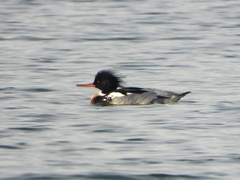
Red-breasted Merganser

Red-breasted Merganser

Mergus serrator

Silhouette: Sheatherius · PhyloPic

LCLeast ConcernNTVUENCR
Daily sighting probability <5% · Rare
at Liverpool

In 3 days ~10% in a week ~30%

160 Verified sightings at Liverpool
15,805 In all 34 parks From 2019 to 2026
December Best month
☀️ Diurnal When it's spotted

About the Red-breasted Merganser

The red-breasted merganser (Mergus serrator) is a duck species that is native to much of the temperate to subarctic Northern Hemisphere. The red breast that gives the species its common name is only displayed by males in breeding plumage. Individuals fly rapidly, and feed by diving from the surface to pursue aquatic animals underwater, using serrated bills to capture slippery fish. They migrate each year from breeding sites on lakes and rivers to their mostly coastal wintering areas, making them the most frequent species in the genus Mergus to frequent saltwater regularly. The worldwide population of this species is stable, though it is threatened in some areas by habitat loss and other factors.

The red-breasted merganser was formally described in 1758 by the Swedish naturalist Carl Linnaeus in the tenth edition of his Systema Naturae under the current binomial name Mergus serrator. The species is monotypic; no subspecies are recognised. Birds breeding in Greenland were sometimes distinguised as a subspecies M. s. schioleri in the past on the basis of averaging very marginally larger, but this is no longer accepted as distinct.

The genus name Mergus is... Wikipedia →

Sounds

Call0:13

Netherlands · 2025

© Astrid Cervantes · XC1029233 · CC BY-NC-SA 4.0

Flight call0:10

Sweden · 2023

© Lars Edenius · XC801187 · CC BY-NC-SA 4.0

Alarm call0:15

United Kingdom · 2020

© Peter Stronach · XC553571 · CC BY-NC-SA 4.0

Global Distribution

Parks Where Found

# Park Country Daily sighting probability
1 Point Pelee National Park 🇨🇦 Canada
~50%
2 Isle Royale National Park 🇺🇸 United States
~40%
3 Katmai National Park 🇺🇸 United States
~20%
4 El Vizcaíno Biosphere Reserve 🇲🇽 Mexico
~20%
5 Acadia National Park 🇺🇸 United States
~20%
6 Great Bear Rainforest 🇨🇦 Canada
~20%
7 Padre Island National Seashore 🇺🇸 United States
~10%
8 Pacific Rim National Park Reserve 🇨🇦 Canada
~10%
9 Wadden Sea National Park 🇩🇪 Germany
~10%
10 Cape Breton Highlands National Park 🇨🇦 Canada
~10%
11 Snowdonia National Park 🇬🇧 United Kingdom
~10%
12 Channel Islands National Park 🇺🇸 United States
~10%
13 Vatnajokull National Park 🇮🇸 Iceland
~10%
14 Kluane National Park 🇨🇦 Canada
~10%
15 Redwood National Park 🇺🇸 United States
~10%
16 Merritt Island National Wildlife Refuge 🇺🇸 United States
~10%
17 Gros Morne National Park 🇨🇦 Canada
~10%
18 Kenai Fjords National Park 🇺🇸 United States
~10%
19 Olympic National Park 🇺🇸 United States
<5%
20 Camargue 🇫🇷 France
<5%
21 Voyageurs National Park 🇺🇸 United States
<5%
22 Ría Lagartos Biosphere Reserve 🇲🇽 Mexico
<5%
23 Death Valley National Park 🇺🇸 United States
<5%
24 Everglades National Park 🇺🇸 United States
<5%
25 Ciénaga de Zapata 🇨🇺 Cuba
<5%
26 Kiskunság National Park 🇭🇺 Hungary
<5%
27 Cairngorms National Park 🇬🇧 United Kingdom
<5%
28 Denali National Park 🇺🇸 United States
<5%
29 Celestún Biosphere Reserve 🇲🇽 Mexico
<5%
30 Shenandoah National Park 🇺🇸 United States
<5%
31 Yellowstone National Park 🇺🇸 United States
<5%
32 Banff National Park 🇨🇦 Canada
<5%
33 Grand Teton National Park 🇺🇸 United States
<5%
34 Rocky Mountain National Park 🇺🇸 United States
<5%

Cities Where Found

# City Country Daily sighting probability
1 Sendai 🇯🇵 Japan
~20%
2 Toronto 🇨🇦 Canada
~20%
3 Dalian 🇨🇳 China
~20%
4 Chicago 🇺🇸 United States
~20%
5 Boston 🇺🇸 United States
~10%
6 San Diego 🇺🇸 United States
~10%
7 Busan 🇰🇷 South Korea
~10%
8 Kitakyushu 🇯🇵 Japan
~10%
9 Helsinki 🇫🇮 Finland
~10%
10 Dublin 🇮🇪 Ireland
~10%

Zoos & Centres Where Found

# Zoo / Centre Country
1 Prague Zoo 🇨🇿 Czechia In captivity
2 Tierpark Berlin 🇩🇪 Germany In captivity
3 Slimbridge Wetland Centre 🇬🇧 United Kingdom In captivity
4 Fort Worth Zoo 🇺🇸 United States In captivity
5 Santillana Zoo 🇪🇸 Spain In captivity
6 Alpenzoo Innsbruck 🇦🇹 Austria In captivity
7 Rákosův pavilon 🇨🇿 Czechia In captivity
8 Velemlokárium 🇨🇿 Czechia In captivity
9 akwarium warszawskiego ZOO 🇵🇱 Poland In captivity

Before you go

What are the chances of seeing a Red-breasted Merganser in Liverpool?

Rare

Under 5% of wildlife watchers report a Red-breasted Merganser sighting in Liverpool on a given day, based on 160 verified sightings from GBIF citizen-science data. It is the 100th most-seen of the 168 birds we can rate there. Over three days the chance rises to about 10%, and over a week to about 30%, if each day is a fresh chance.

When is the best time to see a Red-breasted Merganser in Liverpool?

December

In that month about 20% of wildlife watchers report a Red-breasted Merganser in Liverpool on a given day, against under 5% in April to October, the lowest months.

What time of day is best to see a Red-breasted Merganser?

Between 10 am and 1 pm

Across all the parks we cover, that three-hour window holds the most Red-breasted Merganser sightings with a recorded time, and about 9 in 10 of them come between 6 am and 6 pm: it is a daytime animal.

Is Liverpool the best place to see a Red-breasted Merganser?

16th of 57

Of the 57 cities where we can rate Red-breasted Merganser sightings, Liverpool ranks 16th at under 5%. The best odds are in Sendai (Japan, about 20%), Toronto (Canada, about 20%) and Dalian (China, about 20%).

Where does the Red-breasted Merganser sighting chance come from?

GBIF citizen-science records

It is estimated from how often the Red-breasted Merganser is recorded against all the birds logged in Liverpool (160 verified sightings), calibrated against known sighting rates. Figures are rounded to the nearest 10% because citizen-science data supports honest approximations, not decimals, and months with records from fewer than five people show "—". How it works.

← Back to Liverpool