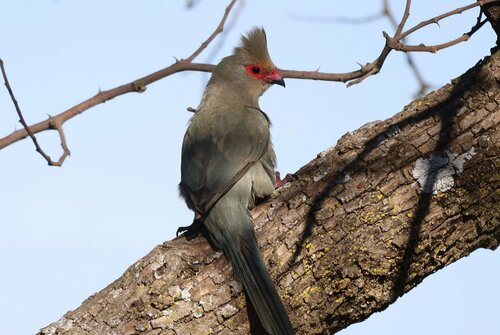
Emerald-spotted Wood-Dove

Emerald-spotted Wood-Dove

Turtur chalcospilos

Silhouette: Sheatherius · PhyloPic

LCLeast ConcernNTVUENCR
Daily sighting probability ~10% · With luck
at Lusaka

In 3 days ~20% in a week ~40%

17 Verified sightings at Lusaka
15,483 In all 43 parks From 2019 to 2026
January Best month
☀️ Diurnal When it's spotted

About the Emerald-spotted Wood-Dove

The emerald-spotted wood dove or emerald-spotted dove (Turtur chalcospilos) is a bird of the family Columbidae, resident across eastern and southern Africa. It is a species of open drier deciduous woodland and second growth. It is absent from evergreen rainforests and semidesert areas.

The emerald-spotted wood dove is a small plump pigeon, typically 20 cm in length. Its back, hindneck, wings, and tail are pale grey-brown, and the folded wings have green metallic patches. There are blackish bands on the lower back and tail. The forehead, crown, and nape are bluish-grey, fading to pinkish-grey on the throat. The underparts are mauve-pink, becoming whiter on the belly.

The bill of this dove is blackish with a red base. The sexes are similar, but the female may be slightly duller than the male. The immature has duller green spots and buff fringes to the feathers. When flying, the black-billed wood dove is told from this species by its bright chestnut underwings.

The call is in three parts: two soft long coos, followed by a series of slow descending coos lasting 10 seconds, and concluding with 4 seconds of rapid coos, which decrease in volume. This species shows some... Wikipedia →

Sounds

Song0:16

Botswana · 2023

© Marc Anderson · XC1004812 · CC BY-NC-ND 4.0

Call0:36

Kenya · 2017

© James Bradley · XC396568 · CC BY-NC-SA 4.0

Song0:54

Kenya · 2024

© Peter Boesman · XC948548 · CC BY-NC-ND 4.0

Global Distribution

Parks Where Found

# Park Country Daily sighting probability
1 uMkhuze Game Reserve 🇿🇦 South Africa
~80%
2 Gonarezhou National Park 🇿🇼 Zimbabwe
~80%
3 Mana Pools National Park 🇿🇼 Zimbabwe
~70%
4 Lower Zambezi National Park 🇿🇲 Zambia
~70%
5 Hluhluwe-Imfolozi Park 🇿🇦 South Africa
~60%
6 South Luangwa National Park 🇿🇲 Zambia
~60%
7 Meru National Park 🇰🇪 Kenya
~60%
8 Tsavo West National Park 🇰🇪 Kenya
~60%
9 Ruaha National Park 🇹🇿 Tanzania
~60%
10 Kafue National Park 🇿🇲 Zambia
~60%
11 Akagera National Park 🇷🇼 Rwanda
~60%
12 Lake Mburo National Park 🇺🇬 Uganda
~60%
13 Mkomazi National Park 🇹🇿 Tanzania
~50%
14 Lake Manyara National Park 🇹🇿 Tanzania
~50%
15 Gorongosa National Park 🇲🇿 Mozambique
~50%
16 Kruger National Park 🇿🇦 South Africa
~50%
17 Liwonde National Park 🇲🇼 Malawi
~50%
18 Samburu National Reserve 🇰🇪 Kenya
~40%
19 Nairobi National Park 🇰🇪 Kenya
~40%
20 Tsavo East National Park 🇰🇪 Kenya
~40%
21 Moremi Game Reserve 🇧🇼 Botswana
~40%
22 Tarangire National Park 🇹🇿 Tanzania
~30%
23 Hwange National Park 🇿🇼 Zimbabwe
~30%
24 Mikumi National Park 🇹🇿 Tanzania
~30%
25 Chobe National Park 🇧🇼 Botswana
~30%
26 Masai Mara National Reserve 🇰🇪 Kenya
~20%
27 iSimangaliso Wetland Park 🇿🇦 South Africa
~20%
28 Etosha National Park 🇳🇦 Namibia
~20%
29 Arusha National Park 🇹🇿 Tanzania
~20%
30 Addo Elephant National Park 🇿🇦 South Africa
~20%
31 Lake Nakuru National Park 🇰🇪 Kenya
~20%
32 Serengeti National Park 🇹🇿 Tanzania
~10%
33 Kidepo Valley National Park 🇺🇬 Uganda
~10%
34 Waterberg Plateau Park 🇳🇦 Namibia
~10%
35 Awash National Park 🇪🇹 Ethiopia
~10%
36 Amboseli National Park 🇰🇪 Kenya
~10%
37 Ngorongoro Conservation Area 🇹🇿 Tanzania
~10%
38 Aberdare National Park 🇰🇪 Kenya
<5%
39 Virunga National Park 🇨🇩 Democratic Republic of the Congo
<5%
40 Murchison Falls National Park 🇺🇬 Uganda
<5%
41 Pilanesberg National Park 🇿🇦 South Africa
<5%
42 Queen Elizabeth National Park 🇺🇬 Uganda
<5%
43 Bwindi Impenetrable National Park 🇺🇬 Uganda
<5%

Cities Where Found

# City Country Daily sighting probability
1 Mombasa 🇰🇪 Kenya
~60%
2 Dar es-Salaam 🇹🇿 Tanzania
~20%
3 Lusaka 🇿🇲 Zambia
~10%
4 Kigali 🇷🇼 Rwanda
<5%
5 Nairobi 🇰🇪 Kenya
<5%
6 Harare 🇿🇼 Zimbabwe
<5%

Zoos & Centres Where Found

# Zoo / Centre Country
1 San Diego Zoo 🇺🇸 United States In captivity

Before you go

What are the chances of seeing an Emerald-spotted Wood-Dove in Lusaka?

With luck

About 10% of wildlife watchers report an Emerald-spotted Wood-Dove sighting in Lusaka on a given day, based on 17 verified sightings from GBIF citizen-science data. It is the 52nd most-seen of the 87 birds we can rate there. Over three days the chance rises to about 20%, and over a week to about 40%, if each day is a fresh chance.

When is the best time to see an Emerald-spotted Wood-Dove in Lusaka?

January

In that month about 20% of wildlife watchers report an Emerald-spotted Wood-Dove in Lusaka on a given day, against under 5% in April–May, September and November–December, the lowest months. That is one of Lusaka's wettest months, with about 210 mm of rain against almost none in August.

What time of day is best to see an Emerald-spotted Wood-Dove?

Between 8 and 11 am

Across all the parks we cover, that three-hour window holds the most Emerald-spotted Wood-Dove sightings with a recorded time, and about 9 in 10 of them come between 6 am and 6 pm: it is a daytime animal.

Is Lusaka the best place to see an Emerald-spotted Wood-Dove?

3rd of 6

Of the 6 cities where we can rate Emerald-spotted Wood-Dove sightings, Lusaka ranks 3rd at about 10%. The best odds are in Mombasa (Kenya, about 60%) and Dar es-Salaam (Tanzania, about 20%).

Which relatives of the Emerald-spotted Wood-Dove live in Lusaka?

Same family: Columbidae

The closest relatives of the Emerald-spotted Wood-Dove that you can see in Lusaka (family Columbidae, Pigeons and Doves) are Red-eyed Dove (about 80%), Cape Turtle Dove (about 30%) and Laughing Dove (about 20%), with each one's daily chance of a sighting.

Where does the Emerald-spotted Wood-Dove sighting chance come from?

GBIF citizen-science records

It is estimated from how often the Emerald-spotted Wood-Dove is recorded against all the birds logged in Lusaka (17 verified sightings), calibrated against known sighting rates. Figures are rounded to the nearest 10% because citizen-science data supports honest approximations, not decimals, and months with records from fewer than five people show "—". How it works.

← Back to Lusaka