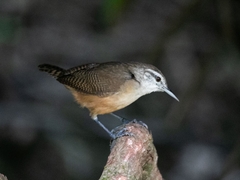
Buff-breasted Wren

Buff-breasted Wren

Cantorchilus leucotis

Silhouette: Matt Wilkins · PhyloPic

LCLeast ConcernNTVUENCR
Daily sighting probability ~10% · With luck
at Manaus

In 3 days ~30% in a week ~50%

50 Verified sightings at Manaus
4,643 In all 16 parks From 2019 to 2026
May Best month
☀️ Diurnal When it's spotted

About the Buff-breasted Wren

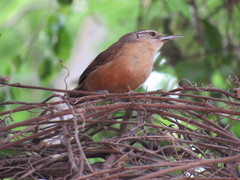
The buff-breasted wren (Cantorchilus leucotis) is a species of bird in the family Troglodytidae. It is found in the Amazon Basin of northern Brazil and Amazonian Colombia, Ecuador, Peru and northern-border Bolivia, and also the Guianan countries of Guyana, Suriname, and French Guiana. It occurs in non-Amazonian regions of Venezuela and Colombia and its range extends into eastern Panama.

As the buff-breasted wren is understood in 2021, it has 11 subspecies. However, there are suggestions that some of them might not be valid, that some might be separate species, and on a larger scale, that the taxonomy of the entire genus Cantorchilus has not been completely resolved.

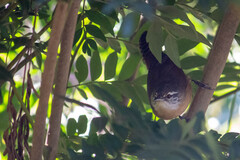
Male buff-breasted wrens weigh 18.5 to 22.8 g (0.65 to 0.80 oz) and females are lighter at 16.0 to 19.5 g (0.56 to 0.69 oz), but the sexes are otherwise similar. There is considerable variation in plumage across the species' wide range. Adults' head, nape, shoulders, tail, and back are rufescent to grayish brown; the tail is heavily barred. The throat, supercilium, and the rest of the face range from whitish through gray to gray-brown. The chest is buffy and the belly more... Wikipedia →

Sounds

Call0:27

Brazil · 2026

© JAYRSON ARAUJO DE OLIVEIRA · XC1186261 · CC BY-NC-SA 4.0

Song0:45

French Guiana · 2024

© Tristan Guillebot de Nerville · XC1147163 · CC BY-NC-SA 4.0

Alarm call0:26

Brazil · 2025

© Robson Silva e Silva · XC1018879 · CC BY-NC-SA 4.0

Global Distribution

Parks Where Found

# Park Country Daily sighting probability
1 Tayrona National Natural Park 🇨🇴 Colombia
~50%
2 Soberanía National Park 🇵🇦 Panama
~20%
3 Anavilhanas National Park 🇧🇷 Brazil
~20%
4 Amacayacu National Natural Park 🇨🇴 Colombia
~20%
5 Parque Estadual Encontro das Águas 🇧🇷 Brazil
~20%
6 San Lorenzo Protected Forest 🇵🇦 Panama
~10%
7 Tambopata National Reserve 🇵🇪 Peru
~10%
8 Sierra de la Macarena National Park 🇨🇴 Colombia
~10%
9 Manu National Park 🇵🇪 Peru
<5%
10 Henri Pittier National Park 🇻🇪 Venezuela
<5%
11 Parque Natural Metropolitano 🇵🇦 Panama
<5%
12 Chapada dos Guimarães National Park 🇧🇷 Brazil
<5%
13 Darién National Park 🇵🇦 Panama
<5%
14 Chagres National Park 🇵🇦 Panama
<5%
15 Cuyabeno Wildlife Reserve 🇪🇨 Ecuador
<5%
16 Yasuní National Park 🇪🇨 Ecuador
<5%

Cities Where Found

# City Country Daily sighting probability
1 Goiânia 🇧🇷 Brazil
~40%
2 Manaus 🇧🇷 Brazil
~10%
3 Campo Grande 🇧🇷 Brazil
~10%
4 Brasilia 🇧🇷 Brazil
<5%
5 Valencia 🇻🇪 Venezuela
<5%
6 Panama City 🇵🇦 Panama
<5%
7 Caracas 🇻🇪 Venezuela
<5%

Before you go

What are the chances of seeing a Buff-breasted Wren in Manaus?

With luck

About 10% of wildlife watchers report a Buff-breasted Wren sighting in Manaus on a given day, based on 50 verified sightings from GBIF citizen-science data. It is the 37th most-seen of the 116 birds we can rate there. Over three days the chance rises to about 30%, and over a week to about 50%, if each day is a fresh chance.

When is the best time to see a Buff-breasted Wren in Manaus?

January and May

In those months about 20% of wildlife watchers report a Buff-breasted Wren in Manaus on a given day, against under 5% in August–September and December, the lowest months.

What time of day is best to see a Buff-breasted Wren?

Between 7 and 10 am

Across all the parks we cover, that three-hour window holds the most Buff-breasted Wren sightings with a recorded time, and about 8 in 10 of them come between 6 am and 6 pm: it is a daytime animal.

Is Manaus the best place to see a Buff-breasted Wren?

2nd of 7

Of the 7 cities where we can rate Buff-breasted Wren sightings, Manaus ranks 2nd at about 10%. The best odds are in Goiânia (Brazil, about 40%).

Where does the Buff-breasted Wren sighting chance come from?

GBIF citizen-science records

It is estimated from how often the Buff-breasted Wren is recorded against all the birds logged in Manaus (50 verified sightings), calibrated against known sighting rates. Figures are rounded to the nearest 10% because citizen-science data supports honest approximations, not decimals, and months with records from fewer than five people show "—". How it works.

← Back to Manaus