Orange-headed Thrush

Orange-headed Thrush

Geokichla citrina

Silhouette: Francesco "Architetto" Rollandin · PhyloPic

LCLeast ConcernNTVUENCR
Daily sighting probability <5% · Rare
at New Delhi

In 3 days <5%

28 Verified sightings at New Delhi
3,521 In all 26 parks From 2019 to 2026
February Best month
🌅 Crepuscular When it's spotted

About the Orange-headed Thrush

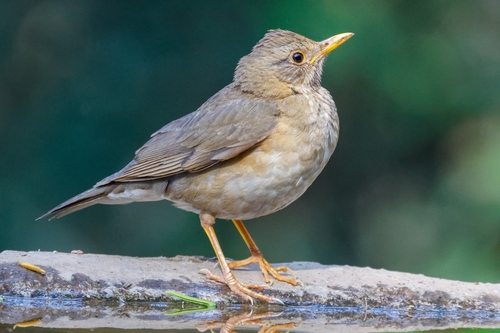
The orange-headed thrush (Geokichla citrina) is a bird in the thrush family. It is common in well-wooded areas of the Indian subcontinent and Southeast Asia. Most populations are resident. The species shows a preference for shady damp areas, and like many Geokichla and Zoothera thrushes, can be quite secretive.

The orange-headed thrush is omnivorous, eating a wide range of insects, earthworms and fruit. It nests in trees but does not form flocks. The male of this small thrush has uniform grey upperparts, and an orange head and underparts. The females and young birds have browner upper parts.

This species was first described by John Latham in 1790 as Turdus citrinus, the species name meaning "citrine" and referencing the colour of the head and underparts. It has about 12 subspecies. Rasmussen and Anderton (2005) suggest that this complex may consist of more than one species.

G. c. citrina, the nominate subspecies breeds from northern India east along the Himalayas to eastern Bangladesh and possibly in western and northern Burma. It winters further south in India, Sri Lanka and Bangladesh. G. c. cyanota is mainly resident in Peninsular India south to Kerala. It has a... Wikipedia →

Sounds

Recording0:36

India · 2023

© Afsar Nayakkan · iNaturalist · CC BY 4.0

Recording0:40

India · 2022

© Aaditya S Rajesh 🐯🐾🐾🦅:D:D · iNaturalist · CC BY-NC 4.0

Recording0:53

India · 2025

© Sabrina Pacheco · iNaturalist · CC BY-NC 4.0

Global Distribution

Parks Where Found

# Park Country Daily sighting probability
1 Cuc Phuong National Park 🇻🇳 Vietnam
~30%
2 Cat Tien National Park 🇻🇳 Vietnam
~20%
3 Bandhavgarh National Park 🇮🇳 India
~20%
4 Periyar National Park 🇮🇳 India
~20%
5 Kanha National Park 🇮🇳 India
~10%
6 Nagarhole National Park 🇮🇳 India
~10%
7 Keoladeo National Park 🇮🇳 India
~10%
8 Khao Sok National Park 🇹🇭 Thailand
~10%
9 Khao Luang National Park 🇹🇭 Thailand
~10%
10 Minneriya National Park 🇱🇰 Sri Lanka
~10%
11 Mudumalai National Park 🇮🇳 India
~10%
12 Jim Corbett National Park 🇮🇳 India
~10%
13 Satpura National Park 🇮🇳 India
~10%
14 Manas National Park 🇮🇳 India
~10%
15 Wilpattu National Park 🇱🇰 Sri Lanka
~10%
16 Kaeng Krachan National Park 🇹🇭 Thailand
~10%
17 Royal Bardia National Park 🇳🇵 Nepal
<5%
18 Khao Yai National Park 🇹🇭 Thailand
<5%
19 Royal Manas National Park 🇧🇹 Bhutan
<5%
20 Bandipur National Park 🇮🇳 India
<5%
21 Chitwan National Park 🇳🇵 Nepal
<5%
22 Kinabalu Park 🇲🇾 Malaysia
<5%
23 Kaziranga National Park 🇮🇳 India
<5%
24 Yala National Park 🇱🇰 Sri Lanka
<5%
25 Sundarbans National Park 🇮🇳 India
<5%
26 Doi Inthanon National Park 🇹🇭 Thailand
<5%

Cities Where Found

# City Country Daily sighting probability
1 Jabalpur 🇮🇳 India
~40%
2 Savar 🇧🇩 Bangladesh
~20%
3 Nagpur 🇮🇳 India
~20%
4 Dhaka 🇧🇩 Bangladesh
~10%
5 Thrissur 🇮🇳 India
~10%
6 Hefei 🇨🇳 China
~10%
7 Kolkata 🇮🇳 India
~10%
8 Dehradun 🇮🇳 India
~10%
9 Tamluk 🇮🇳 India
~10%
10 Mumbai 🇮🇳 India
~10%

Zoos & Centres Where Found

# Zoo / Centre Country
1 Prague Zoo 🇨🇿 Czechia In captivity
2 Berlin Zoological Garden 🇩🇪 Germany In captivity
3 London Zoo 🇬🇧 United Kingdom In captivity
4 Birdworld 🇬🇧 United Kingdom In captivity
5 Hong Kong Zoological and Botanical Gardens 🇨🇳 China In captivity
6 Edward Youde Aviary 🇭🇰 Hong Kong SAR China In captivity
7 Aquarium Berlin 🇩🇪 Germany In captivity
8 Rákosův pavilon 🇨🇿 Czechia In captivity
9 Velemlokárium 🇨🇿 Czechia In captivity

Before you go

What are the chances of seeing an Orange-headed Thrush in New Delhi?

Rare

Under 5% of wildlife watchers report an Orange-headed Thrush sighting in New Delhi on a given day, based on 28 verified sightings from GBIF citizen-science data. It is the 187th most-seen of the 248 birds we can rate there. Over three days the chance rises to under 5%, if each day is a fresh chance.

When is the best time to see an Orange-headed Thrush in New Delhi?

Any time of year

In every month with enough records, under 5% of wildlife watchers report an Orange-headed Thrush in New Delhi on a given day, so our monthly data shows no clear season.

What time of day is best to see an Orange-headed Thrush?

Between 3 and 6 am

Across all the parks we cover, that three-hour window holds the most Orange-headed Thrush sightings with a recorded time, and about 6 in 10 of them come between 6 am and 6 pm: it is most active around dawn and dusk.

Is New Delhi the best place to see an Orange-headed Thrush?

30th of 32

Of the 32 cities where we can rate Orange-headed Thrush sightings, New Delhi ranks 30th at under 5%. The best odds are in Jabalpur (India, about 40%), Savar (Bangladesh, about 20%) and Nagpur (India, about 20%).

Where does the Orange-headed Thrush sighting chance come from?

GBIF citizen-science records

It is estimated from how often the Orange-headed Thrush is recorded against all the birds logged in New Delhi (28 verified sightings), calibrated against known sighting rates. Figures are rounded to the nearest 10% because citizen-science data supports honest approximations, not decimals, and months with records from fewer than five people show "—". How it works.

← Back to New Delhi