Yellow-tailed Oriole

Yellow-tailed Oriole

Icterus mesomelas

Silhouette: Matt Wilkins · PhyloPic

LCLeast ConcernNTVUENCR
Daily sighting probability ~20% · Possible
at Cockscomb Basin Wildlife Sanctuary

In 3 days ~50% in a week ~80%

229 Verified sightings at Cockscomb Basin Wildlife Sanctuary From 2019 to 2026
2,691 In all 16 parks
February Best month
☀️ Diurnal When it's spotted

About the Yellow-tailed Oriole

The yellow-tailed oriole (Icterus mesomelas) is a passerine bird in the New World family Icteridae. It breeds from southern Mexico to western Peru and northwestern Venezuela; in Peru it also lives in a river valley corridor.

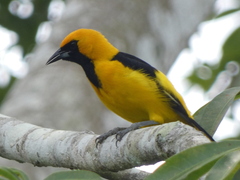
The yellow-tailed oriole is 22–23 cm (8.7–9.1 in) long and weighs 70 g (2.5 oz). It is mainly yellow with a black back, lower face and upper breast. The wings are black with yellow epaulets. The tail, seen from above, is black with yellow margins; from below, it appears almost entirely yellow. This is the only oriole with prominent yellow in the tail, hence the species' name. The sexes are similar, but young birds have the black on the back and tail replaced with olive-green.

There are four subspecies: Icterus mesomelas mesomelas – (Wagler, 1829): nominate, found from Mexico to Honduras, has yellow fringes to the tertials Icterus mesomelas salvinii – Cassin, 1867: found in the Caribbean lowlands of Nicaragua and Costa Rica, has no yellow fringes to the tertials and is more orange than the nominate race

Icterus mesomelas carrikeri – Todd, 1917: found in Panama, Colombia and northwestern Venezuela, is like salvinii, but less orange and smaller-billed Icterus mesomelas taczanowskiis – Ridgway, 1901: found in Pacific South America from Ecuador to western Peru, has white fringes to the tertials

The calls of this species include a chick and a weechaw. The song is a melodic repetition of rich whistles, chuck, chuck-yeeaow. It is often given as a duet, with the female's response following or overlapping the male's longer phrases.

This large oriole inhabits dense thickets, often with vines, Heliconias and similar dense growths, in swampy lowlands. The birds forage in pairs or small groups in denser vegetation than most orioles, mainly feeding on insects, although they will also take nectar and certain fruits such as gumbo-limbo (Bursera simaruba).

It builds a deep but thin cup nest 2 m (6.6 ft) high in a thorny scrub by a stream. It lays three dark-blotched white eggs, which hatch in 13 days with a further 14 days to fledging. The yellow-tailed oriole is fairly common except in Peru and Venezuela, but is reducing in numbers in parts of its range because of persecution by the cage-bird trade; this species is valued for both its appearance and its beautiful song. Wikipedia →

Sounds

Call0:23

Ecuador · 2025

© Manuel Sánchez-Nivicela · XC1180080 · CC BY-NC-ND 4.0

Song0:07

Mexico · 2023

© Manuel Grosselet · XC782897 · CC BY-NC-SA 4.0

Duet0:35

Ecuador · 2002

© John V. Moore · XC260044 · CC BY-NC-SA 4.0

Global Distribution

Parks Where Found

# Park Country Daily sighting probability
1 Cockscomb Basin Wildlife Sanctuary 🇧🇿 Belize
~20%
2 Soberanía National Park 🇵🇦 Panama
~20%
3 Montes Azules Biosphere Reserve 🇲🇽 Mexico
~20%
4 Machalilla National Park 🇪🇨 Ecuador
~10%
5 Calakmul Biosphere Reserve 🇲🇽 Mexico
~10%
6 Ría Lagartos Biosphere Reserve 🇲🇽 Mexico
<5%
7 Sian Ka'an Biosphere Reserve 🇲🇽 Mexico
<5%
8 Celestún Biosphere Reserve 🇲🇽 Mexico
<5%
9 Bastimentos Island National Marine Park 🇵🇦 Panama
<5%
10 Darién National Park 🇵🇦 Panama
<5%
11 Tayrona National Natural Park 🇨🇴 Colombia
<5%
12 La Amistad International Park (Panama) 🇵🇦 Panama
<5%
13 Tikal National Park 🇬🇹 Guatemala
<5%
14 Parque Natural Metropolitano 🇵🇦 Panama
<5%
15 Podocarpus National Park 🇪🇨 Ecuador
<5%
16 Gandoca-Manzanillo Wildlife Refuge 🇨🇷 Costa Rica
<5%

Cities Where Found

# City Country Daily sighting probability
1 Guayaquil 🇪🇨 Ecuador
<5%
2 Medellín 🇨🇴 Colombia
<5%

Zoos & Centres Where Found

# Zoo / Centre Country
1 Xcaret 🇲🇽 Mexico In captivity

Before you go

What are the chances of seeing a Yellow-tailed Oriole in Cockscomb Basin Wildlife Sanctuary?

Possible

About 20% of wildlife watchers report a Yellow-tailed Oriole sighting in Cockscomb Basin Wildlife Sanctuary on a given day, based on 229 verified sightings from GBIF citizen-science data from 2019 to 2026. It is the 80th most-seen of the 277 birds we can rate there. Over three days the chance rises to about 50%, and over a week to about 80%, if each day is a fresh chance.

When is the best time to see a Yellow-tailed Oriole in Cockscomb Basin Wildlife Sanctuary?

February and April–May

In those months about 30% of wildlife watchers report a Yellow-tailed Oriole in Cockscomb Basin Wildlife Sanctuary on a given day, against about 10% in August–September and November–December, the lowest months.

What time of day is best to see a Yellow-tailed Oriole?

Between 7 and 10 am

Across all the parks we cover, that three-hour window holds the most Yellow-tailed Oriole sightings with a recorded time, and about 9 in 10 of them come between 6 am and 6 pm: it is a daytime animal.

Is Cockscomb Basin Wildlife Sanctuary the best place to see a Yellow-tailed Oriole?

Yes

Of the 16 parks where we can rate Yellow-tailed Oriole sightings, Cockscomb Basin Wildlife Sanctuary has the highest daily chance: about 20%. Next come Soberanía National Park (Panama, about 20%) and Montes Azules Biosphere Reserve (Mexico, about 20%).

Which relatives of the Yellow-tailed Oriole live in Cockscomb Basin Wildlife Sanctuary?

Same genus: Icterus

The closest relatives of the Yellow-tailed Oriole that you can see in Cockscomb Basin Wildlife Sanctuary (genus Icterus, New World Orioles) are Black-cowled Oriole (about 30%) and Baltimore Oriole (about 20%), with each one's daily chance of a sighting.

Where does the Yellow-tailed Oriole sighting chance come from?

GBIF citizen-science records

It is estimated from how often the Yellow-tailed Oriole is recorded against all the birds logged in Cockscomb Basin Wildlife Sanctuary (229 verified sightings from 2019 to 2026), calibrated against known sighting rates. Figures are rounded to the nearest 10% because citizen-science data supports honest approximations, not decimals, and months with records from fewer than five people show "—". How it works.

← Back to Cockscomb Basin Wildlife Sanctuary