Black-headed Trogon

Black-headed Trogon

Trogon melanocephalus

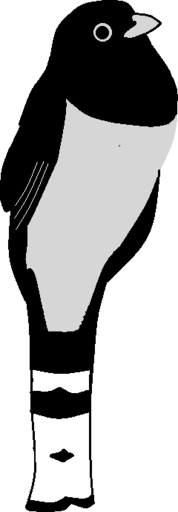
Silhouette: Edwin Price · PhyloPic

LCLeast ConcernNTVUENCR
Daily sighting probability <5% · Rare
at Arrecifes de Cozumel National Park

In 3 days ~10%

34 Verified sightings at Arrecifes de Cozumel National Park From 2019 to 2026
9,317 In all 23 parks
June Best month
☀️ Diurnal When it's spotted

About the Black-headed Trogon

The black-headed trogon (Trogon melanocephalus) is a species of bird in the family Trogonidae. It is found in Belize, Costa Rica, El Salvador, Guatemala, Honduras, Mexico, and Nicaragua. The black-headed trogon is treated as monotypic by the International Ornithological Committee and BirdLife International's Handbook of the Birds of the World.

This article follows the monotypic model. The black-headed trogon is 27 to 28 cm (11 to 11 in) long and weighs about 74 to 95 g (2.6 to 3.4 oz). Adults of both sexes have slate-black to black head, neck, and chest. A sky-blue ring of bare skin surrounds the dark eye. A thin white line separates the chest from the rest of their underparts, which are cadmium to chrome yellow that becomes lighter at the vent area. The two inner pairs of tail feathers are metallic bronze breen to bluish green with black tips. The next pair are all black and the outermost three pairs are black with wide white tips. Their wings are slate black with some white. Adult males' upperparts are bright metallic... Wikipedia →

Sounds

Call1:10

Mexico · 2025

© Homero Bennet · XC982615 · CC BY-NC-SA 4.0

Song0:27

Belize · 2019

© Paul Driver · XC522429 · CC BY-NC-SA 4.0

Song0:57

Costa Rica · 2019

© GABRIEL LEITE · XC489571 · CC BY-NC-SA 4.0

Global Distribution

Parks Where Found

# Park Country Daily sighting probability
1 Cockscomb Basin Wildlife Sanctuary 🇧🇿 Belize
~60%
2 Calakmul Biosphere Reserve 🇲🇽 Mexico
~50%
3 Ostional Wildlife Refuge 🇨🇷 Costa Rica
~50%
4 Tikal National Park 🇬🇹 Guatemala
~50%
5 Cabo Blanco Absolute Nature Reserve 🇨🇷 Costa Rica
~50%
6 Sian Ka'an Biosphere Reserve 🇲🇽 Mexico
~50%
7 Santa Rosa National Park 🇨🇷 Costa Rica
~50%
8 Pico Bonito National Park 🇭🇳 Honduras
~40%
9 Las Baulas Marine National Park 🇨🇷 Costa Rica
~40%
10 Palo Verde National Park 🇨🇷 Costa Rica
~30%
11 Montes Azules Biosphere Reserve 🇲🇽 Mexico
~30%
12 Carara National Park 🇨🇷 Costa Rica
~30%
13 Rincón de la Vieja National Park 🇨🇷 Costa Rica
~20%
14 Biotopo Cerro Cahuí 🇬🇹 Guatemala
~20%
15 Cerro Azul Meámbar National Park 🇭🇳 Honduras
~10%
16 Cusuco National Park 🇭🇳 Honduras
~10%
17 Masaya Volcano National Park 🇳🇮 Nicaragua
~10%
18 Lago de Yojoa 🇭🇳 Honduras
<5%
19 Celestún Biosphere Reserve 🇲🇽 Mexico
<5%
20 Arrecifes de Cozumel National Park 🇲🇽 Mexico
<5%
21 Tenorio Volcano National Park 🇨🇷 Costa Rica
<5%
22 Ría Lagartos Biosphere Reserve 🇲🇽 Mexico
<5%
23 Monteverde Cloud Forest Reserve 🇨🇷 Costa Rica
<5%

Cities Where Found

# City Country Daily sighting probability
1 San Pedro Sula 🇭🇳 Honduras
~10%
2 Managua 🇳🇮 Nicaragua
<5%
3 San José 🇨🇷 Costa Rica
<5%

Zoos & Centres Where Found

# Zoo / Centre Country
1 Woodland Park Zoo 🇺🇸 United States In captivity

Closest Relatives at Arrecifes de Cozumel National Park

No species of the same family or order lives in Arrecifes de Cozumel National Park, so these are its closest relatives here: other birds.

Before you go

What are the chances of seeing a Black-headed Trogon in Arrecifes de Cozumel National Park?

Rare

Under 5% of wildlife watchers report a Black-headed Trogon sighting in Arrecifes de Cozumel National Park on a given day, based on 34 verified sightings from GBIF citizen-science data from 2019 to 2026. It is the 153rd most-seen of the 205 birds we can rate there. Over three days the chance rises to about 10%, if each day is a fresh chance.

When is the best time to see a Black-headed Trogon in Arrecifes de Cozumel National Park?

June and October

In those months about 10% of wildlife watchers report a Black-headed Trogon in Arrecifes de Cozumel National Park on a given day, against under 5% in July–September and November–May, the lowest months. Those are among Arrecifes de Cozumel National Park's wettest months, with about 210 mm of rain a month against 30 mm in March.

What time of day is best to see a Black-headed Trogon?

Between 6 and 9 am

Across all the parks we cover, that three-hour window holds the most Black-headed Trogon sightings with a recorded time, and about 9 in 10 of them come between 6 am and 6 pm: it is a daytime animal.

Where does the Black-headed Trogon sighting chance come from?

GBIF citizen-science records

It is estimated from how often the Black-headed Trogon is recorded against all the birds logged in Arrecifes de Cozumel National Park (34 verified sightings from 2019 to 2026), calibrated against known sighting rates. Figures are rounded to the nearest 10% because citizen-science data supports honest approximations, not decimals, and months with records from fewer than five people show "—". How it works.

← Back to Arrecifes de Cozumel National Park