Forest Elaenia

Forest Elaenia

Myiopagis gaimardii

Silhouette: Emily Willoughby · PhyloPic

LCLeast ConcernNTVUENCR
Daily sighting probability <5% · Rare
at Cuyabeno Wildlife Reserve

In 3 days ~10% in a week ~20%

18 Verified sightings at Cuyabeno Wildlife Reserve From 2019 to 2026
5,778 In all 20 parks
December Best month
☀️🌙 Day & Night When it's spotted

About the Forest Elaenia

The forest elaenia (Myiopagis gaimardii) is a small passerine bird in the tyrant flycatcher family. It breeds from Panama through Colombia, Venezuela and the Guianas to Bolivia and Brazil. It also occurs on Trinidad. This species is found in forests and the edges of mangrove swamps. The nest is a shallow cup of roots, bark and grass built in a tree. The typical clutch is two cream-coloured eggs marked with rufous and lavender.

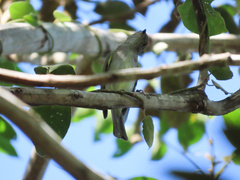
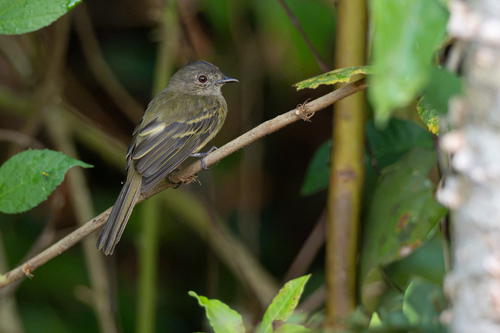
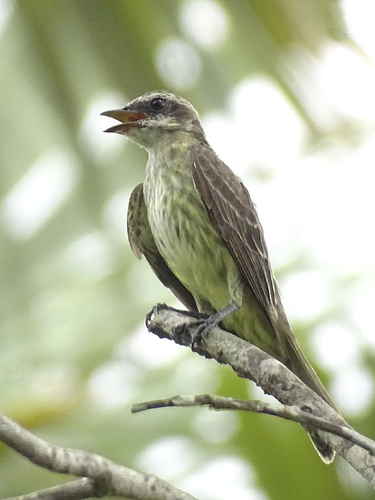
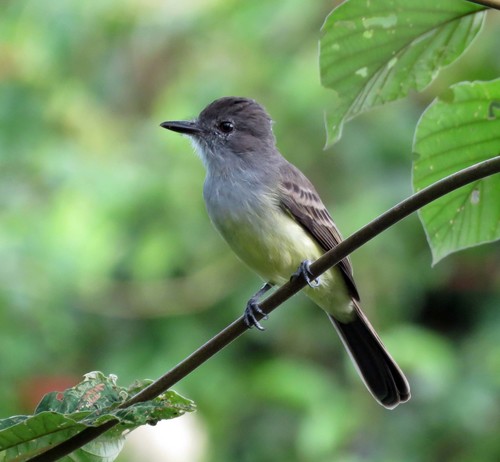
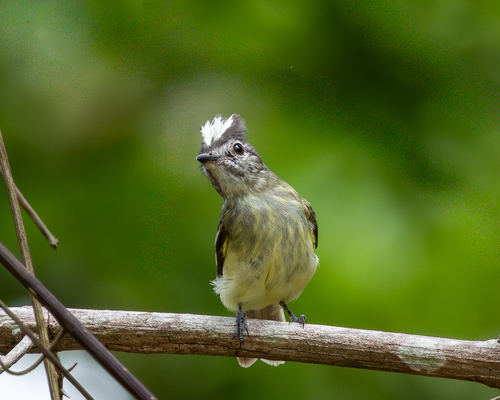
The adult forest elaenia is 12.7 cm long and weighs 12.2g. The head has a blackish crown with a partly concealed white or pale yellow central stripe, a weak whitish supercilium and white eyering. The upperparts are olive-green, and the brown wings have yellow feather edging and two yellow wing bars. The throat is whitish and the breast is greenish-yellow shading to yellow on the belly. The long narrow bill is black above and pink-based below. Sexes are similar.

M. g. trinitatis, the subspecies endemic to Trinidad, is larger and has duller upper parts than mainland forms. Forest elaenias are seen alone or in pairs, perched inconspicuously or catching insects and spiders in higher levels of the foliage. They also frequently eat berries. They... Wikipedia →
Sounds

Call0:24

French Guiana · 2024

© Tristan Guillebot de Nerville · XC1174408 · CC BY-NC-SA 4.0

Song0:05

Brazil · 2024

© JAYRSON ARAUJO DE OLIVEIRA · XC901505 · CC BY-NC-SA 4.0

Recording0:07

Bolivia · 2020

© Jacob Wijpkema · XC603627 · CC BY-NC-SA 4.0

Global Distribution

Parks Where Found

# Park Country Daily sighting probability
1 Soberanía National Park 🇵🇦 Panama
~30%
2 San Lorenzo Protected Forest 🇵🇦 Panama
~20%
3 Anavilhanas National Park 🇧🇷 Brazil
~20%
4 Chapada dos Guimarães National Park 🇧🇷 Brazil
~20%
5 Tambopata National Reserve 🇵🇪 Peru
~20%
6 Brownsberg Nature Park 🇸🇷 Suriname
~20%
7 Parque Natural Metropolitano 🇵🇦 Panama
~10%
8 Amacayacu National Natural Park 🇨🇴 Colombia
~10%
9 Sierra de la Macarena National Park 🇨🇴 Colombia
~10%
10 Henri Pittier National Park 🇻🇪 Venezuela
~10%
11 Tayrona National Natural Park 🇨🇴 Colombia
~10%
12 Manu National Park 🇵🇪 Peru
~10%
13 Emas National Park 🇧🇷 Brazil
~10%
14 Parque Estadual Encontro das Águas 🇧🇷 Brazil
~10%
15 Chagres National Park 🇵🇦 Panama
<5%
16 Darién National Park 🇵🇦 Panama
<5%
17 Yasuní National Park 🇪🇨 Ecuador
<5%
18 Cuyabeno Wildlife Reserve 🇪🇨 Ecuador
<5%
19 Amboró National Park 🇧🇴 Bolivia
<5%
20 Podocarpus National Park 🇪🇨 Ecuador
<5%

Cities Where Found

# City Country Daily sighting probability
1 Belém 🇧🇷 Brazil
<5%
2 Valencia 🇻🇪 Venezuela
<5%
3 Caracas 🇻🇪 Venezuela
<5%
4 Panama City 🇵🇦 Panama
<5%

Before you go

What are the chances of seeing a Forest Elaenia in Cuyabeno Wildlife Reserve?

Rare

Under 5% of wildlife watchers report a Forest Elaenia sighting in Cuyabeno Wildlife Reserve on a given day, based on 18 verified sightings from GBIF citizen-science data from 2019 to 2026. It is the 197th most-seen of the 328 birds we can rate there. Over three days the chance rises to about 10%, and over a week to about 20%, if each day is a fresh chance.

When is the best time to see a Forest Elaenia in Cuyabeno Wildlife Reserve?

May, September and December–January

In those months about 10% of wildlife watchers report a Forest Elaenia in Cuyabeno Wildlife Reserve on a given day, against under 5% in February–April, June–August and October–November, the lowest months.

What time of day is best to see a Forest Elaenia?

Between 10 pm and 1 am

Across all the parks we cover, that three-hour window holds the most Forest Elaenia sightings with a recorded time, and about 6 in 10 of them come between 6 pm and 6 am: it is seen both by day and at night.

Where does the Forest Elaenia sighting chance come from?

GBIF citizen-science records

It is estimated from how often the Forest Elaenia is recorded against all the birds logged in Cuyabeno Wildlife Reserve (18 verified sightings from 2019 to 2026), calibrated against known sighting rates. Figures are rounded to the nearest 10% because citizen-science data supports honest approximations, not decimals, and months with records from fewer than five people show "—". How it works.

← Back to Cuyabeno Wildlife Reserve