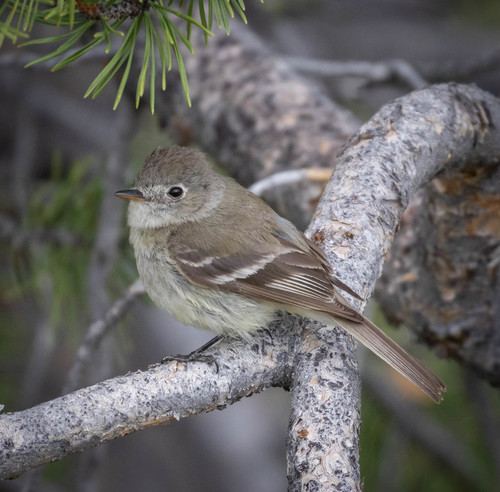
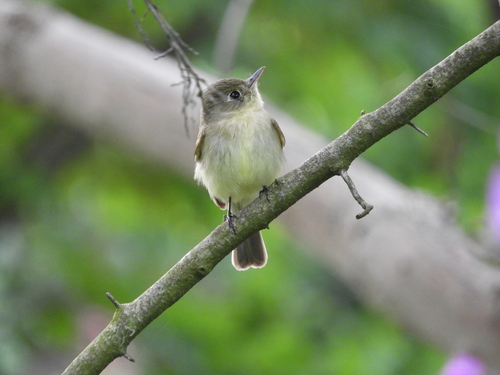
Western Kingbird

Western Kingbird

Tyrannus verticalis

Silhouette: Andy Wilson · PhyloPic

LCLeast ConcernNTVUENCR
Daily sighting probability ~10% · With luck
at Death Valley National Park

In 3 days ~30% in a week ~60%

146 Verified sightings at Death Valley National Park From 2019 to 2026
4,549 In all 36 parks
May Best month
☀️ Diurnal When it's spotted

About the Western Kingbird

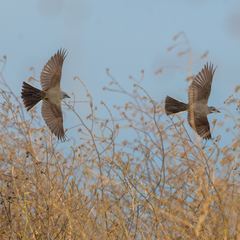
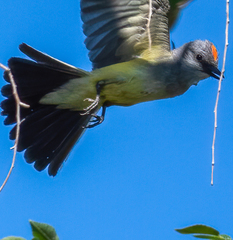
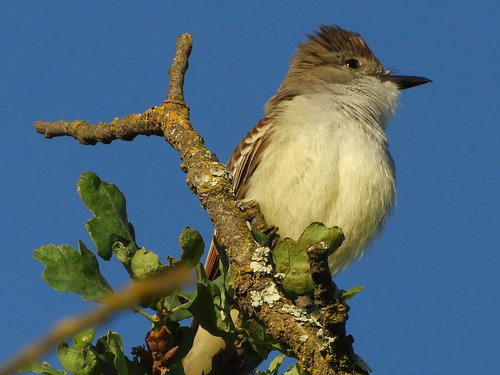
The western kingbird (Tyrannus verticalis) is a large tyrant flycatcher found throughout western North America, as far south as Mexico. Adults are a combination of both gray and yellow plumage, along with crimson feathers that are hidden until courtship or against intruders. Characteristic of kingbird species, the western kingbird is very territorial. Although the western is often misidentified as Cassin's kingbird, Couch's kingbird, or the tropical kingbird due to the yellow coloration, it can be distinguished from these other species through its black, squared tail with white edges.

The breeding habitat is open areas in western North America. The increased presence of trees throughout the Great Plains during the past century due to fire suppression and tree planting facilitated the range expansion of the western kingbird, as well as range expansions of many other species of birds.

Instances of hybridization with the closely related Eastern Kingbird (Tyrannus tyrannus) have been reported. Hybridization between the two species may become more frequent as the expanding range of the Western Kingbird increasingly... Wikipedia →

Sounds

Call0:17

United States · 2025

© Ed Pandolfino · XC989818 · CC BY-NC-SA 4.0

Song0:25

United States · 1990

© Ken Hall · XC509627 · CC BY-NC-SA 4.0

Dawn song0:25

United States · 2018

© Russ Wigh · XC415515 · CC BY-NC-SA 4.0

Global Distribution

Parks Where Found

# Park Country Daily sighting probability
1 Badlands National Park 🇺🇸 United States
~40%
2 Zion National Park 🇺🇸 United States
~20%
3 Big Bend National Park 🇺🇸 United States
~10%
4 Everglades National Park 🇺🇸 United States
~10%
5 Death Valley National Park 🇺🇸 United States
~10%
6 El Triunfo 🇲🇽 Mexico
~10%
7 Celaque National Park 🇭🇳 Honduras
~10%
8 Cañón del Sumidero National Park 🇲🇽 Mexico
~10%
9 Joshua Tree National Park 🇺🇸 United States
~10%
10 Saguaro National Park 🇺🇸 United States
~10%
11 Santa Rosa National Park 🇨🇷 Costa Rica
~10%
12 Sequoia and Kings Canyon National Parks 🇺🇸 United States
<5%
13 Ostional Wildlife Refuge 🇨🇷 Costa Rica
<5%
14 Palo Verde National Park 🇨🇷 Costa Rica
<5%
15 Las Baulas Marine National Park 🇨🇷 Costa Rica
<5%
16 Guadalupe Mountains National Park 🇺🇸 United States
<5%
17 Grand Canyon National Park 🇺🇸 United States
<5%
18 Big Cypress National Preserve 🇺🇸 United States
<5%
19 Cabo Blanco Absolute Nature Reserve 🇨🇷 Costa Rica
<5%
20 Yellowstone National Park 🇺🇸 United States
<5%
21 Redwood National Park 🇺🇸 United States
<5%
22 Riding Mountain National Park 🇨🇦 Canada
<5%
23 Yosemite National Park 🇺🇸 United States
<5%
24 Channel Islands National Park 🇺🇸 United States
<5%
25 El Vizcaíno Biosphere Reserve 🇲🇽 Mexico
<5%
26 Cumbres de Monterrey National Park 🇲🇽 Mexico
<5%
27 Rincón de la Vieja National Park 🇨🇷 Costa Rica
<5%
28 Grand Teton National Park 🇺🇸 United States
<5%
29 Rocky Mountain National Park 🇺🇸 United States
<5%
30 Carara National Park 🇨🇷 Costa Rica
<5%
31 Masaya Volcano National Park 🇳🇮 Nicaragua
<5%
32 Piedras Blancas National Park 🇨🇷 Costa Rica
<5%
33 Glacier National Park 🇺🇸 United States
<5%
34 Merritt Island National Wildlife Refuge 🇺🇸 United States
<5%
35 Monteverde Cloud Forest Reserve 🇨🇷 Costa Rica
<5%
36 Arenal Volcano National Park 🇨🇷 Costa Rica
<5%

Cities Where Found

# City Country Daily sighting probability
1 Torreón 🇲🇽 México
~20%
2 Ciudad Juárez 🇲🇽 México
~10%
3 San Antonio 🇺🇸 United States
~10%
4 Salt Lake City 🇺🇸 United States
~10%
5 Dallas 🇺🇸 United States
~10%
6 Austin 🇺🇸 United States
~10%
7 Denver 🇺🇸 United States
~10%
8 Las Vegas 🇺🇸 United States
~10%
9 Sacramento 🇺🇸 United States
~10%
10 Mesa 🇺🇸 United States
~10%

Zoos & Centres Where Found

# Zoo / Centre Country
1 Abilene Zoological Gardens 🇺🇸 United States In captivity
2 The Abilene Zoo 🇺🇸 United States In captivity

Before you go

What are the chances of seeing a Western Kingbird in Death Valley National Park?

With luck

About 10% of wildlife watchers report a Western Kingbird sighting in Death Valley National Park on a given day, based on 146 verified sightings from GBIF citizen-science data from 2019 to 2026. It is the 61st most-seen of the 213 birds we can rate there. Over three days the chance rises to about 30%, and over a week to about 60%, if each day is a fresh chance.

When is the best time to see a Western Kingbird in Death Valley National Park?

May and September

In those months about 30% of wildlife watchers report a Western Kingbird in Death Valley National Park on a given day, against under 5% in October to March, the lowest months.

What time of day is best to see a Western Kingbird?

Between 7 and 10 am

Across all the parks we cover, that three-hour window holds the most Western Kingbird sightings with a recorded time, and about 9 in 10 of them come between 6 am and 6 pm: it is a daytime animal.

Is Death Valley National Park the best place to see a Western Kingbird?

5th of 36

Of the 36 parks where we can rate Western Kingbird sightings, Death Valley National Park ranks 5th at about 10%. The best odds are in Badlands National Park (United States, about 40%), Zion National Park (United States, about 20%) and Big Bend National Park (United States, about 10%).

Which relatives of the Western Kingbird live in Death Valley National Park?

Same family: Tyrannidae

The closest relatives of the Western Kingbird that you can see in Death Valley National Park (family Tyrannidae, Tyrant Flycatchers) are Say's Phoebe (about 60%), Black Phoebe (about 40%) and Vermilion Flycatcher (about 20%), with each one's daily chance of a sighting.

Where does the Western Kingbird sighting chance come from?

GBIF citizen-science records

It is estimated from how often the Western Kingbird is recorded against all the birds logged in Death Valley National Park (146 verified sightings from 2019 to 2026), calibrated against known sighting rates. Figures are rounded to the nearest 10% because citizen-science data supports honest approximations, not decimals, and months with records from fewer than five people show "—". How it works.

← Back to Death Valley National Park