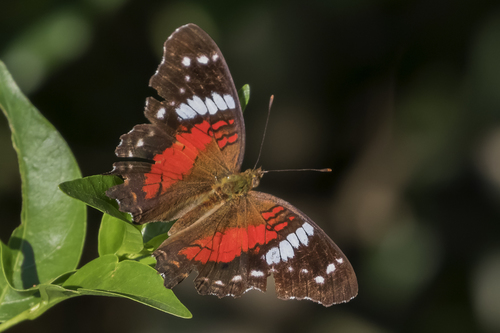
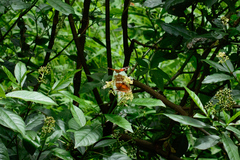
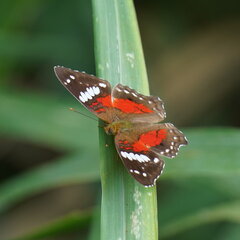

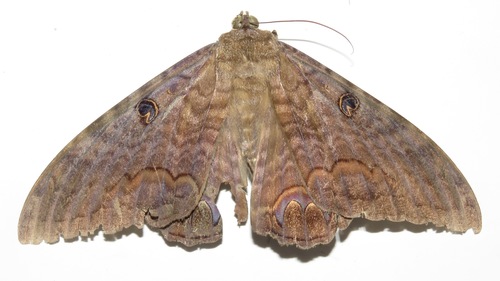
Red Peacock
Daily sighting probability ~30% · Possible
at Henri Pittier National Park

In 3 days ~60% in a week ~90%

21 Verified sightings at Henri Pittier National Park From 2019 to 2026
767 In all 18 parks
August Best month
☀️ Diurnal When it's spotted

About the Red Peacock

Anartia amathea, the brown peacock (scarlet peacock, red peacock), is a species of nymphalid butterfly, found primarily in South America. This butterfly is very similar to the banded peacock or Anartia fatima, which primarily exists north of the range of Anartia amathea. The type locality is probably Suriname, and the species is found from Panama to Argentina; Grenada, Barbados and Antigua. It consumes nectar. It is reported as common in Argentina, Paraguay, Uruguay, the Brazilian highlands, the eastern Amazon, the Guianas, Venezuela, and Panama, as well as Trinidad and other Caribbean islands. North American records are either in error or refer to strays.

Larval host plants are mostly undetermined, but these include the families Acanthaceae and Labiatae. Uniprot Taxonomy Wikipedia →

Global Distribution

Parks Where Found

# Park Country Daily sighting probability
1 Iguazú National Park 🇦🇷 Argentina
~40%
2 Main Ridge Forest Reserve 🇹🇹 Trinidad and Tobago
~40%
3 Iberá National Park 🇦🇷 Argentina
~40%
4 Tayrona National Natural Park 🇨🇴 Colombia
~40%
5 Brownsberg Nature Park 🇸🇷 Suriname
~40%
6 Iguaçu National Park 🇧🇷 Brazil
~40%
7 Farallones de Cali National Natural Park 🇨🇴 Colombia
~30%
8 Yasuní National Park 🇪🇨 Ecuador
~30%
9 Henri Pittier National Park 🇻🇪 Venezuela
~30%
10 Machalilla National Park 🇪🇨 Ecuador
~30%
11 El Palmar National Park 🇦🇷 Argentina
~30%
12 Caroni Swamp 🇹🇹 Trinidad and Tobago
~20%
13 Podocarpus National Park 🇪🇨 Ecuador
~20%
14 Manu National Park 🇵🇪 Peru
~20%
15 Serra dos Órgãos National Park 🇧🇷 Brazil
~20%
16 Itatiaia National Park 🇧🇷 Brazil
~20%
17 Cuyabeno Wildlife Reserve 🇪🇨 Ecuador
~20%
18 Tambopata National Reserve 🇵🇪 Peru
~10%

Cities Where Found

# City Country Daily sighting probability
1 Valencia 🇻🇪 Venezuela
~50%
2 Cali 🇨🇴 Colombia
~40%
3 Medellín 🇨🇴 Colombia
~30%
4 Porto Alegre 🇧🇷 Brazil
~30%
5 Curitiba 🇧🇷 Brazil
~30%
6 Caracas 🇻🇪 Venezuela
~20%
7 Recife 🇧🇷 Brazil
~20%
8 São Paulo 🇧🇷 Brazil
~20%
9 Manaus 🇧🇷 Brazil
~10%
10 Guayaquil 🇪🇨 Ecuador
~10%

Before you go

What are the chances of seeing a Red Peacock in Henri Pittier National Park?

Possible

About 30% of wildlife watchers report a Red Peacock sighting in Henri Pittier National Park on a given day, based on 21 verified sightings from GBIF citizen-science data from 2019 to 2026. It is the 2nd most-seen of the 18 insects we can rate there. Over three days the chance rises to about 60%, and over a week to about 90%, if each day is a fresh chance.

When is the best time to see a Red Peacock in Henri Pittier National Park?

February and July–August

In those months about 40% of wildlife watchers report a Red Peacock in Henri Pittier National Park on a given day, against under 5% in May, September and November–January, the lowest months.

What time of day is best to see a Red Peacock?

Between 10 am and 1 pm

Across all the parks we cover, that three-hour window holds the most Red Peacock sightings with a recorded time, and about 9 in 10 of them come between 6 am and 6 pm: it is a daytime animal.

Where does the Red Peacock sighting chance come from?

GBIF citizen-science records

It is estimated from how often the Red Peacock is recorded against all the insects logged in Henri Pittier National Park (21 verified sightings from 2019 to 2026), calibrated against known sighting rates. Figures are rounded to the nearest 10% because citizen-science data supports honest approximations, not decimals, and months with records from fewer than five people show "—". How it works.

← Back to Henri Pittier National Park