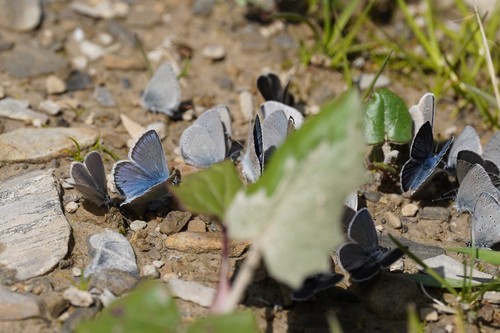
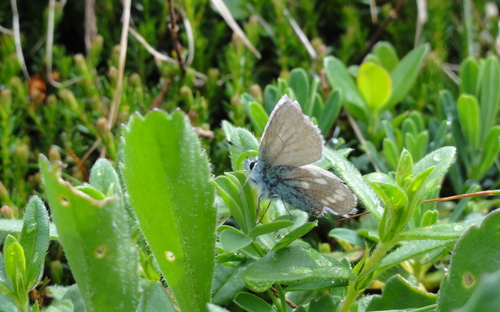
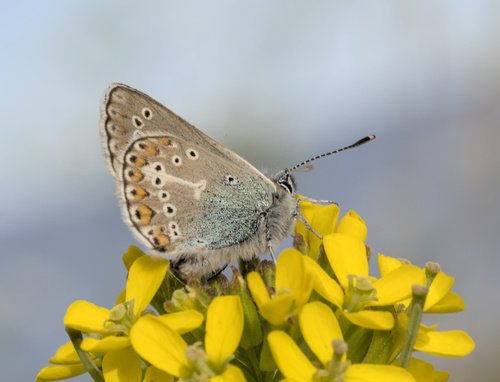
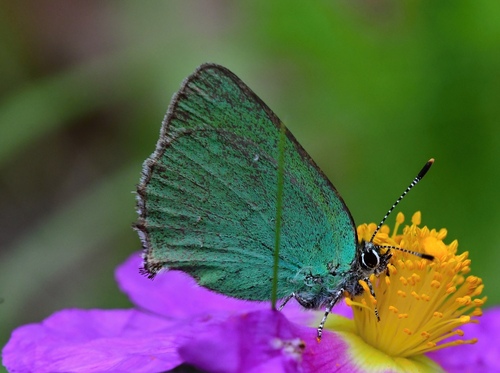
Small Copper
Daily sighting probability ~20% · Possible
at Hohe Tauern National Park

In 3 days ~40% in a week ~70%

10 Verified sightings at Hohe Tauern National Park From 2019 to 2026
1,478 In all 18 parks
November Best month
☀️ Diurnal When it's spotted

About the Small Copper

Lycaena phlaeas, the small copper, American copper, or common copper, is a butterfly of the Lycaenids or gossamer-winged butterfly family. According to Guppy and Shepard (2001), its specific name phlaeas is said to be derived either from the Greek φλέγω (phlégo), "to burn up", or from the Latin floreo, "to flourish".

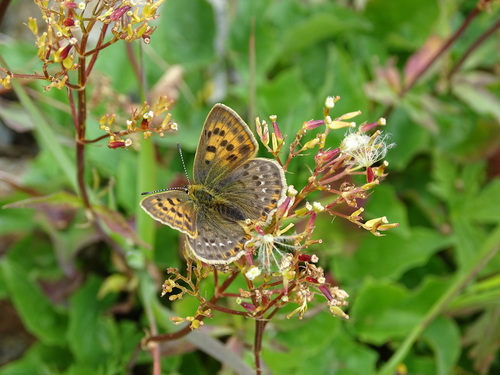
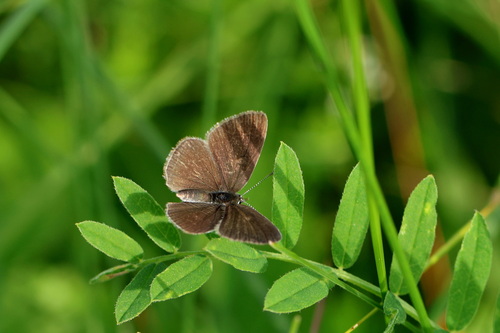
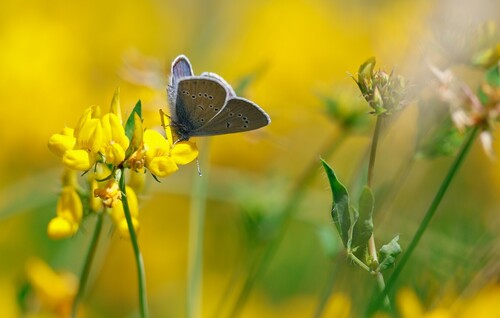
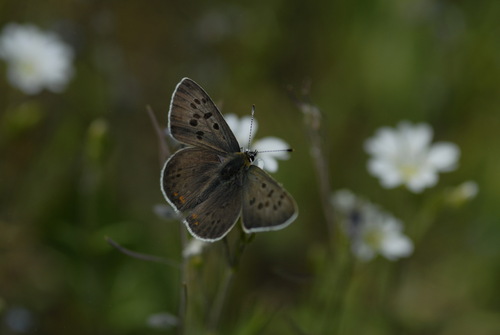
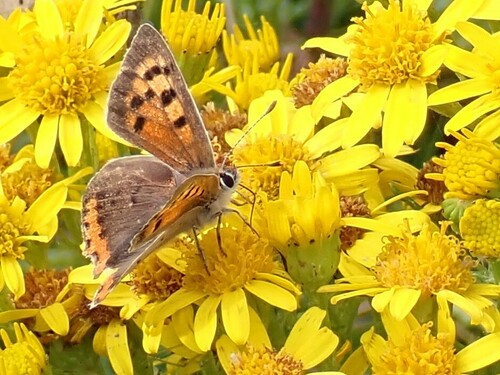
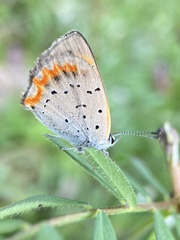
The upperside forewings are a bright orange with a dark outside edge border and with eight or nine black spots. The hindwings are dark with an orange border. Some females also have a row of blue spots inside the orange border and are known as form caeruleopunctata. The undersides are patterned in a similar way but are paler. The black spots on the forewings are outlined in yellow and the dark colouring is replaced by a pale brownish grey. The hindwings are the same brown/grey colour with small black dots and a narrow orange border. The caterpillars (larvae) are usually green, but some have a purple stripe down the middle of the back and along each side.

It is a holarctic species, widespread and common across Europe, Asia, North America, and also found in North Africa south through to Ethiopia. It can be found almost anywhere in south/central... Wikipedia →
Global Distribution

Parks Where Found

# Park Country Daily sighting probability
1 Sierra Nevada National Park 🇪🇸 Spain
~30%
2 Sierra de Guadarrama National Park 🇪🇸 Spain
~30%
3 Kiskunság National Park 🇭🇺 Hungary
~30%
4 Cévennes National Park 🇫🇷 France
~30%
5 Monfragüe National Park 🇪🇸 Spain
~30%
6 Aigüestortes National Park 🇪🇸 Spain
~30%
7 Hortobágy National Park 🇭🇺 Hungary
~30%
8 Doñana National Park 🇪🇸 Spain
~30%
9 Bavarian Forest National Park 🇩🇪 Germany
~20%
10 Biebrza National Park 🇵🇱 Poland
~20%
11 Mercantour National Park 🇫🇷 France
~20%
12 Wadden Sea National Park 🇩🇪 Germany
~20%
13 Snowdonia National Park 🇬🇧 United Kingdom
~20%
14 Pyrénées National Park 🇫🇷 France
~20%
15 Hohe Tauern National Park 🇦🇹 Austria
~20%
16 Cairngorms National Park 🇬🇧 United Kingdom
~10%
17 Triglav National Park 🇸🇮 Slovenia
~10%
18 Fertő-Hanság National Park 🇭🇺 Hungary
~10%

Cities Where Found

# City Country Daily sighting probability
1 Nagoya 🇯🇵 Japan
~30%
2 Tianjin 🇨🇳 China
~30%
3 Gwangju 🇰🇷 South Korea
~30%
4 Srinagar 🇮🇳 India
~30%
5 Sendai 🇯🇵 Japan
~30%
6 Milan 🇮🇹 Italy
~20%
7 Istanbul 🇹🇷 Turkey
~20%
8 Helsinki 🇫🇮 Finland
~20%
9 London 🇬🇧 United Kingdom
~20%
10 Turin 🇮🇹 Italy
~20%

Before you go

What are the chances of seeing a Small Copper in Hohe Tauern National Park?

Possible

About 20% of wildlife watchers report a Small Copper sighting in Hohe Tauern National Park on a given day, based on 10 verified sightings from GBIF citizen-science data from 2019 to 2026. It is the 80th most-seen of the 165 insects we can rate there. Over three days the chance rises to about 40%, and over a week to about 70%, if each day is a fresh chance.

When is the best time to see a Small Copper in Hohe Tauern National Park?

November

In that month about 50% of wildlife watchers report a Small Copper in Hohe Tauern National Park on a given day, against under 5% in February–May and September, the lowest months. December has too few records to rate.

What time of day is best to see a Small Copper?

Between 11 am and 2 pm

Across all the parks we cover, that three-hour window holds the most Small Copper sightings with a recorded time, and nearly all of them come between 6 am and 6 pm: it is a daytime animal.

Where does the Small Copper sighting chance come from?

GBIF citizen-science records

It is estimated from how often the Small Copper is recorded against all the insects logged in Hohe Tauern National Park (10 verified sightings from 2019 to 2026), calibrated against known sighting rates. Figures are rounded to the nearest 10% because citizen-science data supports honest approximations, not decimals, and months with records from fewer than five people show "—". How it works.

← Back to Hohe Tauern National Park