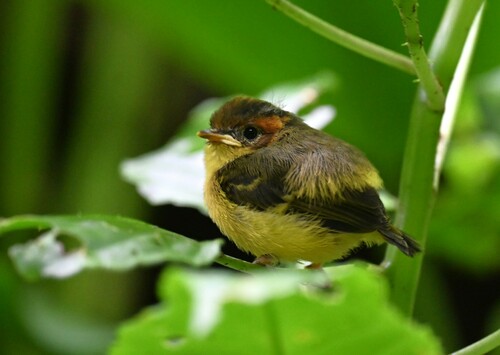
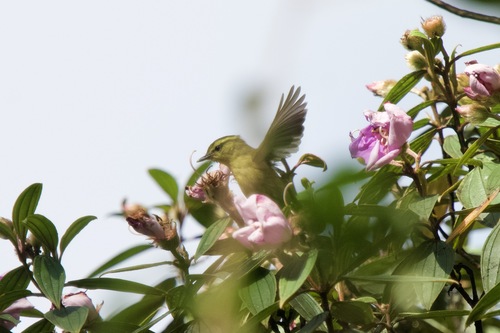
Black-backed Dwarf-Kingfisher

Black-backed Dwarf-Kingfisher

Ceyx erithaca

Silhouette: Rachael Joakim · PhyloPic

LCNTNear ThreatenedVUENCR
Daily sighting probability <5% · Rare
at Kinabalu Park

In 3 days <5% in a week ~10%

67 Verified sightings at Kinabalu Park From 2019 to 2026
2,744 In all 21 parks
October Best month
☀️ Diurnal When it's spotted

About the Black-backed Dwarf-Kingfisher

The black-backed dwarf kingfisher (Ceyx erithaca), also known as the three-toed kingfisher, is a pocket-sized bird in the family Alcedinidae. It was formerly considered as conspecific with the rufous-backed dwarf kingfisher and together the species complex was known by the English name "oriental dwarf kingfisher".

This tropical kingfisher is a partial migrant that is endemic to parts of the Indian Subcontinent and Mainland Southeast Asia. It resides in lowland forests, typically near streams or ponds, where it feeds upon insects, spiders, worms, crabs, fish, frogs, and lizards. It is easily distinguishable from other birds in its range due to its red bill, yellow-orange underparts, lilac-rufous upperparts, and blue-black back.

The black-backed kingfisher was formally described in 1758 by the Swedish naturalist Carl Linnaeus in the tenth edition of his Systema Naturae. He placed it with the other kingfishers in the genus Alcedo and coined the binomial name Alcedo erithaca. The specific epithet is from Latin erithacus meaning "robin" and hence "red-breasted". Linnaeus based his account on "The small kingfisher from Bengall" that had been described and illustrated... Wikipedia →

Sounds

Call0:41

Malaysia · 2026

© Ding Li Yong · XC1092137 · CC BY-NC-ND 4.0

Flight call0:10

Indonesia · 2019

© Frank Lambert · XC501271 · CC BY-NC-ND 4.0

Song0:33

Malaysia · 2022

© GABRIEL LEITE · XC730722 · CC BY-NC-SA 4.0

Global Distribution

Parks Where Found

# Park Country Daily sighting probability
1 Sepilok 🇲🇾 Malaysia
~40%
2 Way Kambas National Park 🇮🇩 Indonesia
~30%
3 Tanjung Puting National Park 🇮🇩 Indonesia
~20%
4 Bali Barat National Park 🇮🇩 Indonesia
~20%
5 Kinabatangan Wildlife Sanctuary 🇲🇾 Malaysia
~20%
6 Danum Valley Conservation Area 🇲🇾 Malaysia
~20%
7 Gunung Leuser National Park 🇮🇩 Indonesia
~10%
8 Bako National Park 🇲🇾 Malaysia
~10%
9 Taman Negara National Park 🇲🇾 Malaysia
~10%
10 Khao Sok National Park 🇹🇭 Thailand
<5%
11 Wilpattu National Park 🇱🇰 Sri Lanka
<5%
12 Sinharaja Forest Reserve 🇱🇰 Sri Lanka
<5%
13 Kaeng Krachan National Park 🇹🇭 Thailand
<5%
14 Minneriya National Park 🇱🇰 Sri Lanka
<5%
15 Khao Luang National Park 🇹🇭 Thailand
<5%
16 Kerinci Seblat National Park 🇮🇩 Indonesia
<5%
17 Kinabalu Park 🇲🇾 Malaysia
<5%
18 Cat Tien National Park 🇻🇳 Vietnam
<5%
19 Yala National Park 🇱🇰 Sri Lanka
<5%
20 Manas National Park 🇮🇳 India
<5%
21 Royal Manas National Park 🇧🇹 Bhutan
<5%

Cities Where Found

# City Country Daily sighting probability
1 Singapore 🇸🇬 Singapore
<5%
2 Mumbai 🇮🇳 India
<5%

Before you go

What are the chances of seeing a Black-backed Dwarf-Kingfisher in Kinabalu Park?

Rare

Under 5% of wildlife watchers report a Black-backed Dwarf-Kingfisher sighting in Kinabalu Park on a given day, based on 67 verified sightings from GBIF citizen-science data from 2019 to 2026. It is the 145th most-seen of the 247 birds we can rate there. Over three days the chance rises to under 5%, and over a week to about 10%, if each day is a fresh chance.

When is the best time to see a Black-backed Dwarf-Kingfisher in Kinabalu Park?

Any time of year

In every month with enough records, under 5% of wildlife watchers report a Black-backed Dwarf-Kingfisher in Kinabalu Park on a given day, so our monthly data shows no clear season.

What time of day is best to see a Black-backed Dwarf-Kingfisher?

Between noon and 3 pm

Across all the parks we cover, that three-hour window holds the most Black-backed Dwarf-Kingfisher sightings with a recorded time, and about 7 in 10 of them come between 6 am and 6 pm: it is a daytime animal.

Is Kinabalu Park the best place to see a Black-backed Dwarf-Kingfisher?

17th of 21

Of the 21 parks where we can rate Black-backed Dwarf-Kingfisher sightings, Kinabalu Park ranks 17th at under 5%. The best odds are in Sepilok (Malaysia, about 40%), Way Kambas National Park (Indonesia, about 30%) and Tanjung Puting National Park (Indonesia, about 20%).

Where does the Black-backed Dwarf-Kingfisher sighting chance come from?

GBIF citizen-science records

It is estimated from how often the Black-backed Dwarf-Kingfisher is recorded against all the birds logged in Kinabalu Park (67 verified sightings from 2019 to 2026), calibrated against known sighting rates. Figures are rounded to the nearest 10% because citizen-science data supports honest approximations, not decimals, and months with records from fewer than five people show "—". How it works.

← Back to Kinabalu Park