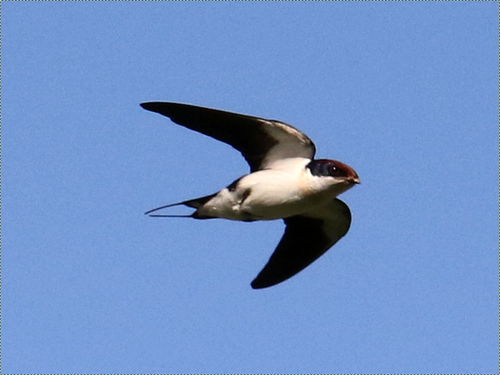
African Paradise-Flycatcher

African Paradise-Flycatcher

Terpsiphone viridis

Silhouette: PhyloPic

LCLeast ConcernNTVUENCR
Daily sighting probability ~30% · Possible
at Lower Zambezi National Park

In 3 days ~60% in a week ~90%

74 Verified sightings at Lower Zambezi National Park From 2019 to 2026
10,175 In all 51 parks
November Best month
☀️ Diurnal When it's spotted

About the African Paradise-Flycatcher

The African paradise flycatcher (Terpsiphone viridis) is a medium-sized passerine bird. The two central tail feathers of the male are extended into streamers that commonly are more than twice as long as the body. The female tail feathers are of moderate length and without streamers. The upper parts of the male body, wings, and tail are boldly coloured in chestnut or rusty shades, but the underparts and the head are variably grey to blue-gray, with the head of the mature male being darker, commonly glossy black with greenish highlights. The beak and other bare areas, including a wattle ring round the eye, match the colour of the surrounding feathers. The female coloration is similar, though not so showy and glossy and with the head paler.

The African paradise flycatcher feeds mainly on insects. It builds a neat cup nest in which it lays a clutch, usually of two or three eggs. It generally inhabits open forest and savanna, and is a locally common resident breeder in Africa south of the Sahara. The International Union for Conservation of Nature has listed it as being of "least concern".

This is the original bird known as ọ̀kín in Yorùbá language instead of the peacock. Wikipedia →

Sounds

Call0:23

Kenya · 2026

© Ding Li Yong · XC1180157 · CC BY-NC-ND 4.0

Alarm call0:35

South Africa · 2025

© Tim Cockcroft · XC1059308 · CC BY-NC-SA 4.0

Song0:05

Kenya · 2021

© isaac kilusu · XC627664 · CC BY-NC-SA 4.0

Global Distribution

Parks Where Found

# Park Country Daily sighting probability
1 Arusha National Park 🇹🇿 Tanzania
~50%
2 Bwindi Impenetrable National Park 🇺🇬 Uganda
~40%
3 Nairobi National Park 🇰🇪 Kenya
~40%
4 uMkhuze Game Reserve 🇿🇦 South Africa
~40%
5 Volcanoes National Park 🇷🇼 Rwanda
~30%
6 Meru National Park 🇰🇪 Kenya
~30%
7 Gorongosa National Park 🇲🇿 Mozambique
~30%
8 Niokolo-Koba National Park 🇸🇳 Senegal
~30%
9 Nyungwe National Park 🇷🇼 Rwanda
~30%
10 Lake Nakuru National Park 🇰🇪 Kenya
~30%
11 Masai Mara National Reserve 🇰🇪 Kenya
~30%
12 Akagera National Park 🇷🇼 Rwanda
~30%
13 Mana Pools National Park 🇿🇼 Zimbabwe
~30%
14 Lower Zambezi National Park 🇿🇲 Zambia
~30%
15 Kidepo Valley National Park 🇺🇬 Uganda
~20%
16 Tsavo West National Park 🇰🇪 Kenya
~20%
17 Garden Route National Park 🇿🇦 South Africa
~20%
18 Virunga National Park 🇨🇩 Democratic Republic of the Congo
~20%
19 Kafue National Park 🇿🇲 Zambia
~20%
20 Murchison Falls National Park 🇺🇬 Uganda
~20%
21 Ruaha National Park 🇹🇿 Tanzania
~20%
22 Hluhluwe-Imfolozi Park 🇿🇦 South Africa
~20%
23 Mikumi National Park 🇹🇿 Tanzania
~20%
24 Kruger National Park 🇿🇦 South Africa
~20%
25 Waterberg Plateau Park 🇳🇦 Namibia
~20%
26 Lake Manyara National Park 🇹🇿 Tanzania
~20%
27 Lake Mburo National Park 🇺🇬 Uganda
~20%
28 Gonarezhou National Park 🇿🇼 Zimbabwe
~20%
29 Aberdare National Park 🇰🇪 Kenya
~10%
30 Hwange National Park 🇿🇼 Zimbabwe
~10%
31 Chobe National Park 🇧🇼 Botswana
~10%
32 iSimangaliso Wetland Park 🇿🇦 South Africa
~10%
33 Liwonde National Park 🇲🇼 Malawi
~10%
34 Mkomazi National Park 🇹🇿 Tanzania
~10%
35 Ngorongoro Conservation Area 🇹🇿 Tanzania
~10%
36 Amboseli National Park 🇰🇪 Kenya
~10%
37 Golden Gate Highlands National Park 🇿🇦 South Africa
~10%
38 Moremi Game Reserve 🇧🇼 Botswana
~10%
39 Queen Elizabeth National Park 🇺🇬 Uganda
~10%
40 South Luangwa National Park 🇿🇲 Zambia
~10%
41 Table Mountain National Park 🇿🇦 South Africa
~10%
42 Tsavo East National Park 🇰🇪 Kenya
~10%
43 Semuliki National Park 🇺🇬 Uganda
~10%
44 Addo Elephant National Park 🇿🇦 South Africa
~10%
45 Kibale National Park 🇺🇬 Uganda
~10%
46 Tarangire National Park 🇹🇿 Tanzania
~10%
47 Serengeti National Park 🇹🇿 Tanzania
~10%
48 Samburu National Reserve 🇰🇪 Kenya
~10%
49 Pilanesberg National Park 🇿🇦 South Africa
~10%
50 Etosha National Park 🇳🇦 Namibia
<5%
51 De Hoop Nature Reserve 🇿🇦 South Africa
<5%

Cities Where Found

# City Country Daily sighting probability
1 Kigali 🇷🇼 Rwanda
~60%
2 Ouagadougou 🇧🇫 Burkina Faso
~60%
3 Nairobi 🇰🇪 Kenya
~40%
4 Abuja 🇳🇬 Nigeria
~40%
5 Zanzibar City 🇹🇿 Tanzania
~40%
6 Mombasa 🇰🇪 Kenya
~30%
7 Addis Ababa 🇪🇹 Ethiopia
~30%
8 Serrekunda 🇬🇲 Gambia
~30%
9 Harare 🇿🇼 Zimbabwe
~20%
10 Yaoundé 🇨🇲 Cameroon
~20%

Before you go

What are the chances of seeing an African Paradise-Flycatcher in Lower Zambezi National Park?

Possible

About 30% of wildlife watchers report an African Paradise-Flycatcher sighting in Lower Zambezi National Park on a given day, based on 74 verified sightings from GBIF citizen-science data from 2019 to 2026. It is the 83rd most-seen of the 241 birds we can rate there. Over three days the chance rises to about 60%, and over a week to about 90%, if each day is a fresh chance.

When is the best time to see an African Paradise-Flycatcher in Lower Zambezi National Park?

November

In that month about 50% of wildlife watchers report an African Paradise-Flycatcher in Lower Zambezi National Park on a given day, against about 10% in July and August, the lowest months. February and March have too few records to rate.

What time of day is best to see an African Paradise-Flycatcher?

Between 9 am and noon

Across all the parks we cover, that three-hour window holds the most African Paradise-Flycatcher sightings with a recorded time, and about 8 in 10 of them come between 6 am and 6 pm: it is a daytime animal.

Which relatives of the African Paradise-Flycatcher live in Lower Zambezi National Park?

Same order: Passeriformes

The closest relatives of the African Paradise-Flycatcher that you can see in Lower Zambezi National Park (order Passeriformes, Perching Birds) are Meves's Glossy-starling (about 70%), Fork-tailed Drongo (about 70%) and Common Bulbul (about 60%), with each one's daily chance of a sighting.

Where does the African Paradise-Flycatcher sighting chance come from?

GBIF citizen-science records

It is estimated from how often the African Paradise-Flycatcher is recorded against all the birds logged in Lower Zambezi National Park (74 verified sightings from 2019 to 2026), calibrated against known sighting rates. Figures are rounded to the nearest 10% because citizen-science data supports honest approximations, not decimals, and months with records from fewer than five people show "—". How it works.

← Back to Lower Zambezi National Park