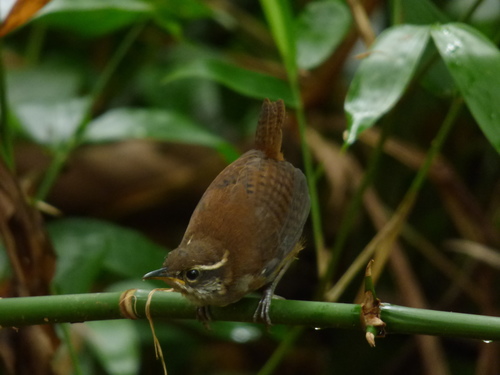
Rufous-and-white Wren

Rufous-and-white Wren

Thryophilus rufalbus

Silhouette: Matt Wilkins · PhyloPic

LCLeast ConcernNTVUENCR
Daily sighting probability ~40% · Likely
at Monteverde Cloud Forest Reserve

In 3 days ~70% in a week >90%

4,991 Verified sightings at Monteverde Cloud Forest Reserve From 2019 to 2026
9,878 In all 25 parks
July Best month
☀️ Diurnal When it's spotted

About the Rufous-and-white Wren

The rufous-and-white wren (Thryophilus rufalbus) is a small songbird of the wren family. It is a resident breeding species from southwesternmost Mexico to northern Colombia and northwestern Venezuela. It was formerly placed in the genus Thryothorus (Mann et al., 2006).

This large wren breeds in lowlands and foothills from sea level up to 1,500 m (4,900 ft) altitude in dry forests or, in wetter areas, more open scrubby woodland. In Central America, it mainly occurs on the Pacific side of the central mountain ranges Its flask-shaped nest is constructed 2–3 m (6 ft 7 in – 9 ft 10 in) high in a tree or shrub. The female alone incubates the three or four greenish-blue eggs for about two weeks to hatching, and the young fledge in about the same length of time again.

The adult rufous-and-white wren is 14–15 cm (5.5–5.9 in) long and weighs 22–25 g (0.78–0.88 oz). It has chestnut brown upperparts with a darker crown, strong white supercilium, brown stripe through the eye and black streaking on the cheeks. The underparts are white, with black barring on the lower belly and brown flanks. The wings and tail are barred with black. Young birds have duller upperparts and buff-tinged underparts. The subspecies T. r. minlosi of the Andean foothills of Venezuela has a greyish tinge to the crown and underparts.

The call of this species is a sharp chek or explosive tuck, and the song is a melodious and very distinctive sequence of slow hooting whistles, such as weee, boo, boo, booo, boo, whit. Pairs may duet, with the second bird responding with a purring ou-ou-ou-oouu,u,u,u.

The rufous-and-white wren forages actively in low vegetation or on the ground in pairs; it is a shy species more often heard than seen. It mainly eats insects, spiders and other invertebrates During an El Niño-driven food shortage, rufous-and-white wrens were observed killing southern house wren nestlings, possibly to reduce competition for resources. Wikipedia →

Sounds

Song1:08

Colombia · 2022

© Frank Lambert · XC1033068 · CC BY-NC-ND 4.0

Call1:07

Panama · 2021

© Kent Livezey · XC670503 · CC BY-NC-ND 4.0

Alarm call0:21

Colombia · 2018

© Jerome Fischer · XC443828 · CC BY-NC-SA 4.0

Global Distribution

Parks Where Found

# Park Country Daily sighting probability
1 Monteverde Cloud Forest Reserve 🇨🇷 Costa Rica
~40%
2 Parque Natural Metropolitano 🇵🇦 Panama
~30%
3 Tayrona National Natural Park 🇨🇴 Colombia
~20%
4 El Triunfo 🇲🇽 Mexico
~20%
5 Rincón de la Vieja National Park 🇨🇷 Costa Rica
~20%
6 Carara National Park 🇨🇷 Costa Rica
~20%
7 Cabo Blanco Absolute Nature Reserve 🇨🇷 Costa Rica
~20%
8 Henri Pittier National Park 🇻🇪 Venezuela
~20%
9 Santa Rosa National Park 🇨🇷 Costa Rica
~10%
10 Lago de Yojoa 🇭🇳 Honduras
~10%
11 Sierra de la Macarena National Park 🇨🇴 Colombia
~10%
12 Ostional Wildlife Refuge 🇨🇷 Costa Rica
~10%
13 La Amistad International Park (Panama) 🇵🇦 Panama
~10%
14 Chagres National Park 🇵🇦 Panama
~10%
15 San Lorenzo Protected Forest 🇵🇦 Panama
<5%
16 Soberanía National Park 🇵🇦 Panama
<5%
17 Volcán Barú National Park 🇵🇦 Panama
<5%
18 Tenorio Volcano National Park 🇨🇷 Costa Rica
<5%
19 Cerro Azul Meámbar National Park 🇭🇳 Honduras
<5%
20 Las Baulas Marine National Park 🇨🇷 Costa Rica
<5%
21 Chingaza National Natural Park 🇨🇴 Colombia
<5%
22 Palo Verde National Park 🇨🇷 Costa Rica
<5%
23 Manuel Antonio National Park 🇨🇷 Costa Rica
<5%
24 Masaya Volcano National Park 🇳🇮 Nicaragua
<5%
25 Arenal Volcano National Park 🇨🇷 Costa Rica
<5%

Cities Where Found

# City Country Daily sighting probability
1 Caracas 🇻🇪 Venezuela
<5%
2 San José 🇨🇷 Costa Rica
<5%
3 Panama City 🇵🇦 Panama
<5%
4 San Pedro Sula 🇭🇳 Honduras
<5%
5 Valencia 🇻🇪 Venezuela
<5%
6 San Salvador 🇸🇻 El Salvador
<5%

Before you go

What are the chances of seeing a Rufous-and-white Wren in Monteverde Cloud Forest Reserve?

Likely

About 40% of wildlife watchers report a Rufous-and-white Wren sighting in Monteverde Cloud Forest Reserve on a given day, based on 4,991 verified sightings from GBIF citizen-science data from 2019 to 2026. It is the 21st most-seen of the 412 birds we can rate there. Over three days the chance rises to about 70%, and over a week to over 90%, if each day is a fresh chance.

When is the best time to see a Rufous-and-white Wren in Monteverde Cloud Forest Reserve?

July

In that month about 60% of wildlife watchers report a Rufous-and-white Wren in Monteverde Cloud Forest Reserve on a given day, against about 20% in December and January, the lowest months.

What time of day is best to see a Rufous-and-white Wren?

Between 8 and 11 am

Across all the parks we cover, that three-hour window holds the most Rufous-and-white Wren sightings with a recorded time, and about 9 in 10 of them come between 6 am and 6 pm: it is a daytime animal.

Is Monteverde Cloud Forest Reserve the best place to see a Rufous-and-white Wren?

Yes

Of the 25 parks where we can rate Rufous-and-white Wren sightings, Monteverde Cloud Forest Reserve has the highest daily chance: about 40%. Next come Parque Natural Metropolitano (Panama, about 30%) and Tayrona National Natural Park (Colombia, about 20%).

Which relatives of the Rufous-and-white Wren live in Monteverde Cloud Forest Reserve?

Same family: Troglodytidae

The closest relatives of the Rufous-and-white Wren that you can see in Monteverde Cloud Forest Reserve (family Troglodytidae, Wrens) are Southern House Wren (about 50%), Cabanis's Wren (about 40%) and Gray-breasted Wood-Wren (about 40%), with each one's daily chance of a sighting.

Where does the Rufous-and-white Wren sighting chance come from?

GBIF citizen-science records

It is estimated from how often the Rufous-and-white Wren is recorded against all the birds logged in Monteverde Cloud Forest Reserve (4,991 verified sightings from 2019 to 2026), calibrated against known sighting rates. Figures are rounded to the nearest 10% because citizen-science data supports honest approximations, not decimals, and months with records from fewer than five people show "—". How it works.

← Back to Monteverde Cloud Forest Reserve