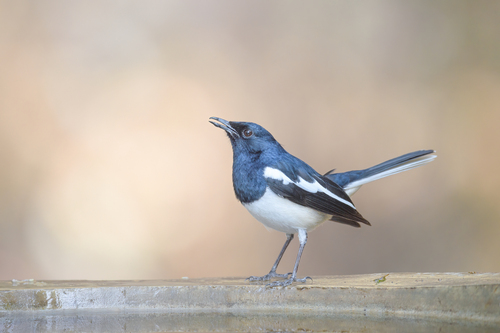
Ashy Prinia

Ashy Prinia

Prinia socialis

Silhouette: Sheatherius · PhyloPic

LCLeast ConcernNTVUENCR
Daily sighting probability ~20% · Possible
at Mudumalai National Park

In 3 days ~50% in a week ~80%

196 Verified sightings at Mudumalai National Park From 2019 to 2026
6,540 In all 22 parks
July Best month
☀️ Diurnal When it's spotted

About the Ashy Prinia

The ashy prinia or ashy wren-warbler (Prinia socialis) is a small warbler in the family Cisticolidae. This prinia is a resident breeder in the Indian subcontinent, ranging across most of India, Nepal, Bangladesh, eastern Pakistan, Bhutan, Sri Lanka and western Myanmar. It is a common bird in urban gardens and farmlands in many parts of India and its small size, distinctive colours and upright tail make it easy to identify. The northern populations have a rufous rump and back and have a distinct breeding and non-breeding plumage while other populations lack such variation.

These 13–14 cm long warblers have short rounded wings and a longish graduated cream tail tipped with black subterminal spots. The tail is usually held upright and the strong legs are used for clambering about and hopping on the ground. They have a short black bill. The crown is grey and the underparts are rufous in most plumages. In breeding plumage, adults of the northern population are ash grey above, with a black crown and cheek with no supercilium and coppery brown wings. In non-breeding season, this population has a short and narrow white supercilium and the tail is longer. They are found singly... Wikipedia →

Sounds

Subsong0:31

India · 2026

© Ding Li Yong · XC1086017 · CC BY-NC-ND 4.0

Song0:41

India · 2025

© Peter Boesman · XC1030834 · CC BY-NC-ND 4.0

Call0:58

India · 2023

© Jelle Scharringa · XC788229 · CC BY-NC-SA 4.0

Global Distribution

Parks Where Found

# Park Country Daily sighting probability
1 Keoladeo National Park 🇮🇳 India
~60%
2 Udawalawe National Park 🇱🇰 Sri Lanka
~40%
3 Ranthambore National Park 🇮🇳 India
~30%
4 Gir National Park 🇮🇳 India
~30%
5 Bandipur National Park 🇮🇳 India
~20%
6 Jim Corbett National Park 🇮🇳 India
~20%
7 Kanha National Park 🇮🇳 India
~20%
8 Mudumalai National Park 🇮🇳 India
~20%
9 Royal Bardia National Park 🇳🇵 Nepal
~20%
10 Nagarhole National Park 🇮🇳 India
~20%
11 Manas National Park 🇮🇳 India
~20%
12 Wilpattu National Park 🇱🇰 Sri Lanka
~20%
13 Minneriya National Park 🇱🇰 Sri Lanka
~20%
14 Yala National Park 🇱🇰 Sri Lanka
~20%
15 Satpura National Park 🇮🇳 India
~20%
16 Eravikulam National Park 🇮🇳 India
~10%
17 Chitwan National Park 🇳🇵 Nepal
~10%
18 Bandhavgarh National Park 🇮🇳 India
~10%
19 Horton Plains National Park 🇱🇰 Sri Lanka
~10%
20 Kaziranga National Park 🇮🇳 India
~10%
21 Periyar National Park 🇮🇳 India
<5%
22 Sinharaja Forest Reserve 🇱🇰 Sri Lanka
<5%

Cities Where Found

# City Country Daily sighting probability
1 Vasai-Virar 🇮🇳 India
~80%
2 Solapur 🇮🇳 India
~70%
3 Indore 🇮🇳 India
~70%
4 Kalyan-Dombivli 🇮🇳 India
~70%
5 Bengaluru 🇮🇳 India
~70%
6 Tiruppur 🇮🇳 India
~60%
7 Mysuru 🇮🇳 India
~60%
8 Bhopal 🇮🇳 India
~60%
9 Hyderabad 🇮🇳 India
~60%
10 Pune 🇮🇳 India
~60%

Before you go

What are the chances of seeing an Ashy Prinia in Mudumalai National Park?

Possible

About 20% of wildlife watchers report an Ashy Prinia sighting in Mudumalai National Park on a given day, based on 196 verified sightings from GBIF citizen-science data from 2019 to 2026. It is the 71st most-seen of the 233 birds we can rate there. Over three days the chance rises to about 50%, and over a week to about 80%, if each day is a fresh chance.

When is the best time to see an Ashy Prinia in Mudumalai National Park?

July

In that month about 50% of wildlife watchers report an Ashy Prinia in Mudumalai National Park on a given day, against about 10% in June and November–March, the lowest months. That is one of Mudumalai National Park's wettest months, with about 230 mm of rain against 10 mm in February.

What time of day is best to see an Ashy Prinia?

Between 7 and 10 am

Across all the parks we cover, that three-hour window holds the most Ashy Prinia sightings with a recorded time, and about 9 in 10 of them come between 6 am and 6 pm: it is a daytime animal.

Where does the Ashy Prinia sighting chance come from?

GBIF citizen-science records

It is estimated from how often the Ashy Prinia is recorded against all the birds logged in Mudumalai National Park (196 verified sightings from 2019 to 2026), calibrated against known sighting rates. Figures are rounded to the nearest 10% because citizen-science data supports honest approximations, not decimals, and months with records from fewer than five people show "—". How it works.

← Back to Mudumalai National Park