Spotted Redshank

Spotted Redshank

Tringa erythropus

Silhouette: Andy Wilson · PhyloPic

LCLeast ConcernNTVUENCR
Daily sighting probability <5% · Rare
at Ngorongoro Conservation Area

In 3 days <5% in a week ~10%

21 Verified sightings at Ngorongoro Conservation Area From 2019 to 2026
3,033 In all 19 parks
October Best month
☀️ Diurnal When it's spotted

About the Spotted Redshank

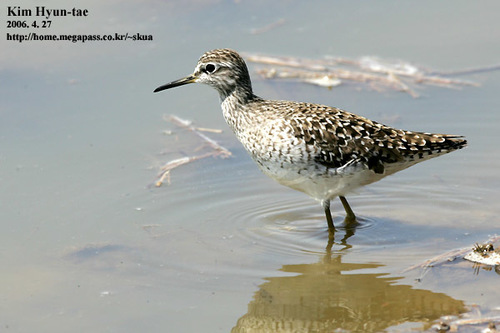
The spotted redshank (Tringa erythropus) is a wader (shorebird) in the large bird family Scolopacidae. It breeds across northern Scandinavia and the northern Palearctic and migrates south to the Mediterranean, the southern British Isles, France, tropical Africa, and tropical Asia for the winter. It is an occasional vagrant to Australia and North America.

The spotted redshank was described by German zoologist Peter Simon Pallas in 1764 and given the binomial name Scolopax erythropus. It is a monotypic species, with no recognised subspecies. Taxonomically, it forms a close-knit group with several other large Tringa species, with molecular sequencing showing it to be a sister clade to that containing the greater yellowlegs and the common greenshank. The genus name Tringa is the Neo-Latin name given to the green sandpiper by Aldrovandus in 1599 based on Ancient Greek trungas, a thrush-sized, white-rumped, tail-bobbing wading bird mentioned by Aristotle. The specific erythropus is from Ancient Greek eruthros, "red", and pous, "foot".

This is a large wader (shorebird), measuring 29–31 cm (11–12 in) long, with a wingspan of 61–67 cm (24–26 in) and a weight... Wikipedia →

Sounds

Call0:34

China · 2026

© Bo Shunqi 薄顺奇 · XC1175012 · CC BY-NC-SA 4.0

Song0:14

Sweden · 2025

© Lars Edenius · XC1005879 · CC BY-NC-SA 4.0

Flight call0:36

Mongolia · 2022

© Stanislas Wroza · XC765767 · CC BY-NC-SA 4.0

Global Distribution

Parks Where Found

# Park Country Daily sighting probability
1 Hortobágy National Park 🇭🇺 Hungary
~30%
2 Fertő-Hanság National Park 🇭🇺 Hungary
~20%
3 Kaziranga National Park 🇮🇳 India
~20%
4 Kiskunság National Park 🇭🇺 Hungary
~20%
5 Camargue 🇫🇷 France
~10%
6 Wadden Sea National Park 🇩🇪 Germany
~10%
7 Ranthambore National Park 🇮🇳 India
~10%
8 Keoladeo National Park 🇮🇳 India
~10%
9 Doñana National Park 🇪🇸 Spain
~10%
10 Biebrza National Park 🇵🇱 Poland
~10%
11 Białowieża National Park 🇵🇱 Poland
<5%
12 Bavarian Forest National Park 🇩🇪 Germany
<5%
13 Snowdonia National Park 🇬🇧 United Kingdom
<5%
14 Lake Nakuru National Park 🇰🇪 Kenya
<5%
15 Ngorongoro Conservation Area 🇹🇿 Tanzania
<5%
16 Serengeti National Park 🇹🇿 Tanzania
<5%
17 Jim Corbett National Park 🇮🇳 India
<5%
18 Monfragüe National Park 🇪🇸 Spain
<5%
19 Kanha National Park 🇮🇳 India
<5%

Cities Where Found

# City Country Daily sighting probability
1 Quanzhou 🇨🇳 China
~20%
2 Nanchang 🇨🇳 China
~10%
3 Helsinki 🇫🇮 Finland
~10%
4 Liverpool 🇬🇧 United Kingdom
~10%
5 Tuen Mun 🇨🇳 China
~10%
6 Tunis 🇹🇳 Tunisia
<5%
7 Prayagraj 🇮🇳 India
<5%
8 Izmir 🇹🇷 Turkey
<5%
9 Naha 🇯🇵 Japan
<5%
10 Kuwait City 🇰🇼 Kuwait
<5%

Zoos & Centres Where Found

# Zoo / Centre Country
1 Korkeasaari Zoo 🇫🇮 Finland In captivity

Before you go

What are the chances of seeing a Spotted Redshank in Ngorongoro Conservation Area?

Rare

Under 5% of wildlife watchers report a Spotted Redshank sighting in Ngorongoro Conservation Area on a given day, based on 21 verified sightings from GBIF citizen-science data from 2019 to 2026. It is the 414th most-seen of the 519 birds we can rate there. Over three days the chance rises to under 5%, and over a week to about 10%, if each day is a fresh chance.

When is the best time to see a Spotted Redshank in Ngorongoro Conservation Area?

Any time of year

In every month with enough records, under 5% of wildlife watchers report a Spotted Redshank in Ngorongoro Conservation Area on a given day, so our monthly data shows no clear season.

What time of day is best to see a Spotted Redshank?

Between 10 am and 1 pm

Across all the parks we cover, that three-hour window holds the most Spotted Redshank sightings with a recorded time, and about 9 in 10 of them come between 6 am and 6 pm: it is a daytime animal.

Which relatives of the Spotted Redshank live in Ngorongoro Conservation Area?

Same genus: Tringa

The closest relatives of the Spotted Redshank that you can see in Ngorongoro Conservation Area (genus Tringa, Shanks, Tattlers, and Allies) are Wood Sandpiper (about 20%), Marsh Sandpiper (about 20%) and Common Greenshank (about 10%), with each one's daily chance of a sighting.

Where does the Spotted Redshank sighting chance come from?

GBIF citizen-science records

It is estimated from how often the Spotted Redshank is recorded against all the birds logged in Ngorongoro Conservation Area (21 verified sightings from 2019 to 2026), calibrated against known sighting rates. Figures are rounded to the nearest 10% because citizen-science data supports honest approximations, not decimals, and months with records from fewer than five people show "—". How it works.

← Back to Ngorongoro Conservation Area