Temminck's Stint

Temminck's Stint

Calidris temminckii

Silhouette: Edwin Price · PhyloPic

LCLeast ConcernNTVUENCR
Daily sighting probability <5% · Rare
at Ngorongoro Conservation Area

In 3 days <5% in a week ~10%

21 Verified sightings at Ngorongoro Conservation Area From 2019 to 2026
1,718 In all 26 parks
October Best month
☀️ Diurnal When it's spotted

About the Temminck's Stint

Temminck's stint (Calidris temminckii) is a small wader native to the Old World. This bird's common name and Latin binomial commemorate the Dutch naturalist Coenraad Jacob Temminck. The genus name is from Ancient Greek kalidris or skalidris, a term used by Aristotle for some grey-coloured waterside birds.

Within the genus Calidris, Temminck's stint is most closely related to the long-toed stint (Calidris subminuta). Temminck's stint is one of the species to which the Agreement on the Conservation of African-Eurasian Migratory Waterbirds (AEWA) applies.

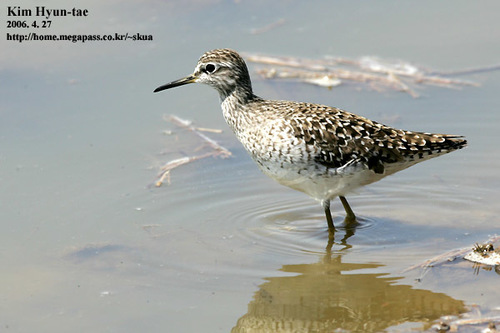
These birds are very small waders, at 13.5–15 cm (5.3–5.9 in) length. They are similar in size to the little stint (Calidris minuta) but shorter legged and longer winged. The legs are dull yellowish or brown, and the outer tail feathers white, in contrast to little stint's black legs and grey outer tail feathers.

This is a rather drab wader, with mainly plain brown upperparts and head, and underparts white apart from a darker breast. The breeding adult has some brighter rufous and/or blackish mantle feathers to relieve the generally undistinguished appearance. In winter plumage, the general appearance recalls a tiny... Wikipedia →

Sounds

Call0:06

Sweden · 2023

© Lars Edenius · XC824834 · CC BY-NC-SA 4.0

Alarm call0:11

Sweden · 2021

© Thomas Bergman · XC669842 · CC BY-NC-SA 4.0

Flight call0:10

Russian Federation · 2019

© Albert Lastukhin · XC497506 · CC BY-NC-SA 4.0

Global Distribution

Parks Where Found

# Park Country Daily sighting probability
1 Kaziranga National Park 🇮🇳 India
~20%
2 Chitwan National Park 🇳🇵 Nepal
~10%
3 Ranthambore National Park 🇮🇳 India
~10%
4 Doñana National Park 🇪🇸 Spain
~10%
5 Keoladeo National Park 🇮🇳 India
~10%
6 Hortobágy National Park 🇭🇺 Hungary
~10%
7 Hemis National Park 🇮🇳 India
~10%
8 Royal Bardia National Park 🇳🇵 Nepal
~10%
9 Lake Nakuru National Park 🇰🇪 Kenya
~10%
10 Gobi Gurvansaikhan National Park 🇲🇳 Mongolia
<5%
11 Awash National Park 🇪🇹 Ethiopia
<5%
12 Kiskunság National Park 🇭🇺 Hungary
<5%
13 Wadden Sea National Park 🇩🇪 Germany
<5%
14 Amboseli National Park 🇰🇪 Kenya
<5%
15 Satpura National Park 🇮🇳 India
<5%
16 Nagarhole National Park 🇮🇳 India
<5%
17 Semuliki National Park 🇺🇬 Uganda
<5%
18 Camargue 🇫🇷 France
<5%
19 Yala National Park 🇱🇰 Sri Lanka
<5%
20 Fertő-Hanság National Park 🇭🇺 Hungary
<5%
21 Ngorongoro Conservation Area 🇹🇿 Tanzania
<5%
22 Białowieża National Park 🇵🇱 Poland
<5%
23 Jim Corbett National Park 🇮🇳 India
<5%
24 Manas National Park 🇮🇳 India
<5%
25 Queen Elizabeth National Park 🇺🇬 Uganda
<5%
26 Serengeti National Park 🇹🇿 Tanzania
<5%

Cities Where Found

# City Country Daily sighting probability
1 Agra 🇮🇳 India
~20%
2 Vasai-Virar 🇮🇳 India
~10%
3 Karachi 🇵🇰 Pakistan
~10%
4 Naha 🇯🇵 Japan
~10%
5 Quanzhou 🇨🇳 China
~10%
6 Indore 🇮🇳 India
~10%
7 Helsinki 🇫🇮 Finland
~10%
8 Kathmandu 🇳🇵 Nepal
~10%
9 Manama 🇧🇭 Bahrain
~10%
10 Prayagraj 🇮🇳 India
<5%

Before you go

What are the chances of seeing a Temminck's Stint in Ngorongoro Conservation Area?

Rare

Under 5% of wildlife watchers report a Temminck's Stint sighting in Ngorongoro Conservation Area on a given day, based on 21 verified sightings from GBIF citizen-science data from 2019 to 2026. It is the 412th most-seen of the 519 birds we can rate there. Over three days the chance rises to under 5%, and over a week to about 10%, if each day is a fresh chance.

When is the best time to see a Temminck's Stint in Ngorongoro Conservation Area?

October

In that month about 10% of wildlife watchers report a Temminck's Stint in Ngorongoro Conservation Area on a given day, against under 5% in November to September, the lowest months.

What time of day is best to see a Temminck's Stint?

Between 8 and 11 am

Across all the parks we cover, that three-hour window holds the most Temminck's Stint sightings with a recorded time, and about 9 in 10 of them come between 6 am and 6 pm: it is a daytime animal.

Is Ngorongoro Conservation Area the best place to see a Temminck's Stint?

21st of 26

Of the 26 parks where we can rate Temminck's Stint sightings, Ngorongoro Conservation Area ranks 21st at under 5%. The best odds are in Kaziranga National Park (India, about 20%), Chitwan National Park (Nepal, about 10%) and Ranthambore National Park (India, about 10%).

Which relatives of the Temminck's Stint live in Ngorongoro Conservation Area?

Same genus: Calidris

The closest relatives of the Temminck's Stint that you can see in Ngorongoro Conservation Area (genus Calidris, Calidris Sandpipers) are Little Stint (about 30%), Ruff (about 30%) and Curlew Sandpiper (about 10%), with each one's daily chance of a sighting.

Where does the Temminck's Stint sighting chance come from?

GBIF citizen-science records

It is estimated from how often the Temminck's Stint is recorded against all the birds logged in Ngorongoro Conservation Area (21 verified sightings from 2019 to 2026), calibrated against known sighting rates. Figures are rounded to the nearest 10% because citizen-science data supports honest approximations, not decimals, and months with records from fewer than five people show "—". How it works.

← Back to Ngorongoro Conservation Area