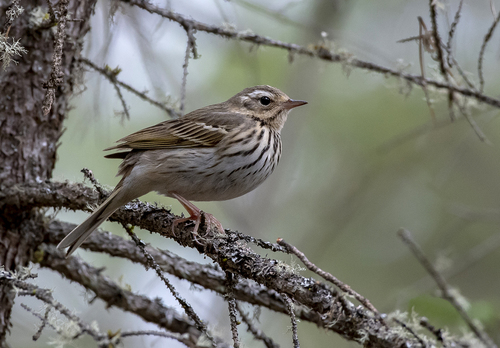
Olive-backed Pipit

Olive-backed Pipit

Anthus hodgsoni

Silhouette: Susan Murphy (original photograph), T. Michael Keesey (vectorization) · PhyloPic

LCLeast ConcernNTVUENCR
Daily sighting probability ~20% · Possible
at Nikko National Park

In 3 days ~40% in a week ~70%

74 Verified sightings at Nikko National Park From 2019 to 2026
2,775 In all 23 parks
July Best month
🌅 Crepuscular When it's spotted

About the Olive-backed Pipit

The olive-backed pipit (Anthus hodgsoni) is a small passerine bird of the pipit (Anthus) genus, which breeds across southern, north central and eastern Asia, as well as in the north-eastern European Russia. It is a long-distance migrant moving in winter to southern Asia and Indonesia. Sometimes it is also called Indian pipit or Hodgson's pipit, as well as tree pipit owing to its resemblance with the tree pipit. However, its back is more olive-toned and less streaked than that species, and its head pattern is different with a better-marked supercilium.

The genus name Anthus is from Latin and is the name for a small bird of grasslands. The specific hodgsoni commemorates English diplomat and collector Brian Houghton Hodgson. Summer: from Himalayan Pakistan and India, westward through Nepal, into China, north to Gansu province, and eastwards through Korea to Japan, and north through north central Asia into north-eastern Europe (European Russia). Occasionally a rare vagrant in western Europe. Breeds up to 4,500 m (14,800 ft) in eastern Nepal.

Winter: Broad southern region across Asia, from peninsular India, east to Southeast Asia and the Philippines. Habitat: Affects open... Wikipedia →
Sounds

Nocturnal flight call0:04

France · 2026

© Julien Piette · XC1185842 · CC BY-NC-SA 4.0

Flight call0:04

Netherlands · 2026

© Maarten Sluijter · XC1185777 · CC BY-NC-SA 4.0

Call0:11

China · 2026

© Peter Boesman · XC1147361 · CC BY-NC-ND 4.0

Global Distribution

Parks Where Found

# Park Country Daily sighting probability
1 Jiuzhaigou National Park 🇨🇳 China
~40%
2 Langtang National Park 🇳🇵 Nepal
~30%
3 Royal Manas National Park 🇧🇹 Bhutan
~20%
4 Chitwan National Park 🇳🇵 Nepal
~20%
5 Cuc Phuong National Park 🇻🇳 Vietnam
~20%
6 Nikko National Park 🇯🇵 Japan
~20%
7 Royal Bardia National Park 🇳🇵 Nepal
~20%
8 Doi Inthanon National Park 🇹🇭 Thailand
~10%
9 Kaziranga National Park 🇮🇳 India
~10%
10 Manas National Park 🇮🇳 India
~10%
11 Bandhavgarh National Park 🇮🇳 India
~10%
12 Gobi Gurvansaikhan National Park 🇲🇳 Mongolia
~10%
13 Kanha National Park 🇮🇳 India
~10%
14 Namdapha National Park 🇮🇳 India
<5%
15 Khao Yai National Park 🇹🇭 Thailand
<5%
16 Jim Corbett National Park 🇮🇳 India
<5%
17 Kaeng Krachan National Park 🇹🇭 Thailand
<5%
18 Ranthambore National Park 🇮🇳 India
<5%
19 Taroko National Park 🇹🇼 Taiwan
<5%
20 Satpura National Park 🇮🇳 India
<5%
21 Keoladeo National Park 🇮🇳 India
<5%
22 Nagarhole National Park 🇮🇳 India
<5%
23 Periyar National Park 🇮🇳 India
<5%

Cities Where Found

# City Country Daily sighting probability
1 Jinhua 🇨🇳 China
~30%
2 Asansol 🇮🇳 India
~30%
3 Tuen Mun 🇨🇳 China
~20%
4 Suzhou 🇨🇳 China
~20%
5 Hangzhou 🇨🇳 China
~20%
6 Nanchang 🇨🇳 China
~20%
7 Kunming 🇨🇳 China
~20%
8 Shanghai 🇨🇳 China
~20%
9 Kathmandu 🇳🇵 Nepal
~20%
10 Savar 🇧🇩 Bangladesh
~20%

Zoos & Centres Where Found

# Zoo / Centre Country
1 Ueno Zoo 🇯🇵 Japan In captivity
2 Ueno Zoological Gardens (West Garden) 🇯🇵 Japan In captivity

Before you go

What are the chances of seeing an Olive-backed Pipit in Nikko National Park?

Possible

About 20% of wildlife watchers report an Olive-backed Pipit sighting in Nikko National Park on a given day, based on 74 verified sightings from GBIF citizen-science data from 2019 to 2026. It is the 45th most-seen of the 102 birds we can rate there. Over three days the chance rises to about 40%, and over a week to about 70%, if each day is a fresh chance.

When is the best time to see an Olive-backed Pipit in Nikko National Park?

June–July and September

In those months about 30% of wildlife watchers report an Olive-backed Pipit in Nikko National Park on a given day, against under 5% in November, the lowest month.

What time of day is best to see an Olive-backed Pipit?

Between 4 and 7 am

Across all the parks we cover, that three-hour window holds the most Olive-backed Pipit sightings with a recorded time, and about half of them come between 6 pm and 6 am: it is most active around dawn and dusk.

Which relatives of the Olive-backed Pipit live in Nikko National Park?

Same family: Motacillidae

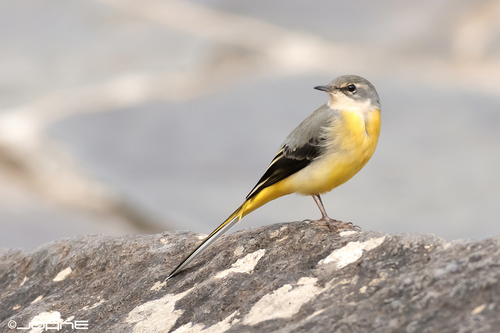
The closest relatives of the Olive-backed Pipit that you can see in Nikko National Park (family Motacillidae, Wagtails and Pipits) are White Wagtail (about 40%), Grey Wagtail (about 40%) and Japanese Wagtail (about 20%), with each one's daily chance of a sighting.

Where does the Olive-backed Pipit sighting chance come from?

GBIF citizen-science records

It is estimated from how often the Olive-backed Pipit is recorded against all the birds logged in Nikko National Park (74 verified sightings from 2019 to 2026), calibrated against known sighting rates. Figures are rounded to the nearest 10% because citizen-science data supports honest approximations, not decimals, and months with records from fewer than five people show "—". How it works.

← Back to Nikko National Park