
Chimney Swift

Chimney Swift

Chaetura pelagica

Silhouette: Aviceda (vectorized by T. Michael Keesey) · PhyloPic

LCNTVUVulnerableENCR
Daily sighting probability <5% · Rare
at Pico Bonito National Park

In 3 days <5% in a week ~10%

10 Verified sightings at Pico Bonito National Park From 2019 to 2026
7,573 In all 32 parks
September Best month
☀️ Diurnal When it's spotted

About the Chimney Swift

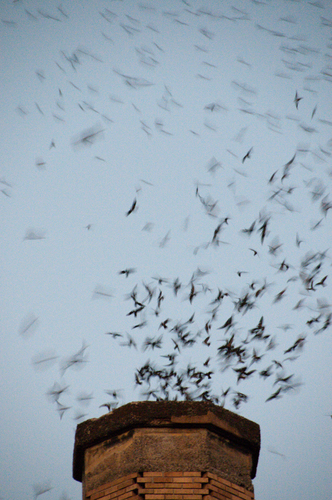
The chimney swift (Chaetura pelagica) is a bird belonging to the swift family Apodidae. A member of the genus Chaetura, it is closely related to both Vaux's swift and Chapman's swift; in the past, the three were sometimes considered to be conspecific. It has no subspecies. The chimney swift is a medium-sized, sooty gray bird with very long, slender wings and very short legs. Like all swifts, it is incapable of perching on flat surfaces, and can only perch on vertical surfaces. Many fly around all day and only come down at night when roosting.

The chimney swift feeds primarily on flying insects, but also on airborne spiders. It generally mates for life. It builds a bracket nest of twigs and saliva stuck to a vertical surface, which is almost always a human-built structure, typically a chimney; historically (before European colonists built chimneys), they nested in hollow trees (including old pileated woodpecker nest holes), a few still do so, though only rarely. The female lays 4–5 white eggs. The altricial young hatch after 19 days and fledge a month later. The average chimney swift lives 4.6 years.

When Carl Linnaeus first described the chimney swift... Wikipedia →

Sounds

Flight call0:16

Ecuador · 2024

© Manuel Sánchez-Nivicela · XC1100770 · CC BY-NC-ND 4.0

Call0:09

United States · 2019

© Russ Wigh · XC560823 · CC BY-NC-SA 4.0

Song0:22

United States · 2014

© Dan Lane · XC180468 · CC BY-NC-SA 4.0

Global Distribution

Parks Where Found

# Park Country Daily sighting probability
1 Congaree National Park 🇺🇸 United States
~30%
2 Point Pelee National Park 🇨🇦 Canada
~30%
3 Great Smoky Mountains National Park 🇺🇸 United States
~20%
4 Shenandoah National Park 🇺🇸 United States
~10%
5 Gandoca-Manzanillo Wildlife Refuge 🇨🇷 Costa Rica
~10%
6 Riding Mountain National Park 🇨🇦 Canada
~10%
7 Tortuguero National Park 🇨🇷 Costa Rica
<5%
8 Soberanía National Park 🇵🇦 Panama
<5%
9 Cahuita National Park 🇨🇷 Costa Rica
<5%
10 Badlands National Park 🇺🇸 United States
<5%
11 Isle Royale National Park 🇺🇸 United States
<5%
12 Arrecifes de Cozumel National Park 🇲🇽 Mexico
<5%
13 Bastimentos Island National Marine Park 🇵🇦 Panama
<5%
14 La Tigra National Park 🇭🇳 Honduras
<5%
15 Acadia National Park 🇺🇸 United States
<5%
16 Darién National Park 🇵🇦 Panama
<5%
17 Everglades National Park 🇺🇸 United States
<5%
18 Big Cypress National Preserve 🇺🇸 United States
<5%
19 Pico Bonito National Park 🇭🇳 Honduras
<5%
20 Parque Natural Metropolitano 🇵🇦 Panama
<5%
21 Merritt Island National Wildlife Refuge 🇺🇸 United States
<5%
22 La Amistad International Park (Panama) 🇵🇦 Panama
<5%
23 Sian Ka'an Biosphere Reserve 🇲🇽 Mexico
<5%
24 Celestún Biosphere Reserve 🇲🇽 Mexico
<5%
25 Chagres National Park 🇵🇦 Panama
<5%
26 Rincón de la Vieja National Park 🇨🇷 Costa Rica
<5%
27 Braulio Carrillo National Park 🇨🇷 Costa Rica
<5%
28 Arenal Volcano National Park 🇨🇷 Costa Rica
<5%
29 Tenorio Volcano National Park 🇨🇷 Costa Rica
<5%
30 Manu National Park 🇵🇪 Peru
<5%
31 Monteverde Cloud Forest Reserve 🇨🇷 Costa Rica
<5%
32 Rocky Mountain National Park 🇺🇸 United States
<5%

Cities Where Found

# City Country Daily sighting probability
1 Baltimore 🇺🇸 United States
~30%
2 Chicago 🇺🇸 United States
~30%
3 Philadelphia 🇺🇸 United States
~30%
4 Washington 🇺🇸 United States
~20%
5 Houston 🇺🇸 United States
~20%
6 Boston 🇺🇸 United States
~20%
7 New York City 🇺🇸 United States
~20%
8 Dallas 🇺🇸 United States
~20%
9 Austin 🇺🇸 United States
~20%
10 Orlando 🇺🇸 United States
~20%

Before you go

What are the chances of seeing a Chimney Swift in Pico Bonito National Park?

Rare

Under 5% of wildlife watchers report a Chimney Swift sighting in Pico Bonito National Park on a given day, based on 10 verified sightings from GBIF citizen-science data from 2019 to 2026. It is the 242nd most-seen of the 271 birds we can rate there. Over three days the chance rises to under 5%, and over a week to about 10%, if each day is a fresh chance.

When is the best time to see a Chimney Swift in Pico Bonito National Park?

Any time of year

In every month with enough records, under 5% of wildlife watchers report a Chimney Swift in Pico Bonito National Park on a given day, so our monthly data shows no clear season.

What time of day is best to see a Chimney Swift?

Between 7 and 10 am

Across all the parks we cover, that three-hour window holds the most Chimney Swift sightings with a recorded time, and about 7 in 10 of them come between 6 am and 6 pm: it is a daytime animal.

Where does the Chimney Swift sighting chance come from?

GBIF citizen-science records

It is estimated from how often the Chimney Swift is recorded against all the birds logged in Pico Bonito National Park (10 verified sightings from 2019 to 2026), calibrated against known sighting rates. Figures are rounded to the nearest 10% because citizen-science data supports honest approximations, not decimals, and months with records from fewer than five people show "—". How it works.

← Back to Pico Bonito National Park