Hudsonian Whimbrel

Hudsonian Whimbrel

Numenius hudsonicus

Silhouette: Rebecca Groom (based on Photo by Andreas Trepte) · PhyloPic

Daily sighting probability ~10% · With luck
at Piedras Blancas National Park

In 3 days ~40% in a week ~60%

8 Verified sightings at Piedras Blancas National Park From 2019 to 2026
1,264 In all 26 parks
January Best month
☀️ Diurnal When it's spotted

About the Hudsonian Whimbrel

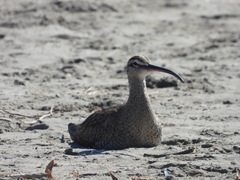
The Hudsonian whimbrel or Hudsonian curlew (Numenius hudsonicus) is a wader in the large family Scolopacidae. It is one of the most widespread of the curlews, breeding across much of subarctic North America. This species and the Eurasian whimbrel were split in 2019 based on genetic and morphological differences and separate breeding ranges.

Two subspecies are recognized: Numenius hudsonicus rufiventris – Vigors, 1829: breeds in Alaska and northwestern Canada Numenius hudsonicus hudsonicus – Latham, 1790: (Hudsonian curlew) breeds in Hudson Bay area to northeastern Canada This is a fairly large wader, though mid-sized as a member of the curlew genus. The English name is imitative of the bird's call. The genus name Numenius is from Ancient Greek noumenios, a bird mentioned by Hesychius. It is associated with the curlews because it appears to be derived from neos, "new" and mene, "moon", referring to the crescent-shaped bill.

It is 37–47 cm (15–19 in) in length, 75–90 cm (30–35 in) in wingspan, and 270–493 g (9.5–17.4 oz; 0.595–1.087 lb) in weight. It is mainly greyish brown, with a rump pattern uniform with upperparts, and a long curved... Wikipedia →

Sounds

Call0:08

Costa Rica · 2017

© Albert Lastukhin · XC1094612 · CC BY-NC-ND 4.0

Song0:05

Ecuador · 2020

© Manuel Sánchez-Nivicela · XC1001186 · CC BY-NC-ND 4.0

Flight call0:05

United States · 2021

© Paul Marvin · XC629774 · CC BY-NC-SA 4.0

Global Distribution

Parks Where Found

# Park Country Daily sighting probability
1 Gandoca-Manzanillo Wildlife Refuge 🇨🇷 Costa Rica
~60%
2 Tortuguero National Park 🇨🇷 Costa Rica
~40%
3 Marino Ballena National Park 🇨🇷 Costa Rica
~40%
4 Carara National Park 🇨🇷 Costa Rica
~40%
5 Las Baulas Marine National Park 🇨🇷 Costa Rica
~30%
6 Galápagos Islands 🇪🇨 Ecuador
~30%
7 Bahía de Loreto National Park 🇲🇽 Mexico
~30%
8 Pacific Rim National Park Reserve 🇨🇦 Canada
~30%
9 Cabo Blanco Absolute Nature Reserve 🇨🇷 Costa Rica
~30%
10 Corcovado National Park 🇨🇷 Costa Rica
~30%
11 Ostional Wildlife Refuge 🇨🇷 Costa Rica
~20%
12 El Vizcaíno Biosphere Reserve 🇲🇽 Mexico
~20%
13 Channel Islands National Park 🇺🇸 United States
~20%
14 Bastimentos Island National Marine Park 🇵🇦 Panama
~20%
15 Cahuita National Park 🇨🇷 Costa Rica
~20%
16 Santa Rosa National Park 🇨🇷 Costa Rica
~20%
17 Piedras Blancas National Park 🇨🇷 Costa Rica
~10%
18 Redwood National Park 🇺🇸 United States
~10%
19 Ría Lagartos Biosphere Reserve 🇲🇽 Mexico
~10%
20 Great Bear Rainforest 🇨🇦 Canada
~10%
21 Point Pelee National Park 🇨🇦 Canada
~10%
22 Padre Island National Seashore 🇺🇸 United States
~10%
23 La Amistad International Park (Panama) 🇵🇦 Panama
~10%
24 Parque Natural Metropolitano 🇵🇦 Panama
~10%
25 Olympic National Park 🇺🇸 United States
~10%
26 Everglades National Park 🇺🇸 United States
<5%

Cities Where Found

# City Country Daily sighting probability
1 São Luís 🇧🇷 Brazil
~30%
2 Panama City 🇵🇦 Panama
~30%
3 San Diego 🇺🇸 United States
~30%
4 Lima 🇵🇪 Peru
~20%
5 Tijuana 🇲🇽 México
~20%
6 San Francisco 🇺🇸 United States
~20%
7 Los Angeles 🇺🇸 United States
~10%
8 Recife 🇧🇷 Brazil
~10%
9 Anchorage 🇺🇸 United States
~10%
10 Rio de Janeiro 🇧🇷 Brazil
~10%

Zoos & Centres Where Found

# Zoo / Centre Country
1 Aviario Nacional de Colombia 🇨🇴 Colombia In captivity
2 Seattle Aquarium 🇺🇸 United States In captivity
3 Montreal Biodome 🇨🇦 Canada In captivity
4 Seattle Marine Aquarium 🇺🇸 United States In captivity

Before you go

What are the chances of seeing a Hudsonian Whimbrel in Piedras Blancas National Park?

With luck

About 10% of wildlife watchers report a Hudsonian Whimbrel sighting in Piedras Blancas National Park on a given day, based on 8 verified sightings from GBIF citizen-science data from 2019 to 2026. It is the 118th most-seen of the 344 birds we can rate there. Over three days the chance rises to about 40%, and over a week to about 60%, if each day is a fresh chance.

When is the best time to see a Hudsonian Whimbrel in Piedras Blancas National Park?

January, March and May

In those months about 20% of wildlife watchers report a Hudsonian Whimbrel in Piedras Blancas National Park on a given day, against under 5% in February, April and June–December, the lowest months. Those are among Piedras Blancas National Park's driest months, with about 170 mm of rain a month against 650 mm in October.

What time of day is best to see a Hudsonian Whimbrel?

Between 9 am and noon

Across all the parks we cover, that three-hour window holds the most Hudsonian Whimbrel sightings with a recorded time, and about 9 in 10 of them come between 6 am and 6 pm: it is a daytime animal.

Where does the Hudsonian Whimbrel sighting chance come from?

GBIF citizen-science records

It is estimated from how often the Hudsonian Whimbrel is recorded against all the birds logged in Piedras Blancas National Park (8 verified sightings from 2019 to 2026), calibrated against known sighting rates. Figures are rounded to the nearest 10% because citizen-science data supports honest approximations, not decimals, and months with records from fewer than five people show "—". How it works.

← Back to Piedras Blancas National Park