Alexandrine Parakeet

Alexandrine Parakeet

Psittacula eupatria

Silhouette: Farelli (photo), John E. McCormack, Michael G. Harvey, Brant C. Faircloth, Nicholas G. Crawford, Travis C. Glenn, Robb T. Brumfield & T. Michael Keesey · PhyloPic

Daily sighting probability ~30% · Possible
at Ranthambore National Park

In 3 days ~60% in a week ~90%

442 Verified sightings at Ranthambore National Park From 2019 to 2026
10,335 In all 17 parks
May Best month
🌅 Crepuscular When it's spotted

About the Alexandrine Parakeet

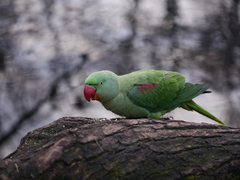
The Alexandrine parakeet (Psittacula eupatria), also known as the Alexandrine parrot, is a medium-sized parrot in the genus Psittacula of the family Psittaculidae, native to South Asia and Southeast Asia. It is named after Alexander the Great, who transported numerous birds from Punjab to various European and Mediterranean countries and regions, where they were prized by the royalty, nobility and warlords.

The Alexandrine parakeet has established feral populations in Turkey, Iraq, Kuwait, Saudi Arabia, Bahrain, Qatar, the United Arab Emirates, Iran, Pakistan, Germany, The Netherlands and Belgium where it lives alongside feral populations of its close relative, the rose-ringed parakeet (Psittacula krameri).

The Alexandrine parakeet was first described by French zoologist Mathurin Jacques Brisson as Psittaca Ginginiana or "La Perruche de Gingi" (The Gingi's Parakeet) in 1760; after the town of Gingee in southeastern India, which was a French outpost then. The birds may, however, merely have been held in captivity there. Carl Linnaeus redescribed the Alexandrine parakeet in 1766 as Psittacus eupatria.

The genus name Psittacula is a diminutive of the Latin word... Wikipedia →

Sounds

Call0:51

India · 2026

© Ding Li Yong · XC1085978 · CC BY-NC-ND 4.0

Flight call0:10

India · 2025

© Lim Ying Hien · XC987012 · CC BY-NC-ND 4.0

Alarm call0:51

France · 2021

© Stanislas Wroza · XC628899 · CC BY-NC-SA 4.0

Global Distribution

Parks Where Found

# Park Country Daily sighting probability
1 Satpura National Park 🇮🇳 India
~50%
2 Royal Bardia National Park 🇳🇵 Nepal
~50%
3 Kanha National Park 🇮🇳 India
~50%
4 Kaziranga National Park 🇮🇳 India
~50%
5 Chitwan National Park 🇳🇵 Nepal
~50%
6 Bandhavgarh National Park 🇮🇳 India
~40%
7 Minneriya National Park 🇱🇰 Sri Lanka
~30%
8 Ranthambore National Park 🇮🇳 India
~30%
9 Udawalawe National Park 🇱🇰 Sri Lanka
~20%
10 Yala National Park 🇱🇰 Sri Lanka
~10%
11 Manas National Park 🇮🇳 India
~10%
12 Keoladeo National Park 🇮🇳 India
~10%
13 Sinharaja Forest Reserve 🇱🇰 Sri Lanka
<5%
14 Jim Corbett National Park 🇮🇳 India
<5%
15 Wilpattu National Park 🇱🇰 Sri Lanka
<5%
16 Sundarbans National Park 🇮🇳 India
<5%
17 Nagarhole National Park 🇮🇳 India
<5%

Cities Where Found

# City Country Daily sighting probability
1 Abu Dhabi 🇦🇪 United Arab Emirates
~60%
2 Mashhad 🇮🇷 Iran
~50%
3 Pune 🇮🇳 India
~50%
4 Asansol 🇮🇳 India
~40%
5 Kathmandu 🇳🇵 Nepal
~40%
6 Kalyan-Dombivli 🇮🇳 India
~40%
7 Dehradun 🇮🇳 India
~30%
8 Amsterdam 🇳🇱 Netherlands
~30%
9 Istanbul 🇹🇷 Turkey
~30%
10 Jamshedpur 🇮🇳 India
~30%

Zoos & Centres Where Found

# Zoo / Centre Country
1 Sri Venkateswara Zoological Park 🇮🇳 India In captivity
2 Bondla Zoo 🇮🇳 India In captivity
3 National Zoological Park Delhi 🇮🇳 India In captivity
4 Nanjing Hongshan Forest Zoo 🇨🇳 China In captivity
5 无锡动物园 🇨🇳 China In captivity
6 Chișinău Zoo 🇲🇩 Moldova In captivity
7 Warangal Zoo 🇮🇳 India In captivity
8 Jijamata Udyaan 🇮🇳 India In captivity
9 杭州动物园 🇨🇳 China In captivity
10 Център за защита на природата и животните 🇧🇬 Bulgaria In captivity
11 Hartley’s Crocodile Adventures 🇦🇺 Australia In captivity
12 Birdworld 🇬🇧 United Kingdom In captivity
13 Paphos Zoo 🇨🇾 Cyprus In captivity
14 Zoo Sibiu 🇷🇴 Romania In captivity
15 Espace zoologique de Saint-Martin-la-Plaine 🇫🇷 France In captivity
16 Loro Parque 🇪🇸 Spain In captivity
17 Monkeyland 🇿🇦 South Africa In captivity
18 Kuala Lumpur Bird Park 🇲🇾 Malaysia In captivity
19 Ménagerie du Jardin des Plantes 🇫🇷 France In captivity
20 Zoopark Limpopo 🇷🇺 Russia In captivity
21 Hong Kong Zoological and Botanical Gardens 🇨🇳 China In captivity
22 Bhiwani Zoo 🇮🇳 India In captivity
23 Zoo Lagos 🇵🇹 Portugal In captivity
24 Birds of Eden 🇿🇦 South Africa In captivity
25 Castellar Zoo 🇪🇸 Spain In captivity
26 Parque Loro Sexi 🇪🇸 Spain In captivity
27 Zoo de Lourosa 🇵🇹 Portugal In captivity
28 Zoo Samara 🇷🇺 Russia In captivity
29 Flying High Bird Sanctuary 🇦🇺 Australia In captivity
30 Cairns Aquarium 🇦🇺 Australia In captivity
31 Edward Youde Aviary 🇭🇰 Hong Kong SAR China In captivity
32 Núcleo Zoológico el Bosque 🇪🇸 Spain In captivity
33 Bird Kingdom 🇨🇦 Canada In captivity
34 Thrissur Zoo 🇮🇳 India In captivity
35 Birdworld Kuranda 🇦🇺 Australia In captivity
36 Kuranda Koala Gardens 🇦🇺 Australia In captivity
37 Acuario de Almuñécar 🇪🇸 Spain In captivity
38 Bangkok Aquarium 🇹🇭 Thailand In captivity
39 Bird Park 🇷🇺 Russia In captivity
40 Dobrich Zoo 🇧🇬 Bulgaria In captivity
41 Faunapark Lipová-lázně 🇨🇿 Czechia In captivity
42 Hangzhou Zoo 🇨🇳 China In captivity
43 Ranger Red’s Zoo & Conservation Park 🇦🇺 Australia In captivity
44 Wing's Wildlife Park 🇦🇺 Australia In captivity

Before you go

What are the chances of seeing an Alexandrine Parakeet in Ranthambore National Park?

Possible

About 30% of wildlife watchers report an Alexandrine Parakeet sighting in Ranthambore National Park on a given day, based on 442 verified sightings from GBIF citizen-science data from 2019 to 2026. It is the 44th most-seen of the 251 birds we can rate there. Over three days the chance rises to about 60%, and over a week to about 90%, if each day is a fresh chance.

When is the best time to see an Alexandrine Parakeet in Ranthambore National Park?

May

In that month about 50% of wildlife watchers report an Alexandrine Parakeet in Ranthambore National Park on a given day, against about 20% in January–March and July–September, the lowest months. That is one of Ranthambore National Park's driest months, with about 15 mm of rain against 270 mm in August.

What time of day is best to see an Alexandrine Parakeet?

Between 6 and 9 pm

Across all the parks we cover, that three-hour window holds the most Alexandrine Parakeet sightings with a recorded time, and about 6 in 10 of them come between 6 am and 6 pm: it is most active around dawn and dusk.

Which relatives of the Alexandrine Parakeet live in Ranthambore National Park?

Same genus: Psittacula

The closest relatives of the Alexandrine Parakeet that you can see in Ranthambore National Park (genus Psittacula, Old World Parakeets) are Rose-ringed Parakeet (about 80%) and Plum-headed Parakeet (about 50%), with each one's daily chance of a sighting.

Where does the Alexandrine Parakeet sighting chance come from?

GBIF citizen-science records

It is estimated from how often the Alexandrine Parakeet is recorded against all the birds logged in Ranthambore National Park (442 verified sightings from 2019 to 2026), calibrated against known sighting rates. Figures are rounded to the nearest 10% because citizen-science data supports honest approximations, not decimals, and months with records from fewer than five people show "—". How it works.

← Back to Ranthambore National Park