Fan-tailed Cuckoo

Fan-tailed Cuckoo

Cacomantis flabelliformis

Silhouette: Nicolas Huet le Jeune and Jean-Gabriel Prêtre (vectorized by T. Michael Keesey) · PhyloPic

LCLeast ConcernNTVUENCR
Daily sighting probability ~20% · Possible
at Royal National Park

In 3 days ~50% in a week ~80%

461 Verified sightings at Royal National Park From 2019 to 2026
3,790 In all 17 parks
September Best month
☀️ Diurnal When it's spotted

About the Fan-tailed Cuckoo

The fan-tailed cuckoo (Cacomantis flabelliformis) is a species of cuckoo in the family Cuculidae. It is found in Australia, Fiji, New Caledonia, New Guinea, Solomon Islands, and Vanuatu. Six subspecies have been recognised:

Cacomantis flabelliformis excitus (Rothschild & Hartert, 1907) – Mountains of New Guinea. Cacomantis flabelliformis flabelliformis (Latham, 1802) – Eastern Australia from Cape York through to southern South Australia; south-western Western Australia.

Cacomantis flabelliformis meeki (Rothschild & Hartert, 1902) – Solomon Islands including Santa Isabel, Kolombangara, Guadalcanal and Bellona. Originally designated Cacomantis meeki. Cacomantis flabelliformis pyrrhophanus (Vieillot, 1817) – New Caledonia including the Loyalty Islands.

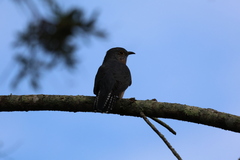
Cacomantis flabelliformis schistaceigularis (Sharpe, 1900) – Vanuatu. Cacomantis flabelliformis simus (Peale, 1848) – Fiji. The fan-tailed cuckoo is about 25–27 cm (9.8–10.6 in) long. The fan-tailed cuckoo has a slate-grey head, back and wings, rufous underparts and barred black and white tail. Its eye is surrounded by a yellow orbital eye ring which helps to distinguish it from the smaller and paler brush... Wikipedia →

Sounds

Song0:04

Australia · 2024

© Romuald Mikusek · XC1173892 · CC BY-NC-SA 4.0

Recording0:17

Australia · 2024

© Drew Davison · XC934932 · CC BY-NC-ND 4.0

Call0:04

Australia · 2024

© Khristos Nizamis · XC911100 · CC BY-NC-ND 4.0

Global Distribution

Parks Where Found

# Park Country Daily sighting probability
1 Maria Island National Park 🇦🇺 Australia
~40%
2 Lamington National Park 🇦🇺 Australia
~30%
3 Great Otway National Park 🇦🇺 Australia
~20%
4 Kosciuszko National Park 🇦🇺 Australia
~20%
5 Royal National Park 🇦🇺 Australia
~20%
6 Grampians National Park 🇦🇺 Australia
~20%
7 Blue Mountains National Park 🇦🇺 Australia
~20%
8 Springbrook National Park 🇦🇺 Australia
~20%
9 Cradle Mountain-Lake St Clair National Park 🇦🇺 Australia
~10%
10 Booderee National Park 🇦🇺 Australia
~10%
11 Wilsons Promontory National Park 🇦🇺 Australia
~10%
12 Flinders Chase 🇦🇺 Australia
~10%
13 Freycinet National Park 🇦🇺 Australia
<5%
14 Flinders Ranges National Park 🇦🇺 Australia
<5%
15 Noosa National Park 🇦🇺 Australia
<5%
16 Hattah-Kulkyne National Park 🇦🇺 Australia
<5%
17 Daintree National Park 🇦🇺 Australia
<5%

Cities Where Found

# City Country Daily sighting probability
1 Brisbane 🇦🇺 Australia
~10%
2 Melbourne 🇦🇺 Australia
<5%
3 Sydney 🇦🇺 Australia
<5%
4 Perth 🇦🇺 Australia
<5%
5 Hobart 🇦🇺 Australia
<5%

Before you go

What are the chances of seeing a Fan-tailed Cuckoo in Royal National Park?

Possible

About 20% of wildlife watchers report a Fan-tailed Cuckoo sighting in Royal National Park on a given day, based on 461 verified sightings from GBIF citizen-science data from 2019 to 2026. It is the 52nd most-seen of the 178 birds we can rate there. Over three days the chance rises to about 50%, and over a week to about 80%, if each day is a fresh chance.

When is the best time to see a Fan-tailed Cuckoo in Royal National Park?

September and October

In those months about 40% of wildlife watchers report a Fan-tailed Cuckoo in Royal National Park on a given day, against under 5% in February and July, the lowest months.

What time of day is best to see a Fan-tailed Cuckoo?

Between 10 am and 1 pm

Across all the parks we cover, that three-hour window holds the most Fan-tailed Cuckoo sightings with a recorded time, and nearly all of them come between 6 am and 6 pm: it is a daytime animal.

Which relatives of the Fan-tailed Cuckoo live in Royal National Park?

Same family: Cuculidae

The closest relatives of the Fan-tailed Cuckoo that you can see in Royal National Park (family Cuculidae, Cuckoos) are Pacific Koel (about 10%), Channel-billed Cuckoo (about 10%) and Shining Cuckoo (about 10%), with each one's daily chance of a sighting.

Where does the Fan-tailed Cuckoo sighting chance come from?

GBIF citizen-science records

It is estimated from how often the Fan-tailed Cuckoo is recorded against all the birds logged in Royal National Park (461 verified sightings from 2019 to 2026), calibrated against known sighting rates. Figures are rounded to the nearest 10% because citizen-science data supports honest approximations, not decimals, and months with records from fewer than five people show "—". How it works.

← Back to Royal National Park