Chestnut-headed Oropendola

Chestnut-headed Oropendola

Psarocolius wagleri

Silhouette: Sheatherius · PhyloPic

LCLeast ConcernNTVUENCR
Daily sighting probability ~20% · Possible
at San Lorenzo Protected Forest

In 3 days ~60% in a week ~90%

51 Verified sightings at San Lorenzo Protected Forest From 2019 to 2026
10,010 In all 26 parks
March Best month
☀️ Diurnal When it's spotted

About the Chestnut-headed Oropendola

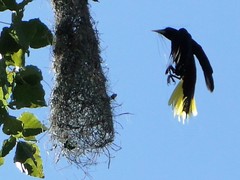
The chestnut-headed oropendola (Psarocolius wagleri) is a species of bird in the family Icteridae, the oropendolas, New World orioles, and New World blackbirds. It is found in Mexico, in every Central American country except El Salvador, and in Colombia and Ecuador.

The chestnut-headed oropendola was formally described in 1844 with an illustration and the binomial Cacicus Wagleri [sic]. Its specific epithet commemorates Johann Georg Wagler, who had erected genus Psarocolius in 1827. It eventually was reassigned to Psarocolius but for a time was placed in its own genus Zarhynchus.

Chestnut-headed oropendola males average 35 cm (14 in) long and females 28 cm (11 in). Males weigh an average of 214 g (7.5 oz) and females 113 g (4.0 oz). The species looks very long-winged in flight. Males have a slight crest. Adult males of the nominate subspecies have a dark purplish chestnut head, throat, and upper breast. Their body and wings are mostly black with a bluish gloss. Their rump and uppertail coverts are dark... Wikipedia →

Sounds

Song1:12

Guatemala · 2024

© Peter Boesman · XC880253 · CC BY-NC-ND 4.0

Recording0:31

Costa Rica · 2024

© Alain Verneau · XC863333 · CC BY-NC-SA 4.0

Call0:17

Panama · 2022

© Kent Livezey · XC733072 · CC BY-NC-ND 4.0

Global Distribution

Parks Where Found

# Park Country Daily sighting probability
1 Cerro Azul Meámbar National Park 🇭🇳 Honduras
~30%
2 Lago de Yojoa 🇭🇳 Honduras
~30%
3 Utría National Natural Park 🇨🇴 Colombia
~30%
4 San Lorenzo Protected Forest 🇵🇦 Panama
~20%
5 Cusuco National Park 🇭🇳 Honduras
~20%
6 Braulio Carrillo National Park 🇨🇷 Costa Rica
~20%
7 Chagres National Park 🇵🇦 Panama
~20%
8 Pico Bonito National Park 🇭🇳 Honduras
~20%
9 Farallones de Cali National Natural Park 🇨🇴 Colombia
~20%
10 Gandoca-Manzanillo Wildlife Refuge 🇨🇷 Costa Rica
~20%
11 Soberanía National Park 🇵🇦 Panama
~20%
12 Cahuita National Park 🇨🇷 Costa Rica
~10%
13 Arenal Volcano National Park 🇨🇷 Costa Rica
~10%
14 Cockscomb Basin Wildlife Sanctuary 🇧🇿 Belize
~10%
15 Chirripó National Park 🇨🇷 Costa Rica
~10%
16 Tenorio Volcano National Park 🇨🇷 Costa Rica
~10%
17 Darién National Park 🇵🇦 Panama
~10%
18 Tapantí-Macizo de la Muerte National Park 🇨🇷 Costa Rica
~10%
19 Tortuguero National Park 🇨🇷 Costa Rica
~10%
20 La Amistad International Park (Panama) 🇵🇦 Panama
<5%
21 Parque Natural Metropolitano 🇵🇦 Panama
<5%
22 Bastimentos Island National Marine Park 🇵🇦 Panama
<5%
23 Cañón del Sumidero National Park 🇲🇽 Mexico
<5%
24 Monteverde Cloud Forest Reserve 🇨🇷 Costa Rica
<5%
25 Poás Volcano National Park 🇨🇷 Costa Rica
<5%
26 Los Quetzales National Park 🇨🇷 Costa Rica
<5%

Cities Where Found

# City Country Daily sighting probability
1 San Pedro Sula 🇭🇳 Honduras
<5%
2 Panama City 🇵🇦 Panama
<5%
3 San José 🇨🇷 Costa Rica
<5%

Before you go

What are the chances of seeing a Chestnut-headed Oropendola in San Lorenzo Protected Forest?

Possible

About 20% of wildlife watchers report a Chestnut-headed Oropendola sighting in San Lorenzo Protected Forest on a given day, based on 51 verified sightings from GBIF citizen-science data from 2019 to 2026. It is the 53rd most-seen of the 249 birds we can rate there. Over three days the chance rises to about 60%, and over a week to about 90%, if each day is a fresh chance.

When is the best time to see a Chestnut-headed Oropendola in San Lorenzo Protected Forest?

March and November

In those months about 40% of wildlife watchers report a Chestnut-headed Oropendola in San Lorenzo Protected Forest on a given day, against about 10% in February and December, the lowest months.

What time of day is best to see a Chestnut-headed Oropendola?

Between 7 and 10 am

Across all the parks we cover, that three-hour window holds the most Chestnut-headed Oropendola sightings with a recorded time, and about 9 in 10 of them come between 6 am and 6 pm: it is a daytime animal.

Is San Lorenzo Protected Forest the best place to see a Chestnut-headed Oropendola?

4th of 26

Of the 26 parks where we can rate Chestnut-headed Oropendola sightings, San Lorenzo Protected Forest ranks 4th at about 20%. The best odds are in Cerro Azul Meámbar National Park (Honduras, about 30%), Lago de Yojoa (Honduras, about 30%) and Utría National Natural Park (Colombia, about 30%).

Where does the Chestnut-headed Oropendola sighting chance come from?

GBIF citizen-science records

It is estimated from how often the Chestnut-headed Oropendola is recorded against all the birds logged in San Lorenzo Protected Forest (51 verified sightings from 2019 to 2026), calibrated against known sighting rates. Figures are rounded to the nearest 10% because citizen-science data supports honest approximations, not decimals, and months with records from fewer than five people show "—". How it works.

← Back to San Lorenzo Protected Forest

