
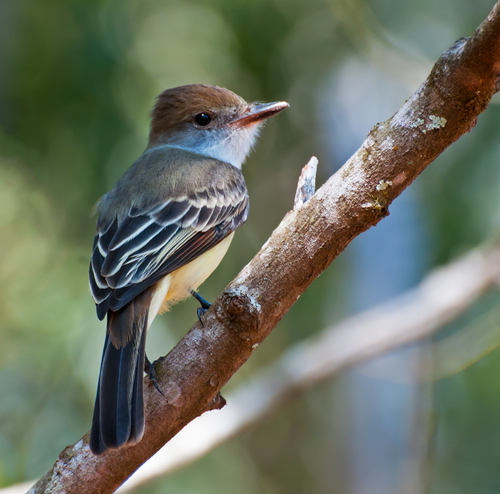
Yellow-throated Euphonia

Yellow-throated Euphonia

Euphonia hirundinacea

Silhouette: Sheatherius · PhyloPic

LCLeast ConcernNTVUENCR
Daily sighting probability ~10% · With luck
at Santa Rosa National Park

In 3 days ~30% in a week ~60%

75 Verified sightings at Santa Rosa National Park From 2019 to 2026
22,982 In all 30 parks
November Best month
☀️ Diurnal When it's spotted

About the Yellow-throated Euphonia

The yellow-throated euphonia (Euphonia hirundinacea) is a species of songbird in the family Fringillidae. It is found in southeastern Mexico and throughout Central America with its range stretching from Belize south to western Panama. It inhabits primarily both humid and dry regions where it prefers the forest edge, open woodland, and shaded plantations. It has two subspecies, the nominate subspecies Euphonia hirundinacea hirundinacea and Euphonia hirundinacea gnatho. This finch is a small bird with pointed wings and a short bill and short tail. Males of this species have dark glossy blue-black upperparts excluding a yellow forecrown, and bright yellow underparts, while females have olive green upperparts and whitish-gray breast and lower parts. It has a shrill song that alternates between high-pitched and moderately pitched and appears to be able to mimic some calls of other birds.

The yellow-throated euphonia is a frugivore that feeds primarily on mistletoe berries, which it swallows whole, and has also been observed feeding on figs and ripe bananas. Breeding dates range from March to August depending on locality. Breeding pairs work together to build a domed nest and visit the nest in pairs to feed hatchlings. It is listed as a species of least concern due to its stable population and large range. Wikipedia →

Sounds

Song1:04

Costa Rica · 2024

© Paul Driver · XC955441 · CC BY-NC-SA 4.0

Call0:31

Guatemala · 2024

© Peter Boesman · XC880108 · CC BY-NC-ND 4.0

Begging call0:47

Mexico · 2016

© Ross Gallardy · XC332604 · CC BY-NC-SA 4.0

Global Distribution

Parks Where Found

# Park Country Daily sighting probability
1 Tenorio Volcano National Park 🇨🇷 Costa Rica
~60%
2 Cerro Azul Meámbar National Park 🇭🇳 Honduras
~50%
3 Sian Ka'an Biosphere Reserve 🇲🇽 Mexico
~50%
4 Arenal Volcano National Park 🇨🇷 Costa Rica
~40%
5 Monteverde Cloud Forest Reserve 🇨🇷 Costa Rica
~40%
6 Tikal National Park 🇬🇹 Guatemala
~40%
7 Cañón del Sumidero National Park 🇲🇽 Mexico
~40%
8 Lago de Yojoa 🇭🇳 Honduras
~40%
9 Calakmul Biosphere Reserve 🇲🇽 Mexico
~30%
10 Cusuco National Park 🇭🇳 Honduras
~30%
11 Pico Bonito National Park 🇭🇳 Honduras
~30%
12 Rincón de la Vieja National Park 🇨🇷 Costa Rica
~30%
13 Cockscomb Basin Wildlife Sanctuary 🇧🇿 Belize
~20%
14 Montes Azules Biosphere Reserve 🇲🇽 Mexico
~20%
15 El Triunfo 🇲🇽 Mexico
~20%
16 Carara National Park 🇨🇷 Costa Rica
~20%
17 Santa Rosa National Park 🇨🇷 Costa Rica
~10%
18 Cabo Blanco Absolute Nature Reserve 🇨🇷 Costa Rica
~10%
19 Tapantí-Macizo de la Muerte National Park 🇨🇷 Costa Rica
~10%
20 Biotopo Cerro Cahuí 🇬🇹 Guatemala
~10%
21 Celaque National Park 🇭🇳 Honduras
~10%
22 Braulio Carrillo National Park 🇨🇷 Costa Rica
~10%
23 Ostional Wildlife Refuge 🇨🇷 Costa Rica
<5%
24 Cahuita National Park 🇨🇷 Costa Rica
<5%
25 Las Baulas Marine National Park 🇨🇷 Costa Rica
<5%
26 Poás Volcano National Park 🇨🇷 Costa Rica
<5%
27 Gandoca-Manzanillo Wildlife Refuge 🇨🇷 Costa Rica
<5%
28 Celestún Biosphere Reserve 🇲🇽 Mexico
<5%
29 Ría Lagartos Biosphere Reserve 🇲🇽 Mexico
<5%
30 Masaya Volcano National Park 🇳🇮 Nicaragua
<5%

Cities Where Found

# City Country Daily sighting probability
1 San José 🇨🇷 Costa Rica
~10%
2 San Pedro Sula 🇭🇳 Honduras
~10%
3 San Salvador 🇸🇻 El Salvador
<5%
4 Guatemala City 🇬🇹 Guatemala
<5%

Zoos & Centres Where Found

# Zoo / Centre Country
1 California Academy of Sciences 🇺🇸 United States In captivity
2 Xcaret 🇲🇽 Mexico In captivity

Before you go

What are the chances of seeing a Yellow-throated Euphonia in Santa Rosa National Park?

With luck

About 10% of wildlife watchers report a Yellow-throated Euphonia sighting in Santa Rosa National Park on a given day, based on 75 verified sightings from GBIF citizen-science data from 2019 to 2026. It is the 80th most-seen of the 233 birds we can rate there. Over three days the chance rises to about 30%, and over a week to about 60%, if each day is a fresh chance.

When is the best time to see a Yellow-throated Euphonia in Santa Rosa National Park?

November

In that month about 30% of wildlife watchers report a Yellow-throated Euphonia in Santa Rosa National Park on a given day, against under 5% in April and August, the lowest months.

What time of day is best to see a Yellow-throated Euphonia?

Between 8 and 11 am

Across all the parks we cover, that three-hour window holds the most Yellow-throated Euphonia sightings with a recorded time, and about 9 in 10 of them come between 6 am and 6 pm: it is a daytime animal.

Where does the Yellow-throated Euphonia sighting chance come from?

GBIF citizen-science records

It is estimated from how often the Yellow-throated Euphonia is recorded against all the birds logged in Santa Rosa National Park (75 verified sightings from 2019 to 2026), calibrated against known sighting rates. Figures are rounded to the nearest 10% because citizen-science data supports honest approximations, not decimals, and months with records from fewer than five people show "—". How it works.

← Back to Santa Rosa National Park