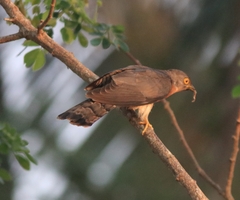
Common Hawk-Cuckoo

Common Hawk-Cuckoo

Cuculus varius

Silhouette: Nicolas Huet le Jeune and Jean-Gabriel Prêtre (vectorized by T. Michael Keesey) · PhyloPic

Daily sighting probability ~20% · Possible
at Satpura National Park

In 3 days ~40% in a week ~70%

217 Verified sightings at Satpura National Park From 2019 to 2026
14,919 In all 21 parks
May Best month
☀️ Diurnal When it's spotted

About the Common Hawk-Cuckoo

The common hawk-cuckoo (Hierococcyx varius), popularly known as the brainfever bird, is a medium-sized cuckoo resident in the Indian subcontinent. It bears a close resemblance to the shikra, even in its style of flying and landing on a perch. The resemblance to hawks gives this group the generic name of hawk-cuckoo; like many other cuckoos, these are brood parasites, laying their eggs in the nests of babblers. During their breeding season in summer males produce loud, repetitive three-note calls that are well-rendered as brain-fever, the second note being longer and higher pitched. These notes rise to a crescendo before ending abruptly and repeat after a few minutes; the calling may go on through the day, well after dusk and before dawn.

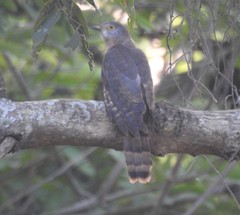
The common hawk-cuckoo is a medium- to large-sized cuckoo, about the size of a pigeon (ca. 34 cm). The plumage is ashy grey above; whitish below, cross-barred with brown. The tail is broadly barred. The sexes are alike. They have a distinctive yellow eye ring. Subadults have the breast streaked, similar to the immature shikra, and there are large brown chevron marks on the belly. At first glance they can be mistaken for a hawk. When... Wikipedia →

Sounds

Recording0:24

India · 2026

© Bikash Kumar Sahoo · iNaturalist · CC BY-NC 4.0

Recording0:05

Bangladesh · 2024

© Manoli Strecker · iNaturalist · CC BY-NC 4.0

Recording0:13

India · 2024

© sunnyjosef · iNaturalist · CC BY 4.0

Global Distribution

Parks Where Found

# Park Country Daily sighting probability
1 Kanha National Park 🇮🇳 India
~50%
2 Bandhavgarh National Park 🇮🇳 India
~40%
3 Periyar National Park 🇮🇳 India
~40%
4 Nagarhole National Park 🇮🇳 India
~40%
5 Mudumalai National Park 🇮🇳 India
~30%
6 Royal Bardia National Park 🇳🇵 Nepal
~30%
7 Bandipur National Park 🇮🇳 India
~20%
8 Chitwan National Park 🇳🇵 Nepal
~20%
9 Jim Corbett National Park 🇮🇳 India
~20%
10 Satpura National Park 🇮🇳 India
~20%
11 Manas National Park 🇮🇳 India
~20%
12 Keoladeo National Park 🇮🇳 India
~20%
13 Ranthambore National Park 🇮🇳 India
~10%
14 Sundarbans National Park 🇮🇳 India
~10%
15 Horton Plains National Park 🇱🇰 Sri Lanka
~10%
16 Sinharaja Forest Reserve 🇱🇰 Sri Lanka
<5%
17 Minneriya National Park 🇱🇰 Sri Lanka
<5%
18 Royal Manas National Park 🇧🇹 Bhutan
<5%
19 Eravikulam National Park 🇮🇳 India
<5%
20 Yala National Park 🇱🇰 Sri Lanka
<5%
21 Kaziranga National Park 🇮🇳 India
<5%

Cities Where Found

# City Country Daily sighting probability
1 Bhubaneshwar 🇮🇳 India
~50%
2 Asansol 🇮🇳 India
~50%
3 Tamluk 🇮🇳 India
~50%
4 Savar 🇧🇩 Bangladesh
~40%
5 Patna 🇮🇳 India
~30%
6 Guwahati 🇮🇳 India
~30%
7 Bareilly 🇮🇳 India
~30%
8 Durg 🇮🇳 India
~20%
9 Tiruppur 🇮🇳 India
~20%
10 Tiruchirappalli 🇮🇳 India
~20%

Zoos & Centres Where Found

# Zoo / Centre Country
1 Nehru Zoological Park 🇮🇳 India In captivity

Before you go

What are the chances of seeing a Common Hawk-Cuckoo in Satpura National Park?

Possible

About 20% of wildlife watchers report a Common Hawk-Cuckoo sighting in Satpura National Park on a given day, based on 217 verified sightings from GBIF citizen-science data from 2019 to 2026. It is the 64th most-seen of the 259 birds we can rate there. Over three days the chance rises to about 40%, and over a week to about 70%, if each day is a fresh chance.

When is the best time to see a Common Hawk-Cuckoo in Satpura National Park?

May and June

In those months about 50% of wildlife watchers report a Common Hawk-Cuckoo in Satpura National Park on a given day, against about 10% in October to March, the lowest months.

What time of day is best to see a Common Hawk-Cuckoo?

Between 7 and 10 am

Across all the parks we cover, that three-hour window holds the most Common Hawk-Cuckoo sightings with a recorded time, and about 8 in 10 of them come between 6 am and 6 pm: it is a daytime animal.

Where does the Common Hawk-Cuckoo sighting chance come from?

GBIF citizen-science records

It is estimated from how often the Common Hawk-Cuckoo is recorded against all the birds logged in Satpura National Park (217 verified sightings from 2019 to 2026), calibrated against known sighting rates. Figures are rounded to the nearest 10% because citizen-science data supports honest approximations, not decimals, and months with records from fewer than five people show "—". How it works.

← Back to Satpura National Park