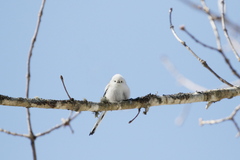
Long-tailed Tit

Long-tailed Tit

Aegithalos caudatus

Silhouette: Matt Wilkins (photo by Andreas Trepte, www.photo-natur.net) · PhyloPic

LCLeast ConcernNTVUENCR
Daily sighting probability ~40% · Likely
at Sierra de Guadarrama National Park

In 3 days ~70% in a week >90%

1,679 Verified sightings at Sierra de Guadarrama National Park From 2019 to 2026
8,220 In all 26 parks
February Best month
☀️ Diurnal When it's spotted

About the Long-tailed Tit

The long-tailed tit or long-tailed bushtit (Aegithalos caudatus) is a common bird species belonging to the bushtit family found throughout Eurasia. An insectivore, it inhabits deciduous and mixed woodlands as well as scrub, heathland, farmland, parks and gardens. The plumage of this small long-tailed bird is predominantly black and white with varying amounts of pink and grey. Northern subspecies are paler and have completely white heads, lacking the large dark eyebrows of southern populations. It is a social bird that forms compact family flocks of six to seventeen individuals outside of the breeding season, when these flocks break up. It has a strong preference for nesting in scrub areas and often builds its nest in thorny bushes less than 3 metres (10 feet) above the ground.

The long-tailed tit was formally described by the Swedish naturalist Carl Linnaeus in 1758 in the tenth edition of his Systema Naturae under the binomial name Parus caudatus. The current genus name Aegithalos was a term used by Aristotle for some European tits, including the long-tailed tit. The specific epithet caudatus is the Latin word for "tailed". Linnaeus did not invent this... Wikipedia →

Sounds

Call0:43

China · 2026

© Peter Boesman · XC1147337 · CC BY-NC-ND 4.0

Alarm call0:05

Poland · 2024

© Jarek Matusiak · XC951577 · CC BY-NC-ND 4.0

Anxious call0:38

Spain · 2024

© Jacobo Ramil Millarengo · XC909344 · CC BY-NC-SA 4.0

Global Distribution

Parks Where Found

# Park Country Daily sighting probability
1 Nikko National Park 🇯🇵 Japan
~60%
2 Sierra Nevada National Park 🇪🇸 Spain
~40%
3 Aigüestortes National Park 🇪🇸 Spain
~40%
4 Sierra de Guadarrama National Park 🇪🇸 Spain
~40%
5 Snowdonia National Park 🇬🇧 United Kingdom
~30%
6 Ordesa y Monte Perdido National Park 🇪🇸 Spain
~30%
7 Monfragüe National Park 🇪🇸 Spain
~30%
8 Pyrénées National Park 🇫🇷 France
~20%
9 Białowieża National Park 🇵🇱 Poland
~20%
10 Kiskunság National Park 🇭🇺 Hungary
~20%
11 Cairngorms National Park 🇬🇧 United Kingdom
~20%
12 Cévennes National Park 🇫🇷 France
~20%
13 Doñana National Park 🇪🇸 Spain
~20%
14 Plitvice Lakes National Park 🇭🇷 Croatia
~20%
15 Picos de Europa National Park 🇪🇸 Spain
~20%
16 Hortobágy National Park 🇭🇺 Hungary
~20%
17 Tatra National Park 🇸🇰 Slovakia
~20%
18 Triglav National Park 🇸🇮 Slovenia
~20%
19 Bavarian Forest National Park 🇩🇪 Germany
~10%
20 Fertő-Hanság National Park 🇭🇺 Hungary
~10%
21 Biebrza National Park 🇵🇱 Poland
~10%
22 Ecrins National Park 🇫🇷 France
~10%
23 Mercantour National Park 🇫🇷 France
~10%
24 Gauja National Park 🇱🇻 Latvia
<5%
25 Camargue 🇫🇷 France
<5%
26 Wadden Sea National Park 🇩🇪 Germany
<5%

Cities Where Found

# City Country Daily sighting probability
1 Manchester 🇬🇧 United Kingdom
~60%
2 Turin 🇮🇹 Italy
~60%
3 Milan 🇮🇹 Italy
~60%
4 Seoul 🇰🇷 South Korea
~50%
5 Birmingham 🇬🇧 United Kingdom
~50%
6 Daejeon 🇰🇷 South Korea
~50%
7 Sendai 🇯🇵 Japan
~50%
8 London 🇬🇧 United Kingdom
~40%
9 Gwangju 🇰🇷 South Korea
~40%
10 Budapest 🇭🇺 Hungary
~40%

Zoos & Centres Where Found

# Zoo / Centre Country
1 Beijing Wildlife Park 🇨🇳 China In captivity

Before you go

What are the chances of seeing a Long-tailed Tit in Sierra de Guadarrama National Park?

Likely

About 40% of wildlife watchers report a Long-tailed Tit sighting in Sierra de Guadarrama National Park on a given day, based on 1,679 verified sightings from GBIF citizen-science data from 2019 to 2026. It is the 18th most-seen of the 202 birds we can rate there. Over three days the chance rises to about 70%, and over a week to over 90%, if each day is a fresh chance.

When is the best time to see a Long-tailed Tit in Sierra de Guadarrama National Park?

February

In that month about 60% of wildlife watchers report a Long-tailed Tit in Sierra de Guadarrama National Park on a given day, against about 20% in June and July, the lowest months.

What time of day is best to see a Long-tailed Tit?

Between 11 am and 2 pm

Across all the parks we cover, that three-hour window holds the most Long-tailed Tit sightings with a recorded time, and about 8 in 10 of them come between 6 am and 6 pm: it is a daytime animal.

Which relatives of the Long-tailed Tit live in Sierra de Guadarrama National Park?

Same order: Passeriformes

The closest relatives of the Long-tailed Tit that you can see in Sierra de Guadarrama National Park (order Passeriformes, Perching Birds) are Chaffinch (about 70%), Eurasian Blackbird (about 60%) and Great Tit (about 60%), with each one's daily chance of a sighting.

Where does the Long-tailed Tit sighting chance come from?

GBIF citizen-science records

It is estimated from how often the Long-tailed Tit is recorded against all the birds logged in Sierra de Guadarrama National Park (1,679 verified sightings from 2019 to 2026), calibrated against known sighting rates. Figures are rounded to the nearest 10% because citizen-science data supports honest approximations, not decimals, and months with records from fewer than five people show "—". How it works.

← Back to Sierra de Guadarrama National Park