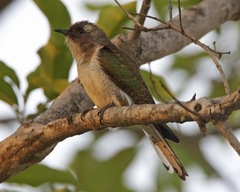
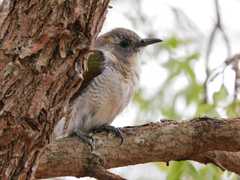

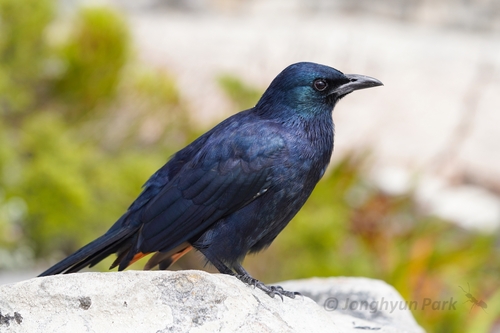
Klaas's Cuckoo

Klaas's Cuckoo

Chrysococcyx klaas

Silhouette: Nicolas Huet le Jeune and Jean-Gabriel Prêtre (vectorized by T. Michael Keesey) · PhyloPic

LCLeast ConcernNTVUENCR
Daily sighting probability <5% · Rare
at Table Mountain National Park

In 3 days ~10% in a week ~20%

252 Verified sightings at Table Mountain National Park From 2019 to 2026
4,299 In all 48 parks
October Best month
☀️ Diurnal When it's spotted

About the Klaas's Cuckoo

Klaas's cuckoo (Chrysococcyx klaas) is a species of cuckoo in the family Cuculidae which is native to the wooded regions of sub-Saharan Africa. The specific name honours Klaas, the Khoikhoi man who collected the type specimen.

The species was named Le Coucou de Klaas by French explorer François Le Vaillant in 1806, in his book Histoire naturelle des oiseaux d'Afrique in recognition of his Khoikhoi servant and assistant, named Klaas, who found the type specimen. Le Vaillant wrote:...mon ami Klaas... Recois l'hommage que je t'adresse ici... Puissent les naturalistes conserver à l'espèce que je vais décrire, le nom que je lui donne, et consacre ainsi les services que tu m'as rendus: ils me prouveront par là que mes travaux ont eu quelque prix à leurs yeux.

Le Vaillant's wish was honoured when the bird's first binomial name, Cuculus klaas, was applied by James Francis Stephens in 1815, and the tribute to Klaas has persisted to the present binomial. The bird is the first known case of a species being named after an Indigenous individual, and Le Vaillant is one of the only colonial biologists to name bird species after local people. Edgar Leopold Layard named the brown-breasted... Wikipedia →

Sounds

Call0:06

South Africa · 2022

© Nick Schaller · XC757706 · CC BY-NC-SA 4.0

Song0:04

Kenya

© isaac kilusu · XC694796 · CC BY-NC-SA 4.0

Song1:16

South Africa · 2021

© Tim Cockcroft · XC684232 · CC BY-NC-SA 4.0

Global Distribution

Parks Where Found

# Park Country Daily sighting probability
1 Kibale National Park 🇺🇬 Uganda
~20%
2 Meru National Park 🇰🇪 Kenya
~20%
3 uMkhuze Game Reserve 🇿🇦 South Africa
~20%
4 Odzala-Kokoua National Park 🇨🇬 Republic of the Congo
~20%
5 Gonarezhou National Park 🇿🇼 Zimbabwe
~20%
6 Niokolo-Koba National Park 🇸🇳 Senegal
~20%
7 Awash National Park 🇪🇹 Ethiopia
~20%
8 Ruaha National Park 🇹🇿 Tanzania
~20%
9 iSimangaliso Wetland Park 🇿🇦 South Africa
~10%
10 Lake Mburo National Park 🇺🇬 Uganda
~10%
11 Virunga National Park 🇨🇩 Democratic Republic of the Congo
~10%
12 Nairobi National Park 🇰🇪 Kenya
~10%
13 Garden Route National Park 🇿🇦 South Africa
~10%
14 Lake Nakuru National Park 🇰🇪 Kenya
~10%
15 Semuliki National Park 🇺🇬 Uganda
~10%
16 Bwindi Impenetrable National Park 🇺🇬 Uganda
~10%
17 Kruger National Park 🇿🇦 South Africa
~10%
18 Liwonde National Park 🇲🇼 Malawi
~10%
19 Tsavo East National Park 🇰🇪 Kenya
~10%
20 Tsavo West National Park 🇰🇪 Kenya
~10%
21 Akagera National Park 🇷🇼 Rwanda
~10%
22 De Hoop Nature Reserve 🇿🇦 South Africa
~10%
23 Masai Mara National Reserve 🇰🇪 Kenya
~10%
24 Arusha National Park 🇹🇿 Tanzania
~10%
25 Queen Elizabeth National Park 🇺🇬 Uganda
~10%
26 Hluhluwe-Imfolozi Park 🇿🇦 South Africa
~10%
27 Ngorongoro Conservation Area 🇹🇿 Tanzania
~10%
28 Kidepo Valley National Park 🇺🇬 Uganda
~10%
29 Mkomazi National Park 🇹🇿 Tanzania
~10%
30 Samburu National Reserve 🇰🇪 Kenya
~10%
31 Aberdare National Park 🇰🇪 Kenya
~10%
32 Volcanoes National Park 🇷🇼 Rwanda
~10%
33 Murchison Falls National Park 🇺🇬 Uganda
<5%
34 Lake Manyara National Park 🇹🇿 Tanzania
<5%
35 Mikumi National Park 🇹🇿 Tanzania
<5%
36 Serengeti National Park 🇹🇿 Tanzania
<5%
37 Addo Elephant National Park 🇿🇦 South Africa
<5%
38 Kafue National Park 🇿🇲 Zambia
<5%
39 Tarangire National Park 🇹🇿 Tanzania
<5%
40 Nyungwe National Park 🇷🇼 Rwanda
<5%
41 Mana Pools National Park 🇿🇼 Zimbabwe
<5%
42 Pilanesberg National Park 🇿🇦 South Africa
<5%
43 Table Mountain National Park 🇿🇦 South Africa
<5%
44 South Luangwa National Park 🇿🇲 Zambia
<5%
45 Hwange National Park 🇿🇼 Zimbabwe
<5%
46 Chobe National Park 🇧🇼 Botswana
<5%
47 Amboseli National Park 🇰🇪 Kenya
<5%
48 West Coast National Park 🇿🇦 South Africa
<5%

Cities Where Found

# City Country Daily sighting probability
1 Kampala 🇺🇬 Uganda
~30%
2 Ouagadougou 🇧🇫 Burkina Faso
~20%
3 Brazzaville 🇨🇬 Republic of the Congo
~20%
4 Mombasa 🇰🇪 Kenya
~20%
5 Nairobi 🇰🇪 Kenya
~10%
6 Yaoundé 🇨🇲 Cameroon
~10%
7 Dar es-Salaam 🇹🇿 Tanzania
~10%
8 Abuja 🇳🇬 Nigeria
~10%
9 Freetown 🇸🇱 Sierra Leone
~10%
10 Kigali 🇷🇼 Rwanda
~10%

Before you go

What are the chances of seeing a Klaas's Cuckoo in Table Mountain National Park?

Rare

Under 5% of wildlife watchers report a Klaas's Cuckoo sighting in Table Mountain National Park on a given day, based on 252 verified sightings from GBIF citizen-science data from 2019 to 2026. It is the 127th most-seen of the 223 birds we can rate there. Over three days the chance rises to about 10%, and over a week to about 20%, if each day is a fresh chance.

When is the best time to see a Klaas's Cuckoo in Table Mountain National Park?

Any time of year

In every month with enough records, under 5% of wildlife watchers report a Klaas's Cuckoo in Table Mountain National Park on a given day, so our monthly data shows no clear season.

What time of day is best to see a Klaas's Cuckoo?

Between 7 and 10 am

Across all the parks we cover, that three-hour window holds the most Klaas's Cuckoo sightings with a recorded time, and about 9 in 10 of them come between 6 am and 6 pm: it is a daytime animal.

Is Table Mountain National Park the best place to see a Klaas's Cuckoo?

43rd of 48

Of the 48 parks where we can rate Klaas's Cuckoo sightings, Table Mountain National Park ranks 43rd at under 5%. The best odds are in Kibale National Park (Uganda, about 20%), Meru National Park (Kenya, about 20%) and uMkhuze Game Reserve (South Africa, about 20%).

Where does the Klaas's Cuckoo sighting chance come from?

GBIF citizen-science records

It is estimated from how often the Klaas's Cuckoo is recorded against all the birds logged in Table Mountain National Park (252 verified sightings from 2019 to 2026), calibrated against known sighting rates. Figures are rounded to the nearest 10% because citizen-science data supports honest approximations, not decimals, and months with records from fewer than five people show "—". How it works.

← Back to Table Mountain National Park