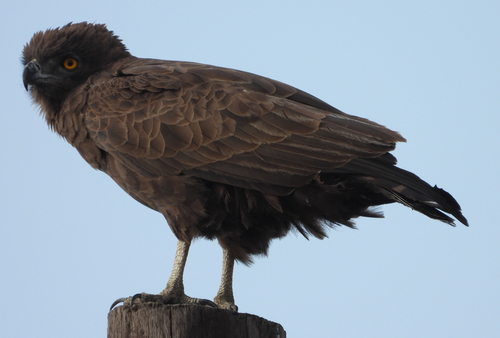
European Honey-buzzard

European Honey-buzzard

Pernis apivorus

Silhouette: Andy Wilson · PhyloPic

LCLeast ConcernNTVUENCR
Daily sighting probability <5% · Rare
at Tsavo East National Park

In 3 days <5% in a week ~10%

6 Verified sightings at Tsavo East National Park From 2019 to 2026
1,402 In all 33 parks
November Best month
☀️ Diurnal When it's spotted

About the European Honey-buzzard

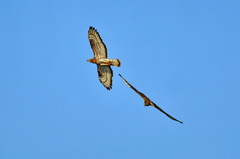
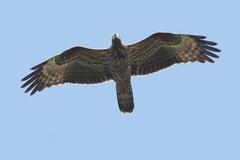
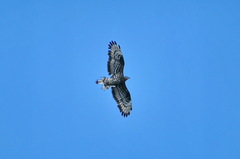
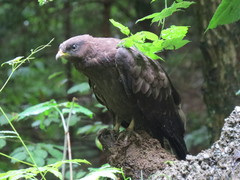
The European honey buzzard (Pernis apivorus) is an insectivorous bird of prey in the family Accipitridae breeding in Europe and western Asia, and wintering in Africa. The European honey buzzard was formally described in 1758 by Carl Linnaeus in the 10th edition of Systema Naturae. He placed it with the falcons and eagles in the genus Falco and coined the binomial name Falco apivorus. Linnaeus cited earlier works including the 1678 description by the English naturalist Francis Willughby and the 1713 description by John Ray.

The European honey buzzard is one of four species now placed in the genus Pernis that was described by Georges Cuvier in 1816. It is a monotypic species, with no subspecies being recognised. The genus is more closely related to kites in the genera Leptodon and Chondrohierax, than to the true buzzards in Buteo.

The binomen is derived from Ancient Greek pernes πέρνης, a term used by Aristotle for a bird of prey, and Latin apivorus "bee-eating", from apis, "bee" and -vorus, "-eating". In the 19th century, it was also sometimes known as the 'pern' or 'common pern', from the scientific name.

The European honey buzzard is... Wikipedia →

Sounds

Call1:06

Slovenia · 2026

© Dare Šere · XC1175103 · CC BY-NC-ND 4.0

Alarm call0:36

Sweden · 2023

© Lars Edenius · XC826297 · CC BY-NC-SA 4.0

Flight call0:35

Italy · 2023

© Gianluca Congi · XC822433 · CC BY-NC-SA 4.0

Global Distribution

Parks Where Found

# Park Country Daily sighting probability
1 Odzala-Kokoua National Park 🇨🇬 Republic of the Congo
~20%
2 Pyrénées National Park 🇫🇷 France
~10%
3 Białowieża National Park 🇵🇱 Poland
~10%
4 Ordesa y Monte Perdido National Park 🇪🇸 Spain
~10%
5 Plitvice Lakes National Park 🇭🇷 Croatia
~10%
6 Picos de Europa National Park 🇪🇸 Spain
~10%
7 Cévennes National Park 🇫🇷 France
~10%
8 Biebrza National Park 🇵🇱 Poland
<5%
9 Triglav National Park 🇸🇮 Slovenia
<5%
10 Kiskunság National Park 🇭🇺 Hungary
<5%
11 Aigüestortes National Park 🇪🇸 Spain
<5%
12 Sierra Nevada National Park 🇪🇸 Spain
<5%
13 Fertő-Hanság National Park 🇭🇺 Hungary
<5%
14 Sierra de Guadarrama National Park 🇪🇸 Spain
<5%
15 Gauja National Park 🇱🇻 Latvia
<5%
16 Camargue 🇫🇷 France
<5%
17 Ngorongoro Conservation Area 🇹🇿 Tanzania
<5%
18 Kibale National Park 🇺🇬 Uganda
<5%
19 Hortobágy National Park 🇭🇺 Hungary
<5%
20 Monfragüe National Park 🇪🇸 Spain
<5%
21 iSimangaliso Wetland Park 🇿🇦 South Africa
<5%
22 Akagera National Park 🇷🇼 Rwanda
<5%
23 Tsavo West National Park 🇰🇪 Kenya
<5%
24 Tarangire National Park 🇹🇿 Tanzania
<5%
25 Tsavo East National Park 🇰🇪 Kenya
<5%
26 Arusha National Park 🇹🇿 Tanzania
<5%
27 Serengeti National Park 🇹🇿 Tanzania
<5%
28 Lake Nakuru National Park 🇰🇪 Kenya
<5%
29 Wadden Sea National Park 🇩🇪 Germany
<5%
30 Nyungwe National Park 🇷🇼 Rwanda
<5%
31 Table Mountain National Park 🇿🇦 South Africa
<5%
32 Bwindi Impenetrable National Park 🇺🇬 Uganda
<5%
33 Masai Mara National Reserve 🇰🇪 Kenya
<5%

Cities Where Found

# City Country Daily sighting probability
1 Algiers 🇩🇿 Algeria
~20%
2 Ramallah 🇵🇸 Palestine
~10%
3 Istanbul 🇹🇷 Turkey
~10%
4 Novosibirsk 🇷🇺 Russia
~10%
5 Jerusalem 🇮🇱 Israel
~10%
6 Bengaluru 🇮🇳 India
~10%
7 Kazan 🇷🇺 Russia
~10%
8 Helsinki 🇫🇮 Finland
<5%
9 Amman 🇯🇴 Jordan
<5%
10 Tel Aviv 🇮🇱 Israel
<5%

Zoos & Centres Where Found

# Zoo / Centre Country
1 Prague Zoo 🇨🇿 Czechia In captivity
2 Ranua Wildlife Park 🇫🇮 Finland In captivity
3 Heinola bird sanctuary 🇫🇮 Finland In captivity
4 Lusen National Park Centre 🇩🇪 Germany In captivity
5 Wisentgehege Springe 🇩🇪 Germany In captivity
6 Tallinn Zoo 🇪🇪 Estonia In captivity
7 Budapest Zoo & Botanical Garden 🇭🇺 Hungary In captivity
8 Minsk Zoo 🇧🇾 Belarus In captivity
9 Wildpark Tannenbusch 🇩🇪 Germany In captivity
10 Zoopark Limpopo 🇷🇺 Russia In captivity
11 Alpenzoo Innsbruck 🇦🇹 Austria In captivity
12 Ивановский зоопарк 🇷🇺 Russia In captivity
13 Rákosův pavilon 🇨🇿 Czechia In captivity
14 Velemlokárium 🇨🇿 Czechia In captivity
15 Birding center in Eilat 🇮🇱 Israel In captivity
16 Дэльфінарый 🇧🇾 Belarus In captivity

Before you go

What are the chances of seeing a European Honey-buzzard in Tsavo East National Park?

Rare

Under 5% of wildlife watchers report a European Honey-buzzard sighting in Tsavo East National Park on a given day, based on 6 verified sightings from GBIF citizen-science data from 2019 to 2026. It is the 322nd most-seen of the 345 birds we can rate there. Over three days the chance rises to under 5%, and over a week to about 10%, if each day is a fresh chance.

When is the best time to see a European Honey-buzzard in Tsavo East National Park?

Any time of year

In every month with enough records, under 5% of wildlife watchers report a European Honey-buzzard in Tsavo East National Park on a given day, so our monthly data shows no clear season.

What time of day is best to see a European Honey-buzzard?

Between 11 am and 2 pm

Across all the parks we cover, that three-hour window holds the most European Honey-buzzard sightings with a recorded time, and about 9 in 10 of them come between 6 am and 6 pm: it is a daytime animal.

Which relatives of the European Honey-buzzard live in Tsavo East National Park?

Same family: Accipitridae

The closest relatives of the European Honey-buzzard that you can see in Tsavo East National Park (family Accipitridae, Hawks, Eagles, and Kites) are Bateleur (about 50%), Tawny Eagle (about 40%) and Eastern Chanting-Goshawk (about 40%), with each one's daily chance of a sighting.

Where does the European Honey-buzzard sighting chance come from?

GBIF citizen-science records

It is estimated from how often the European Honey-buzzard is recorded against all the birds logged in Tsavo East National Park (6 verified sightings from 2019 to 2026), calibrated against known sighting rates. Figures are rounded to the nearest 10% because citizen-science data supports honest approximations, not decimals, and months with records from fewer than five people show "—". How it works.

← Back to Tsavo East National Park