Ruddy Shelduck

Ruddy Shelduck

Tadorna ferruginea

Silhouette: Rebecca Groom · PhyloPic

LCLeast ConcernNTVUENCR
Daily sighting probability <5% · Rare
at Wadden Sea National Park

In 3 days ~10%

164 Verified sightings at Wadden Sea National Park From 2019 to 2026
6,022 In all 18 parks
August Best month
☀️ Diurnal When it's spotted

About the Ruddy Shelduck

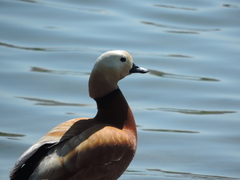
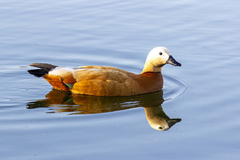
The ruddy shelduck (Tadorna ferruginea) is a bird species in the family Anatidae. It is a distinctive waterfowl, 58 to 70 cm (23 to 28 in) in length with a wingspan of 110 to 135 cm (43 to 53 in). It has orange-brown body plumage with a paler head, while the tail and the flight feathers in the wings are black, contrasting with the white wing-coverts. It is a migratory bird, wintering in the Indian subcontinent and breeding in southeastern Europe and central Asia, though there are small resident populations in North Africa. It has a loud honking call.

The ruddy shelduck mostly inhabits inland water-bodies such as lakes, reservoirs and rivers. The male and female form a lasting pair bond and the nest may be well away from water, in a crevice or hole in a cliff, tree or similar site. A clutch of about eight eggs is laid and is incubated solely by the female for about four weeks. The young are cared for by both parents and fledge about eight weeks after hatching.

In central and eastern Asia populations are steady or rising, but in Europe they are generally in decline. Altogether, the birds have a wide range and large total population, and the International Union for Conservation of Nature has assessed their conservation status as being of least concern. Wikipedia →

Sounds

Call0:47

China · 2026

© Bo Shunqi 薄顺奇 · XC1174800 · CC BY-NC-SA 4.0

Uncertain0:27

China · 2025

© JJSUN · XC1063339 · CC BY-NC-SA 4.0

Flight call0:22

Germany · 2025

© b_hirschmann · XC1051274 · CC BY-NC-ND 4.0

Global Distribution

Parks Where Found

# Park Country Daily sighting probability
1 Kaziranga National Park 🇮🇳 India
~60%
2 Chitwan National Park 🇳🇵 Nepal
~50%
3 Bale Mountains National Park 🇪🇹 Ethiopia
~40%
4 Keoladeo National Park 🇮🇳 India
~40%
5 Gobi Gurvansaikhan National Park 🇲🇳 Mongolia
~30%
6 Ranthambore National Park 🇮🇳 India
~30%
7 Royal Bardia National Park 🇳🇵 Nepal
~20%
8 Sierra de Guadarrama National Park 🇪🇸 Spain
~20%
9 Satpura National Park 🇮🇳 India
~10%
10 Jim Corbett National Park 🇮🇳 India
~10%
11 Manas National Park 🇮🇳 India
<5%
12 Bavarian Forest National Park 🇩🇪 Germany
<5%
13 Wadden Sea National Park 🇩🇪 Germany
<5%
14 Bandhavgarh National Park 🇮🇳 India
<5%
15 Royal Manas National Park 🇧🇹 Bhutan
<5%
16 Fertő-Hanság National Park 🇭🇺 Hungary
<5%
17 Doñana National Park 🇪🇸 Spain
<5%
18 Kanha National Park 🇮🇳 India
<5%

Cities Where Found

# City Country Daily sighting probability
1 Agra 🇮🇳 India
~50%
2 Moscow 🇷🇺 Russia
~40%
3 Zhengzhou 🇨🇳 China
~30%
4 Tianjin 🇨🇳 China
~20%
5 Kazan 🇷🇺 Russia
~20%
6 Beijing 🇨🇳 China
~20%
7 Dalian 🇨🇳 China
~20%
8 Ulaanbaatar 🇲🇳 Mongolia
~20%
9 Visakhapatnam 🇮🇳 India
~10%
10 Bhopal 🇮🇳 India
~10%

Zoos & Centres Where Found

# Zoo / Centre Country
1 Busch Gardens Tampa 🇺🇸 United States In captivity
2 Moscow Zoo 🇷🇺 Russia In captivity
3 Pairi Daiza 🇧🇪 Belgium In captivity
4 Prague Zoo 🇨🇿 Czechia In captivity
5 Denver Zoo 🇺🇸 United States In captivity
6 Cincinnati Zoo and Botanical Garden 🇺🇸 United States In captivity
7 Paris Zoological Park 🇫🇷 France In captivity
8 Zoo Pilsen 🇨🇿 Czechia In captivity
9 Réserve africaine de Sigean 🇫🇷 France In captivity
10 Zoo Hluboka 🇨🇿 Czechia In captivity
11 Kaliningrad Zoo 🇷🇺 Russia In captivity
12 Aquarium du palais de la Porte Dorée 🇫🇷 France In captivity
13 Zoobotánico Jerez 🇪🇸 Spain In captivity
14 Al Hefaiyah Reserve 🇦🇪 United Arab Emirates In captivity
15 Zoo Miami 🇺🇸 United States In captivity
16 Chengdu Research Base of Giant Panda Breeding 🇨🇳 China In captivity
17 Shanghai Wild Animal Park 🇨🇳 China In captivity
18 Kansas City Zoo 🇺🇸 United States In captivity
19 Parc zoologique de Montpellier 🇫🇷 France In captivity
20 Beijing Zoo 🇨🇳 China In captivity
21 Omaha’s Henry Doorly Zoo and Aquarium 🇺🇸 United States In captivity
22 江苏淹城野生动物世界 🇨🇳 China In captivity
23 Chester Zoo 🇬🇧 United Kingdom In captivity
24 Nanjing Hongshan Forest Zoo 🇨🇳 China In captivity
25 Zoo and Botanical Garden of Branféré 🇫🇷 France In captivity
26 Slimbridge Wetland Centre 🇬🇧 United Kingdom In captivity
27 Cape May County Park & Zoo 🇺🇸 United States In captivity
28 São Paulo Zoo 🇧🇷 Brazil In captivity
29 İzmir Wildlife Park 🇹🇷 Türkiye In captivity
30 Selwo Aventura 🇪🇸 Spain In captivity
31 Sanjay Gandhi Biological Park 🇮🇳 India In captivity
32 Antalya Zoo 🇹🇷 Türkiye In captivity
33 Карельский зоопарк 🇷🇺 Russia In captivity
34 Novosibirsk Zoo 🇷🇺 Russia In captivity
35 Guangzhou Zoo 🇨🇳 China In captivity
36 Mysore Zoo 🇮🇳 India In captivity
37 Yerevan Zoo 🇦🇲 Armenia In captivity
38 Kyiv Zoo 🇺🇦 Ukraine In captivity
39 Berlin Zoological Garden 🇩🇪 Germany In captivity
40 Zoológico de Goiânia 🇧🇷 Brazil In captivity
41 Temaikén 🇦🇷 Argentina In captivity
42 Darling Downs Zoo 🇦🇺 Australia In captivity
43 Diergaarde Blijdorp 🇳🇱 Netherlands In captivity
44 Catoctin Wildlife Preserve and Zoo 🇺🇸 United States In captivity
45 Belgorod Zoo 🇷🇺 Russia In captivity
46 Taronga Zoo 🇦🇺 Australia In captivity
47 Chișinău Zoo 🇲🇩 Moldova In captivity
48 Centro Cicogne e Anatidi 🇮🇹 Italy In captivity
49 Zhengzhou Zoo 🇨🇳 China In captivity
50 Zoo Aquarium de Madrid 🇪🇸 Spain In captivity

Before you go

What are the chances of seeing a Ruddy Shelduck in Wadden Sea National Park?

Rare

Under 5% of wildlife watchers report a Ruddy Shelduck sighting in Wadden Sea National Park on a given day, based on 164 verified sightings from GBIF citizen-science data from 2019 to 2026. It is the 180th most-seen of the 285 birds we can rate there. Over three days the chance rises to about 10%, if each day is a fresh chance.

When is the best time to see a Ruddy Shelduck in Wadden Sea National Park?

August and September

In those months about 10% of wildlife watchers report a Ruddy Shelduck in Wadden Sea National Park on a given day, against under 5% in October to July, the lowest months.

What time of day is best to see a Ruddy Shelduck?

Between 11 am and 2 pm

Across all the parks we cover, that three-hour window holds the most Ruddy Shelduck sightings with a recorded time, and nearly all of them come between 6 am and 6 pm: it is a daytime animal.

Where does the Ruddy Shelduck sighting chance come from?

GBIF citizen-science records

It is estimated from how often the Ruddy Shelduck is recorded against all the birds logged in Wadden Sea National Park (164 verified sightings from 2019 to 2026), calibrated against known sighting rates. Figures are rounded to the nearest 10% because citizen-science data supports honest approximations, not decimals, and months with records from fewer than five people show "—". How it works.

← Back to Wadden Sea National Park